Thanks to Alice from Pixabay for this fun royalty-free illustration.
In my last post, I wondered about the big speculative fiction awards and what it means that their “best novel” awards tilt so heavily to those sold by established publishing companies. Some of the short-listed novels this year were indie-published, though–that is, they were published by very small presses or by the author herself.
In the past, indie-published novels–and especially self-published novels–were sneered at. A writer who self-published a novel would be pitied or scorned as a victim of vanity publishing–taken advantage of by predatory “publishing” companies that printed a book cheaply, charged a fortune to the naive writer, forced the writer to buy a lot of copies, and dumped them on her with no editorial or marketing services.
Scams of this type still exist, along with many other scammy, scummy publishing practices. Have you ever thought of writing your own fantasy or SF? Make sure you get to know this well-respected site that helps writers avoid traps for the unwary: Writer Beware, an invaluable service to writers everywhere, sponsored by the Science Fiction and Fantasy Writers Association.
But in the past few decades, many writers have escaped the bounds of traditional publishing. This trend comes as traditional publishing companies have increasingly fallen under the control of conglomerates whose main focus is not books; as these conglomerates have consolidated so that now there are only four or five big traditional publishers, with a corresponding shrinkage of their lists; as the conglomerates have focused increasingly on safe bets like known writers, or writers with big existing platforms (huge numbers of social media followers, for example), and celebrity writers; as the conglomerates have increasingly cut their marketing budgets for all but a few superstar performers. It’s pretty similar to what has happened in the recording industry. As a result, a lot of writers have struck out on their own, with mixed results for most. If the writer is not adept at marketing, her work tends to go unnoticed by readers. And every writer could use an editor! (Well, maybe not Shakespeare. His admirers enthused, “Shakespeare never blotted a line!” To which his colleague Ben Jonson snidely remarked, “Would he had blotted a thousand”–I guess Ben thought even the immortal Will could have used an editor.) All of the tasks of marketing and vetting fall to the writer herself, and that does not work out well for many. On the other hand, many indie-published writers do well, to the great benefit of readers.
FOR YOU, the READER–how do you discover indie-published books you’d like to read? There are ways to do that. Here are just a few speculative fiction indie-published resources:
Commercial sites for book-lovers publish lists of this type. For example, the Amazon-owned site Goodreads publishes this one for SF readers.
Booksellers themselves: My new favorite bookseller platform, Bookshop.org, publishes lists like this, and other sites do as well (Amazon, Barnes&Noble, etc.)
Your friendly librarian. I can’t stress this enough. Librarians know their stuff, and they are trained to find stuff out.
This blog presents a useful list of small presses that publish speculative fiction.
Big review sites like Kirkus Reviews publish lists of indie fantasy and SF. Here’s one.
There are sites helping indie authors promote their books, such as this one for SF.
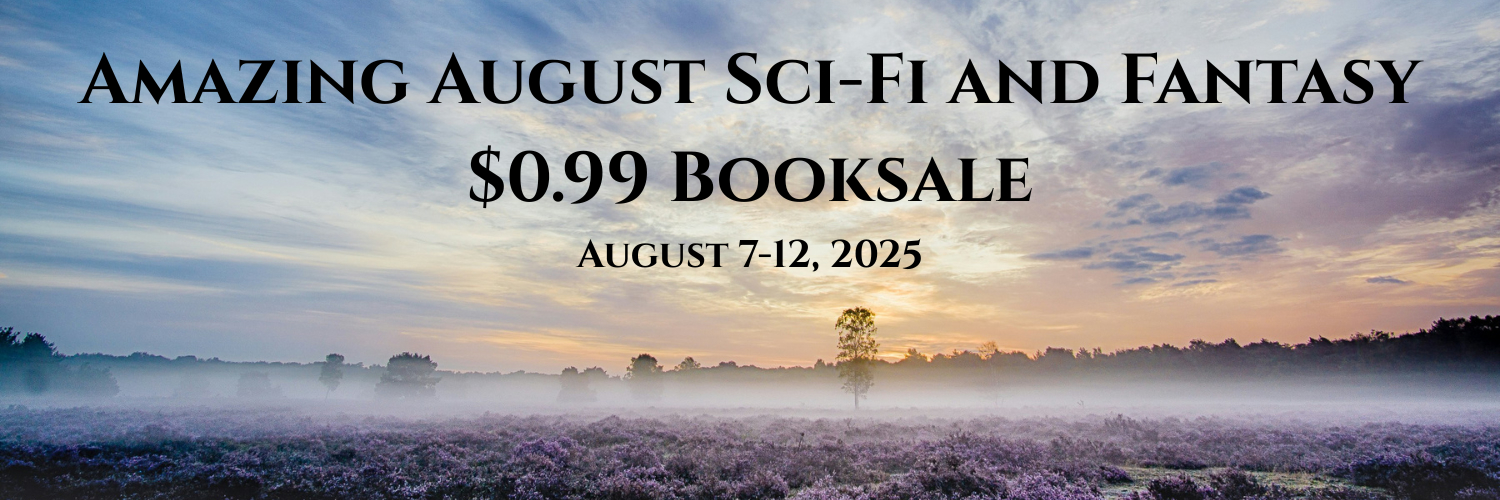
Finally: more DYI attempts within a short timeframe, such as this SF and fantasy book sale happening right now. Full disclosure, shameless self-promotion: I’m in this one! So are a lot of other people, though, so take a look.
The Hugo Awards for 2025 are soon to be announced. Here is the list of finalists for best novel:
The Tainted Cup by Robert Jackson Bennett (Del Rey, Hodderscape UK)
The Ministry of Time by Kaliane Bradley (Avid Reader Press, Sceptre)
A Sorceress Comes to Call by T. Kingfisher (Tor)
Service Model by Adrian Tchaikovsky (Tordotcom)
Alien Clay by Adrian Tchaikovsky (Orbit US, Tor UK)
Someone You Can Build a Nest In by John Wiswell (DAW)
The winner will be announced on August 16, 2025 at Seattle WorldCon. That means you, Reader, have time for some catch-up reading if you haven’t gotten around to all these wonderful novels. I had a fairly easy job of it, since several of the novels on the Hugo list were also short-listed for the Nebula and Arthur C. Clarke awards, and I had already read them before the Hugo finalists were announced.
Disclaimer: I only review the novels. Yet so many wonderful reading experiences await in the other categories! Go to the Hugo Awards web site to find them all.
In the next several posts, I’ll review the short-listed Hugo Awards nominees for best novel.
As always, I need to mention the latest controversy roiling the Hugos. It seems one of these rears its ugly head every year or so. Last year’s controversy was about alleged censorship related to the WorldCon host for the 2024 awards, China. This year’s is about AI. How trendy. Several officials of WorldCon have resigned over the brouhaha. Briefly: In order to cut down on workload BUT ALSO to deal with possible sensitivity issues in the U.S., the WorldCon officials vetted their panel of judges using ChatGPG. Unfortunately, these AI tools are notoriously unreliable, and often seem to reflect possible prejudices. The use of the tool may have helped out with the workload, but how trustworthy was the resulting panel? The decision to use AI for this purpose was also hugely tone deaf, considering the widespread distrust and animus that the SF community feels toward such tools. Find an account of the controversy HERE.
AI in general, and especially for writers, is a magnet for controversy. The Hugos controversy, thankfully, didn’t involve any use of AI by writers, but it does (or did, until WorldCon took corrective action) impugn the integrity of the award, one of the longest-standing, most respected awards for speculative fiction. As a writer myself, I found this blog post–on the Hugo controversy specifically and the use of AI by writers generally–to be especially interesting. How far should the literary world and individual writers go in embracing these tools flooding into the creative process?
For myself, I don’t use it–I say. Then I think again. But I never use grammar checkers, because in my experience they are dead wrong too much of the time and give bad advice even when they are (sort of) right. Good grammar–good. Good grammar used slavishly–wooden writing. (You see those two sentence fragments I just used?) I do use spell checkers, although not all the time. When I do, I use them very judiciously. They too can provide misleading or just wrong advice. I’d rather risk the occasional typo, which comes to us all. And those are very, very basic uses of Al. Generative AI to write a novel? Horrible, horrible idea. Generative AI to plot a novel, organize time, create marketing copy, and so on? Iffy at best.
AND THEN I climb down off my high horse to realize I have sometimes used AI-generated illustrations for this very blog. I am resolving right now not to resort to that in the future. More problematic for me: As a starving artist, I can’t afford to hire a voice actor to narrate my novels. Do I use AI-generated voices, especially considering how many consumers of fiction get their jollies from audiobooks and not the kind you process with your eyeballs? I’m thinking about it. Am I wrong? Am I a hypocrite? The horror! The horror!
NEXT UP: Reviews of short-listed novels by Robert Jackson Bennet and Kalianne Bradley.
The first of three posts: Classic series (today), Some of my Favorites, Problem series
The appeal of a series of novels vs. a standalone
I admit it: while I admire and enjoy short fiction, my true love is the novel. I want to sink into an unknown world and get to know its inhabitants, and I want to stay there a good long while. The unknown world can be practically a clone of my own, and the people who live in it could have stepped right out of my neighborhood. Or the world can be in a galaxy far, far away. Or I could get to it through a magical cupboard. It could be a medieval or ancient world (Europe, Africa, the Americas, Asia–I don’t care), checking every box for historical accuracy. Or worlds that might have been but never were.
What could be better than entering such a world and living in it to the very end of the story as if it were real?
ONE THING: A series of stories set in that world, so I have the illusion, at least, that I’ll never have to leave it.
For me the reader, this accounts for the appeal of a book series. For me the writer, it also accounts for that appeal. For me the writer, I’ll live in my book world a lot longer than any reader, because it will keep populating in my imagination, and I’ll have time to write only some of that down. But I’ll have all of it in my head.
Speculative fiction especially grabs its readers through series. I feel like I should do a lot more reading before I write this post and two more related posts about speculative fiction series. So many books. . .so little time!
SOME OF THE CLASSICS
The Lord of the Rings, J.R.R. Tolkien
Source: the Tolkien Society web site, photographer Pamela Chandler
Tolkien (1892-1973) is the man who wrote the epic fantasy series that started modern-day fantasy. The Lord of the Rings trilogy is totally immersive and hugely influential. The writing is not my favorite, but that hardly matters. Peter Jackson made wonderful movies of the three main volumes (psst, originally written as one mammoth volume, in case you’re wondering why the first and second just stop cold), and Tolkien produced tons of other material that you could think of as series-adjacent. The Tolkien universe is so huge and complex that only its most avid fans know how to thread through it all, from The Hobbit, a beloved children’s book, all the way to a multitude of related books and stories that only the initiate know about. Here’s a helpful web site if you need a guide. Tolkien himself was a fascinating man. He was a celebrated scholar of Anglo-Saxon at Oxford University, the man who brought Beowulf to the attention of the world. He populated his worlds of imagination from his scholarly knowledge and his lifelong fascination with languages, building his fantasy world from the inside out. “Here’s an interesting way language could work, and here’s an interesting potential language that could come out of that. Now, what kind of people would speak such a language, and what kind of world would they live in?” That seemed to have been his thinking. His military service in World War I and his ardent Roman Catholicism also shaped his writing. For a quick read, learn more through the Tolkien Society, and for a deep dive, get Humphrey Carpenter’s 1977 biography. Carpenter also wrote an interesting book about Tolkien and the Inklings, his literary circle: The Inklings: C. S. Lewis, J. R. R. Tolkien, Charles Williams and Their Friends (1979).
The Chronicles of Narnia, C. S. Lewis
The most famous of the Narnia books. Find them all here.
Lewis (1898-1963) was Tolkien’s friend, academic colleague, and fellow Inkling. The Narnia books, like Tolkien’s The Hobbit, are notable classics of children’s literature. The first, The Lion, the Witch, and the Wardrobe, has been a must-read for generations of children, their gateway (wardrobe portal?) into fantasy. With a few exceptions, the other six novels are rather preachy and Christian-apologetic. Lewis was a great scholar of Renaissance English literature, the man who almost single-handedly resurrected literary interest in Edmund Spenser and John Milton (very important to me personally, since that’s my academic field). He also wrote a lot of religious tract-like material beloved of the Religious Right, although he was a faithful Anglican his whole life. Some Religious Right outfit made pretty bad movies from several of the books in the series, but fans can hope Greta Gerwig’s Narnia streaming series gets off the ground. The reading order of the Narnia books isn’t quite as complicated as for Tolkien’s entire body of fantasy work, but it does have its complications. There are two ways to do it: chronologically according to story line, or by publication date. Here is a helpful guide. Unlike Tolkien, and more like most fantasy writers, Lewis wrote from the outside in. He imagined his fantasy world, and then he fleshed it out. The way he was led to do that has roots in his childhood and relationship with his much-loved older brother. Humphrey Carpenter’s book about the Inklings (see above) is a good place to start if you want to do a deep dive, and so is Jack: A Life of C. S. Lewis, by George Sayer. For a quick unbiased overview, see the official C. S. Lewis web site. An evangelical Christian take on Lewis can be found here or here or here. His own book, Surprised by Joy, is a good introduction to both his life and his religious beliefs. The film Shadowlands (1993) explores many of these issues and is really well-done. It was based on a stage play and an earlier BBC televised production which might be even better than the more well-known Anthony Hopkins-Debra Winger film. Mark Saint-Germaine’s 2009 play Freud’s Last Session, imagining a meeting and debate between Sigmund Freud and Lewis, is really great, too, if you ever have a chance to see it. I was lucky enough to attend an off-Broadway production. Lewis wrote prolifically about religious subjects, but he did write other fiction, including an SF series for adults, the Space Trilogy, which is even more indebted to ideas from Spenser and Milton than the Narnia books–not to mention a big academic controversy of the day.
The Time Quintet, Madeleine L’Engle
Image in the public domain, accessed through Wikimedia Commons
A Wrinkle in Time, an SF book for young adults, had a hard road to publication, especially since most SF books of the time did not have female main characters. It went on to win the Newbery Medal among many other awards, and its author, Madeleine L’Engle (1918-2007), wrote four sequels: A Wind in the Door, A Swiftly Tilting Planet, Many Waters, and An Acceptable Time. L’Engle wrote a second, related series and other novels exploring similar ground. Like Lewis, L’Engle was a committed Christian and attended mostly Episcopal churches (The Episcopal Church being the U.S. branch of Anglicanism). She was especially associated with the Episcopal Cathedral of St. John the Divine in Manhattan. Her books explore religious themes congruent with her belief in Christian universalism. I don’t find them as preachy and doctrinaire as the Narnia books, but then my own ideas about religion tilt more in her direction than in his. Some evangelical readers find L’Engle’s books offensive because of her universalism. I think they are great books for young girls to read–an intelligent and spunky young girl is the main character, and L’Engle’s religious ideas are expansive and generous. That’s just me. You, Reader, can make up your own mind. The first of these novels was made into a sadly unsuccessful movie. Learn more about L’Engle by visiting her official web site. Her obituary in the Times of London, accessed through the Wayback machine, is a good way to find out more as well.
TheHainish Cycle, Ursula LeGuin
LeGuin (1929-2018) wrote deeply-involving novels with convincing and fascinating anthropological underpinnings. The daughter of an anthropologist and a writer, she pioneered soft SF, less concerned with hardware and technology, more concerned with imagining different cultures. Her writing is brilliant, lauded by the literary world in general as well as within speculative fiction. The Left Hand of Darkness (1969), one of the Hainish SF novels, won both the Hugo and Nebula Awards in 1970 and is one of the best, most affecting books I have ever read. She wrote many other kinds of books, including the beloved coming-of-age fantasy novel A Wizard of Earthsea (1968), the children’s series Catwings, the brilliant short story “The Ones Who Walk Away from Omelos,” and more. She must hold some kind of record for the number of her major speculative fiction awards–Hugo, Locus, Nebula, others–during a lifetime of influential and highly acclaimed writing. She was heavily influenced by ideas from anthropology and sociology and by Jungian and Taoist thought. She incorporated feminist ideas about gender and sexuality into her writing well before most were very well-informed about such matters, and crusaded for political tolerance and the rights of authors steamrolled by big publishing companies and platforms (See this and this). Learn more through her official web site. The influential literary critic Harold Bloom wrote a detailed critique of her work, which he hugely admired.
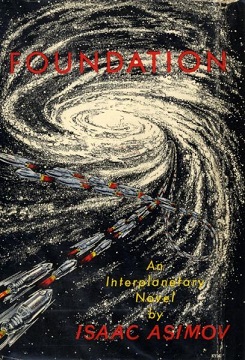
Foundation, Isaac Asimov
Original cover of the first book, 1951
Asimov (1920-1992) was a scientist educated at Columbia University, with a professorship at Boston University, and he poured his knowledge and varied interests into his SF books, some of the best from the Golden Age of SF. The Foundation trilogy won a 1966 Hugo award as best all-time series. Asimov followed the trilogy up with further Foundation novels organized in a number of related series. A streaming series was based on his Foundation world-building. Here’s a terrible confession: I have never been able to get through the Foundation novels. I will say there are standalone Asimov books I’ve loved, especially a deep fondness for Pebble in the Sky (1950) and The Stars, Like Dust (1951)–and I admired but found flawed The Gods Themselves, which won the 1972 Hugo, Nebula, and Locus Awards in a boffo trifecta. Whatever I may think, Asimov’s influence on speculative fiction was and remains immense and his output, prolific. His envisioning of a galaxy-wide empire is the precursor to many another SF book or series of books–and movies and all the rest–world-building that features a galactic empire and its wide-ranging conflicts. Asimov has said he was inspired by Gibbons’s Rise and Fall of the Roman Empire and Thucydides’s history of the Peloponnesian War. Among several other terms he invented, the word “robotics” is probably the most well-known and widely used, and he was a true Renaissance man, writing academic science, popular science, mystery, children’s books, popular history, dirty limericks, and on and on. Hmm, maybe we should conduct a contest to see whether his number of speculative fiction awards beats out Ursula LeGuin’s. He has an impressive list of them. His political views and his behavior frequently roused controversy. To learn more about Asimov, you can’t do better than heading to this web site.
After a career in journalism, the largely self-taught Herbert (1920-1986) began selling stories to SF magazines. With his ground-breaking novel Dune (1965), he achieved fame as one of the New Wave of SF writers. The structure of Dune is innovative–episodes of adventure involving the novel’s main character are interspersed with purported anthropological, historical, and ecological accounts of the culture of his planet, part of a far-flung galactic empire. I found this first book of the series pretty brilliant, with its invented history/anthropology sandwiched between thrilling action sequences. It won the 1965 Nebula award and shared the Hugo in 1966. I could barely get through the next in the series, Dune Messiah, and I didn’t bother reading the other four sequels, the writing was so bad. But many readers love them. You may be among those fans. He died before he could finish the last in the series. Whatever you think about it, the Dune saga is a hugely influential SF series, with innovative world-building and a forward-thinking emphasis on ecology, one of Herbert’s lifelong passions. The Dune universe has tempted several different movie-makers to have a go at it. The latest films, directed by Denis Villeneuve, divided the first book into two parts and have been extremely successful. The second book of the series, Dune Messiah, is in the early stages of production, although it will be the third in the film trilogy. Villeneuve says he won’t go past that book to any later books in the series, which I think is a wise choice. I enjoyed the first of Villeneuve’s films very much, but the second only so-so. (No, really–were you convinced by Timothée Chalamet and Austin Butler going at it as supposedly the best fighters in the universe? Me neither.) But people keep trying to make movies out of this material. Even the crazy 1984 David Lynch version has its rabid fans. Herbert, a complicated man, opposed the Viet Nam War but was a lifelong Republican. Many would call him libertarian. For more about Herbert and the Dune saga, see this web site maintained by his son Brian Herbert and Kevin Anderson. The two have collaborated on fiction that furthers the Dune universe.
COMING UP NEXT: SOME OF MY FAVORITE SPECULATIVE FICTION SERIES



 Fantastes
You must be logged in to post a comment.