2026 Philip K. Dick Award Nominee: SCALES


After a brief hiatus to catch up on reading (fast!) the seven short-listed nominees for the 2026 Philip K. Dick Award, I’m returning to my reviews of each one. See earlier posts in this series for all but the last, coming soon. A reminder–the awards are made by the Philadelphia Science Fiction Society and will be presented at Norwescon‘s annual conference on April 3, 2026.

The Nominees:

Scales by Christopher Hinz (Angry Robot)
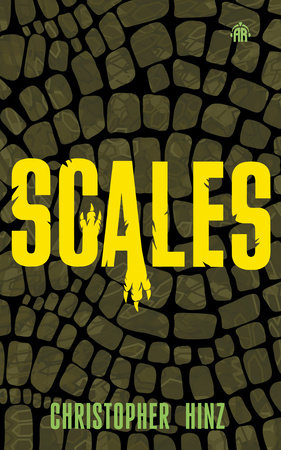
book cover of Scales, by Christopher Hinz
Find out more HERE.

“Perfect for fans of Jurassic Park,” the marketing copy reads. It does not lie. If the Jurassic Park fictoverse farms out spin-off novels to other authors, this is one they’d spin off. HERE is a review that gives the reader some perspective.

In Hinz’s novel, mad scientists and evil military black box operations and lunatic kleptocrats are not cloning dinosaurs from ancient dino DNA. They are cloning dino-MEN. Super-soldiers. One reviewer amusingly dubs the main dino-man “Rambosaurus Rex.” So, as several reviewers have commented, this novel is not just a techno-thriller. It is combination techno thrill-ride and military SF.

As the novel opens (not a spoiler, because we find this out almost immediately), the dino-man project has a problem. After producing four dino-men cloned from four different types of dino DNA, a crazed military/oligarch-funded research institute has chosen Eddie as the one dino-man most likely to succeed as the public face of the project. Embedded in a mission to rescue a kidnapped CEO from terrorists, Eddie has performed admirably. Saved the day, even. As the grateful rescued CEO gushes to Eddie, “Watching you was like watching one of those superhero movies!”

There’s only one problem. When Eddie enters a stressful situation, his carnivorous dino side takes over his human side. “Bad yen,” his psychiatrist back at the institute calls it. And in this most stressful of all situations, Eddie’s bad yen rapidly devolves into outright bloodlust. He chases down one of the terrorists and cannibalizes him.

Very bad for publicity.

Now the institute and the military guys have a decision to make. Abandon their bazillion-dollar investment in Eddie and start over? Or try to train Eddie to control his most ferocious dino impulses.

They go with that one. They call in Dr. Addi LaTour, a kickass and sexy Cajun psychiatrist with unorthodox methods of aversion therapy involving shock collars. The novel works hard to get us to accept that the growing attraction between Addi and Eddie is okay, not creepy. Also, Cajun character. . .cue the swamp scene.

This is an improbable pulp fiction plot for sure. But do we care? Not for nothing, I guess, that the author has also written for DC Comics and Marvel. He paces the novel well, so we are swept from one improbability to the next without thinking about how preposterous it all is. Has that ever stopped the writers of comic books and pulp fiction and superhero movies, though? Has that ever kept their readers/watchers from maximum enjoyment? Are dino-men any more improbable than a guy bitten by a radioactive spider who turns into Spider-Man? Less, probably.

If you love this type of book, I’ll bet you will love this one. The characters are kind of cardboard, the writing is kind of flat, the situations are perfect for adolescent boys–or the adolescent boy in us all. But it’s a lot of fun.

I think it MIGHT have been more fun if it had gone for the broad vibe of Starship Troopers (the movie, I hasten to add, not the fascist Heinlein book). Still–this novel is fun.
NEXT UP: City of All Seasons by Oliver K. Langmead and Aliya Whiteley


2026 Philip K. Dick Award Nominee: CASUAL

The Nominees

Casual by Koji A. Dae (Tenebrous Press)

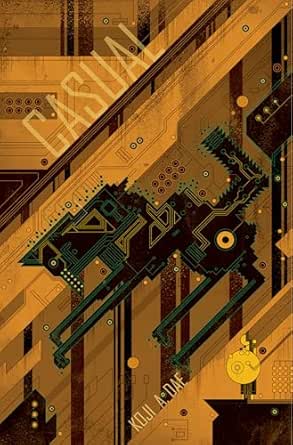
book cover of Casual, by Koji Dai
Find out more HERE.

Casual is a compelling novel about trauma and abuse, set in a future Bulgaria, where the Haves live in the crystal-paved luxurious New Sofia deep underground, while the Have-Nots have to make do with crumbling Old Sofia (a city, I discovered, that has been continuously inhabited for around 7000 years). In the far future of this novel, it is still inhabited, but anyone living there wishes they weren’t. Pollution and disaster have made Old Sofia–and much of the world–almost unlivable.

Into this bleak world, the narrator, Valya, is about to bring a child, a girl. Valya will be a single mother. Just before realizing she was pregnant, she had had a bitter break-up with the father. She hasn’t told him about their child and plans to keep it that way. Yet she desperately needs help and support. She is addicted to a device, Casual, implanted in her brain by her psychiatrist to enable her to cope with her crippling anxiety, but her obstetrician wants her to remove it for the baby’s sake. Valya is torn between concern for her baby’s well-being and concern for her own terrible mental health challenges.

Casual is not a drug but it acts like one. It is an implanted gaming device plunging the user into a virtual-reality landscape tailored to that particular user’s needs. The game has settings sensing how much anxiety the patient is experiencing and automatically adjusts the game experience to soothe the anxiety.

As Valya’s pregnancy progresses, the novel reveals more and more of her backstory, helping us understand the roots of her anxiety and how her ill-chosen relationships, especially with the baby’s father, stem from her deep and troubled history.

If not for the setting and the device of the implanted game, this novel would be one among many about traumatized women and how they cope with trauma and come to understand its sources. The marketing labels the book “horror.” I don’t see that. As I understand it, horror exposes the reader to uncanny and disturbing events and atmosphere, especially those arising from the supernatural. However, in the subgenre of psychological horror, this disturbing atmosphere originates in the inner lives of the characters, so I suppose this novel is that sort. As I think I’ve mentioned, I don’t read much horror, although some fantasy and SF vehicles cross over into horror, and many works of horror have strong elements of fantasy and SF. I’m thinking, for example, of the Ridley Scott film Alien, the Bram Stoker novel Dracula, and many others. As for psychological horror, a classic example might be Charlotte Perkins Gilman’s short story “The Yellow Wallpaper.”

Maybe we shouldn’t quibble over labels here and simply note them as marketing devices. Certainly Valya’s deep-seated trauma and the symptoms arising from it are horrific. The abuse in Margaret Atwood’s The Handmaid’s Tale is horrific, too. I think of Casual as a novel more in that vein than in a book like, say, Christina Henry’s fantasy/horror crossover, Alice.

The picture Casual draws of a woman tormented by abuse is skillful and compelling. I only wish that the author had further developed the many hints of the nature and depth of Valya’s torment. I was left with a lot of questions: The motivations of the baby’s father. The motivations of the medical device company wanting to capitalize on Valya’s vulnerability–and where does it get the clout it has to avoid accountability? and why does it have that clout? The role of Valya’s new friend vs. her old childhood friend. What the reader is supposed to make of the hints that women in New Sofia have trouble conceiving. Exactly why–because I’m not completely sure–Valya acts as she does at the end. Most of all, I’d like to understand more about the nature of Valya’s trauma. By the end of the novel, we readers come to know the facts of it, but I want to know more about the whys–and how deep it goes, how many people were involved in it. I’d also like to know why, in the technical sense, the novel ends the way it does. Are we to expect a sequel? Or are we meant to go on wondering?

In spite of all these questions I’m left with, I did enjoy reading the book and thought it dealt in a sensitive and deft way with some very troubling topics. These are some of the most urgent of our time: power dynamics between men and women, corporate control of a citizenry, our addiction to screens and other technology, the nature of suppressed trauma and the silence surrounding it, the dynamics of abuse, divisive forces creating a population of the pampered rich and the left-behind poor with no middle ground. And also: climate change and its effects, although as a reader I’m not completely sure climate change is the source of the disaster that has befallen the novel’s bleak world.

Up next: The Immeasurable Heaven by Caspar Geon (Solaris)

2026 Philip K. Dick Award Nominee: OUTLAW PLANET

Here’s the second of my posts reviewing the nominees for the 2026 Philip K. Dick Award. A reminder–the awards are made by the Philadelphia Science Fiction Society and will be presented at Norwescon‘s annual conference on April 3, 2026.

The Nominees

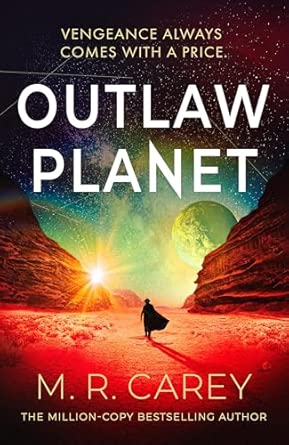
Outlaw Planet by M. R. Carey (Orbit)

Find it HERE.

In this New Weird/Neo-Western, sentient animals (the Wise Peoples) have taken over the world. Other animals (understock) are just. . .animals. Kind of like how Goofy is a talking dog but he, a dog, has a dog, Pluto, who is just a dog. (Wait–I promised I wouldn’t talk about Disney. . .) Humans, known as Pugfaces, are outcasts congregating in clans resembling Native American tribes. But the rest of the characters in this far-future vision of the U.S. are right out of Owen Wister’s The Virginian, crossed with the dark and often gothic humor of the Coen brothers’ 2018 film The Ballad of Buster Scruggs–except they’re animals–with a touch of China Mieville’s The Iron Council thrown in. Thronging the pages are wolves, bears, birds, prairie dogs, you name it. Prim dog schoolmarm Elizabeth from the east heads west by stagecoach and then by katy wagon. (Wagon pulled by a katydid. A large one.) Gets held up by murderous bandit (bear). Ends up in a two-horse (er. . katydid) town at the end of the middle of nowhere. During a plot development that parallels the U.S. Civil War pretty directly (but with animals), prim Elizabeth evolves into Dog-Bitch Bess, the fearsome renegade.

Going against the usual grain of talking animal stories, there is no cutesy stuff in this novel. Nothing twee about this one. It’s not all grim and serious, though. There are jokes. For example, the mayor, a wolf, is described as having a smile “three parts avuncular to two parts blow-your-house down.” Mostly, though, the whole thing is told totally straight-faced.

Okay, I’m lying. That’s just what PART of the book is about. Interwoven with with Bess’s story, a series of field reports from a completely different set of characters inhabiting what seems to be a completely different world starts changing the narrative. It’s pretty jarring. This second narrative takes a completely different tone. The characters are completely different kinds of characters. the whole genre is completely different–hard military SF. The world the author builds is completely different. The contrast with the talking-animals-out-west story is shocking.

Yet as the novel moves forward, the reader begins to realize how ingeniously the author weaves these two disparate story lines together. I doubt many writers could bring something like this off, and Carey does it, brilliantly. I am in awe of his skill. I’m going to have to read other books of his to see if he does anything similar–he is a new author for me. That’s what I love about these lists–a regular reader like me, no particular expertise in the genre, finds many new and delightful books and authors to treasure.

In retrospect, I see clues from the very beginning of the animal narrative that point to the emergence and development of the second story line. Bess’s encounter with one of the Pug-faces at one of the mysterious dream-towers that dot the landscape is one. Another is all the chatter about the Precursors and their prized relics, especially a Precursor weapon that appears early in the book.

This was a fun book to read, and quite thought-provoking. In many ways, it is a cautionary tale. But don’t think Orwell and Animal Farm. This animal book is very different. No THIS ANIMAL = THIS KIND OF HUMAN, or not directly. Actually, I’ve always found Animal Farm kind of ham-handed (bad pun) in its satire. Carey’s novel is much subtler and cuts, in my opinion, much deeper.

NEXT UP: Casual by Koji A. Dae (Tenebrous Press)