Here it is, the day we celebrate what we love–and the end of Fairytale Fantasy Week. This year’s theme: Robin Hood retellings.
This year was especially difficult. When I began, months ago, to search for books to feature in these posts, I had a hard time of it. I read dozens of samples of books that revealed bad writing or inappropriate subject matter. I even read all or parts of whole books leading me to feel, ultimately, I didn’t have much positive to say about them. I don’t like to trash books in this space. I’m a writer, too, and I know how hard it is to conceive of a book, write it, edit it, and then try to get it seen.
I’m not even sure why there aren’t more good Robin Hood books out there. He’s a very popular fellow! As it turns out, there are tons of Robin Hood retellings, but most of them didn’t do that magical thing for me that any novel needs to do for any reader.
At the end of the process, sometimes reading right up to my deadline, I did find some good books. Many of them (most of them?) don’t qualify as fantasy, at least not the kind of fantasy that involves magic and wizards and wands and such. But a fairytale retelling is always, in some ways, fantasy. The characters are not real. They are legend. In the end, many of the best Robin Hood retellings are, I discovered, historical fiction. I suppose people keep wanting to think of Robin as real. They keep saying, “What if he WERE real? What would he be like? What world would he inhabit?”
You may beg to differ. There are several other historical novels in the mix, all of them admirable in many ways. And if you love YA, there are several of those, too. I suppose the novels by Safi and Spooner, listed above, could be considered YA. For me, they are just good novels that I think any reader could enjoy at any age. OR I may have left your favorite Robin Hood retelling off my list entirely. BUT here’s a truth: Every reader is different. Every novel is a different experience for every reader.
DAY FOUR of Fairytale Fantasy Week 2026, and we move to revisionist takes on the Robin Hood legend. This category is a bit unfair, because almost all Robin Hood retellings in the contemporary world are revisionist in one way or another. But some novels set out to turn the Robin Hood legend on its head. Here are a few of the types I’ve seen–and I’m talking about novels and stories here, not Robin Hood tales presented in some other medium:
The many, many books in which Robin is reimagined as a woman.–See the Maid Marion books in this series of posts, where Maid Marion takes on the Robin Hood role. But there are also books where Robin himself turns out to be a woman. The name “Robin,” historically a nickname of “Robert,” has in the past century become a very common name for a woman and less common for a man, so this makes the switcheroo pretty plausible for a lot of readers. A few of these Robin-Hood-As-Woman books seem to be about a daughter or female descendant of Robin Hood instead, a woman who takes on his mission.
Robin set in other historical times and places. Some of these are really interesting. I’ll review two of them in this post.
Robin turned into comedy. I mean, these men are merry, right, but that’s not the main gist of the Robin Hood stories. But it is the main gist of comical Robin Hood tales, most of them children’s books. Now, as for movies. . .! But I will talk about these in my next post.
Robin goes contemporary. I found a few of these. I was actually surprised I didn’t find more. I also read a reviewer who considers Mario Puzo’s The Sicilian a Robin Hood retelling set in more or less contemporary times. I haven’t read that novel, but its promotional materials claim Puzo’s novel is based on a real Sicilian bandit. Maybe he is of that “social bandit” Robin Hood ilk, but I’d suggest he’s his own rogue or bandit and not really indebted to the legend of Robin Hood. I can’t say for certain, though.
The Robin Hood tale in combination with other folk tales/fairytales. I know about a Robin Hood Meets Beauty and the Beast novel, and I believe there are others. I know there are a number of authors who do an amusing mashup of various fairytales in the same story, such as Megan Morrison’s charming middle-grade Tyme novels, but the novels I’m talking about do a kind of folktale ‘ship between Robin Hood and some other tale.
I wish I could have read and reviewed some from each category, but I didn’t have time (and I don’t review books I haven’t read. . .and tried to read carefully). But I’ll mention the variety out there, so if any of them capture your fancy, you can head over to them and read them yourself.
I had definitely planned to read and review at least one of the Robin Hood As Woman books, but in spite of searching through an enormous list of them, reading many sample chapters, etc., I couldn’t find one I felt I could do justice by. With very few exceptions, I don’t want to review a book I have to trash. I ended up reading too many sample chapters that screamed “bad writing” –OR were a bit too YA for me to review very well, even though I have reviewed a few of those–and will in this very post.
I also tried to read one of the books setting the Robin Hood story in contemporary times, but I had to give up on it. It was pretty bad. I will not name it.
Here are two reviews of books I enjoyed very much. Both take the Robin Hood legend out of Sherwood Forest and place it elsewhere. Both make this change in our expectations about the famous outlaw really work.
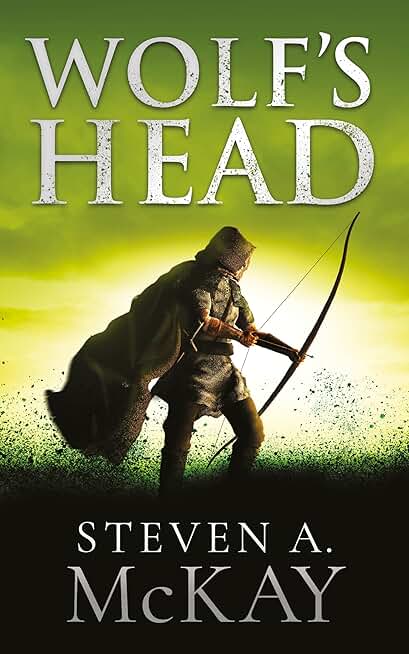
Authors of most Robin Hood retellings follow many of the ballads and much of the lore in placing Robin’s story in Sherwood Forest, in the east Midlands Nottinghamshire, and in the time period of the Third Crusade (1189-1192) and the troubled reign of Richard I. Steven McKay chooses an alternate Robin Hood for his Forest Lord series. McKay doesn’t make this change arbitrarily. There is plenty of historical precedent for his own Robin Hood vision. McKay’s Robin follows a slightly different set of lore placing the famous outlaw in Yorkshire’s Barnsdale Forest, and also in a later historical period, the reign of Edward II around the time of the rebellion of the Marcher lords against the excesses of Edward’s royal favorites, the Despenser family (1321-22). Read McKay’s take on the Robin Hood legend HERE.
I’ve only read Wolf’s Head, the first in the series, but I found it fast-paced and interesting. The writing is workmanlike, nothing fancy, but at least it’s not that flowery drek that some historical novels serve up to readers. I liked the novel for its sense of history. The characters are kind of bland. But all the Merry Men are there, even if Maid Marion is not quite the way she is depicted in the legends. These are the outlaws that the times labeled “wolf’s heads,” perhaps because killing an outlaw, like killing a wolf, wasn’t seen as an act of murder but as a civic service, ridding your community of a danger. The life of a wolf’s head, then, was nothing like romantic ballads about hijinx in the greenwood. This Robin’s life was brutish and full of dangers. McKay’s novel captures the feeling well.
The Sheriff of Nottingham isn’t in the book either, but then, McKay doesn’t set his novel there. There is a dastardly sheriff, though. McKay’s historical note at the end explains who this sheriff was historically and why this was the sheriff he chose for his Robin Hood retelling. In fact, there are a bunch of bad guys in this novel who gave me as much or more of a sense of the problems people faced in the time period than the good guys did. What motivated these baddies? What pressures were they under, and what fueled the worst of their oppressions? This novel answers questions like that–the economic hardships of uncertain climate (leading to poor harvests, leading to starvation), the political chaos during the reign of a corrupt king, the class divisions that allowed some to feel entitled to lord it over others, even to murder or sexually abuse them without facing any kind of consequences. Actually, it seems all too contemporary.
One interesting historical factoid I really liked: all the yeoman characters, because they were required by law to practice archery from the age of seven or eight, had enormously over-developed arms and shoulders–freakishly so, by our standards. I’d heard this before, but I’ve never encountered a Robin Hood character where this bizarre physique is admitted by the author. I suppose people who really, really like bodybuilders might go for such a character, and in the era of the novel’s setting, a physique like that must have seemed normal. It is also very clear that women wouldn’t have been able to compete with these highly trained male archers. Not physically likely, given the nature of women’s lives in the era–so all those Robin-Hood-as-a-woman writers might have to think twice about what their characters actually look like. I’m not saying it’s impossible. A woman given the chance to train like that from a similarly young age would have been able to take on one of the big yew longbows. I’m saying it isn’t very likely. Maybe this is where most Robin Hood retellings really do become fantasy.
McKay’s novel is not fantasy. It’s good solid historical fiction using a legendary character as its centerpiece. If you like Bernard Cornwell’s novels (I personally find the writing style pretty flat), you will probably like this Robin Hood novel.
Will I read the other five books in the series? Two of them were published just this year. I think I probably will. I am fascinated by the time period and this will be an entertaining way to find out more.
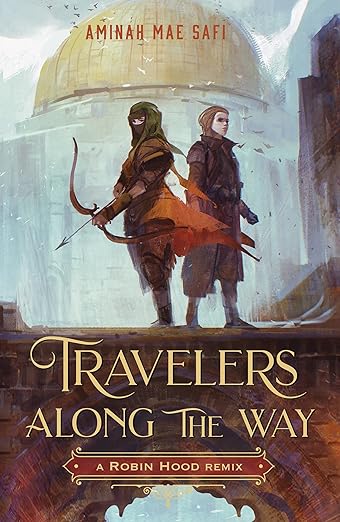
Travelers Along the Way: A Robin Hood Remix, by Aminah Mae Safi (2022)
Part of the Remixed Classics series by various authors, this novel is a delight. I suppose it is YA, but it’s the kind of YA where I, at least, don’t think about that but only how clever and funny the book is–serious, too.
What is at all Robin Hood-like about this book? That was my first question. At first glance–title, cover, the cultural clues it seems to project from the beginning–Safi’s novel seems to have little to do with that most English of legendary figures, Robin Hood.
And yet–lovable rogue? Check. Band of broth. . .er. . .sisters? Check. Set during the Third Crusade? Check. Thrilling escapades, improbable shenanigans, much merriment? Check. Green hood? Check. Robbing from the rich to give to the poor? Check. All the most important features, right there. At the beginning of the novel, the author writes us readers a letter. In it she says, “The following is a story that perhaps we cannot say did happen. We have no proof that such a girl as [the main character, Rahma Al-Hud] ever existed. But neither can we say that the following did not happen.” Safi reminds us that history is a slippery thing, and that true history might exist between and among and around the facts we claim to know and might not really know at all.
This is a novel of the Third Crusade from the other side of the traditional Robin Hood story, the one where Richard the Lion Heart, the bold Crusader king, rides out to do battle with the infidel and recapture the Holy City (leaving his people–Robin, his merry men, all the rest–to suffer in his absence). In Safi’s Robin Hood novel, we see events through the eyes of two sisters, soldiers in the army of the Muslims trying to keep Richard out of that City. The terrible siege of Acre has killed almost everyone inside it, and Richard has committed an act so horrendous we’d quickly label it a war crime today.
All the sisters want to do is creep in disguise across a battle-scarred landscape and get home safely. Circumstances keep thwarting them, and at practically every step they pick up another stray, until they’ve become a merry band of travelers along the way to their destinies. The strays come in all sorts: Christian, Muslim, Jewish, Other. Man, woman. This being YA, there’s some young love in the mix as well, love of all sorts too, but it does not dominate. We come away with a sense of sisterhood and solidarity and camaraderie. If any novel passes the Bechdel Test, this one does. Love, sure. But in many different forms other than romantic–love of country, of honor and courage, of family–biological and found.
And it is so much fun! Here are some chapter titles, to give you a sense of how much: “Oo-de-lolly,” “A Horse With No Name” (the setting here being the desert, you understand), “A Pox on the Phony King of England,” “The Boy With Kaleidoscope Eyes.” What a wonderful book.
You think Robin Hood retellings, you’d be perfectly justified in thinking they’re going to be about Robin Hood, am I right? And they are. They are. But a lot of them don’t feature Robin as the main character in the Sherwood Forest ‘hood. I was amazed at the number of them focusing on someone else, while Robin lurks on the fringes.
As I mentioned in my last post, any good Robin Hood novel or movie needs to have one or more of these iconic Robin Hood sidekick characters, usually part of Robin Hood’s gang, the Merry Men:
Little John, Will Scarlet, Maid Marion (token woman), Much the Miller’s Son, Friar Tuck, and Alan a’Dale. (A Saracen often gets added into the mix in modern retellings. Token POC.)
I have chosen three to review in this post.
First, a look at one of the Maid Marion books.
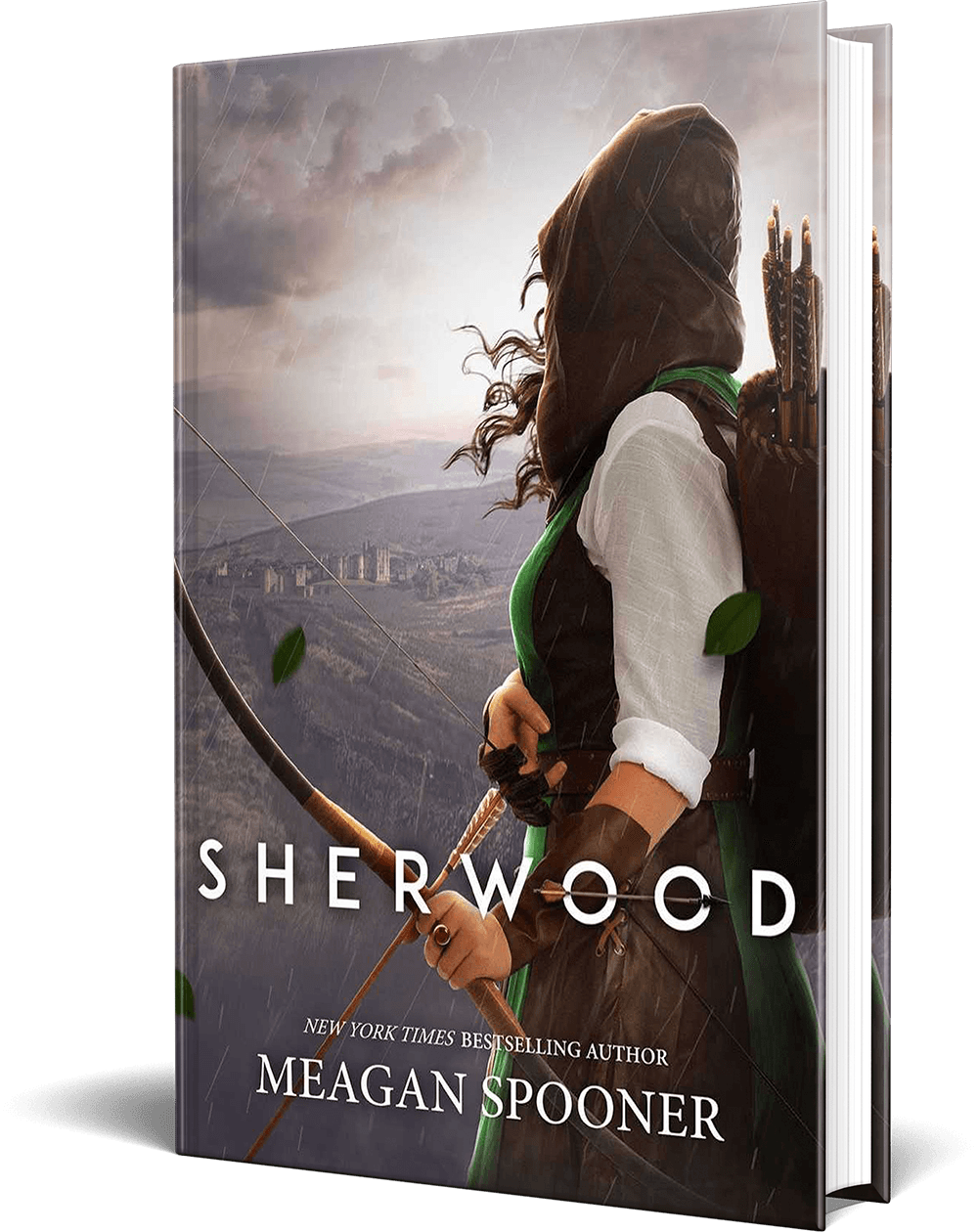
In an era where it has almost become an Olympic sport to reboot a famous piece of literature from the feminist perspective, there are many of these, and a big audience for them, too. (Like, I just saw an absolutely wonderful reboot of Macbeth from a four-woman production/acting/writing team in a south Minneapolis black-box theater a few months ago. I wish you the best, The Macbeths! I wish you the best, Rough Magic Performance Company! You are fabulous!). (And no, south Minneapolis is not a violent place. Or at least it wasn’t before certain people of the thug and goon persuasion came in there and turned it violent.) Wow, two digressions in one part of one post. Must be some kind of record. So, Maid Marion. Tailor-made for this kind of reboot. I should mention that there are also tons of feminist-perspective Robin Hood books in which Robin turns out to be a woman. More about that later. Here’s a Maid Marion novel many readers love. I agree with them!
Lady Marion is in mourning after she learns that her dearest love, Robert of Locksley (nicknamed Robin), has died during the Crusades. But she has to put her grief aside. Will Scarlet, the brother of her maid, is about to be executed. When she disguises herself to help free him, she sets in motion a series of events drawing her ever deeper into the righting of wrongs, the aiding of the innocent and helpless, and eventually, down the slippery slope to rob from the rich to give to the poor. In doing so, she flies in the face of expectations about her social class and her gender.
Spooner’s book is not a historical novel and it is not what I’d call romantasy, either. It seems to be categorized as YA by booksellers and publishers, but I wouldn’t call it YA. This is a fairytale retelling for sure–folk tale, I should say–so while it has no magic in it, it does fit into that retelling category of fantasy. Spooner’s Marion is a courageous and feisty woman who doesn’t wait around to be rescued. She does the rescuing. She’s young, but she is no swooning teen torn between two lovers. (not exactly.) She’s a woman with a lot of what’s called agency in a time when women were rarely allowed any.
The writing is good. It doesn’t distract from its setting around the time of the Crusades, but it doesn’t try to mimic that language, either. As the author says in an afterword, the tale of Robin Hood is patched together from many places and time periods, and her book follows the lead of her original, not worrying too much about any anachronisms or being faithful to any set of historical facts. Was Robin Hood really a nobleman named Robert of Locksley? Or was he somebody else entirely? Or was the name “Robin Hood”–as Spooner suggests in one part of her book, simply the common epithet given to a bandit in late medieval England? I admired Spooner’s ability to build a convincing and compelling novel from the materials of period atmosphere, historical fact, beloved legend, and exciting contemporary character and plot.
This is a book that is fun to read but has serious underpinnings. It’s a book about disguise. A character disguised as someone else, fooling everyone around her, even people who know her well, is a hard fictional tactic to pull off. It’s also one of the hoariest. Remember the scene in Jane Eyre, when Mr. Rochester disguises himself? (Jane wasn’t fooled, but then, very little got past Jane.) Remember The Scarlet Pimpernel? (You don’t? Not many people read that novel any more, but they should. It is tons of fun.) Remember The Prisoner of Zenda? (likewise. . .) Okay, you do remember Tale of Two Cities, right? Hasn’t this disguise business run its course? But every now and then, an author pulls the disguise trope off. Shakespeare did it, and in multiple plays that keep charming and thrilling audiences even now. One of Tana French’s most amazing novels, The Likeness, does. And Spooner’s novel does it, too. Very, very skillfully.
It’s not that a reader won’t say, oh, come on. . .that’s not realistic! A reader will say that. But a writer skilled in the use of this tactic keeps the pace and the excitement so compelling that we don’t stop to ask that question, and even when and if we do, the story just grabs us again and hurries us along. In fact, Spooner’s use of this well-worn trope goes beyond the skillful, because she uses it to raise some very interesting questions about the masks we all wear, masks that society compels us to wear. Marion is not the only character in the novel who puts on a false face.
As for the plausibility of disguise, Spooner asks the question, Don’t we see what we expect to see? In a trivial but very telling incident, a shyster at the fair nails this timeless piece of wisdom down for Marion and her father late in the novel, followed immediately afterward by an important episode that does the same. And Spooner accomplishes this feat without losing the fun and the pace of her novel.
She also raises some important questions about the difference between legality and justice. I think that’s a necessary thing to do in these times. She’s not starry-eyed about the outcome, either.
Then there’s the aspect of the book I maybe appreciated more than any other, the element of surprise. I’ve read too many novels that try to surprise the reader through manipulation, including the abhorrent “O. Henry ending.” I hate them. Hate ’em all! They assume the reader is stupid. By contrast, Sherwood had the ability to surprise me without any of the cheap tricks that turn me off as a reader in too many other books with “twisty” plots. Sherwood earns its surprises. Marion the character earns hers. They are a delight.
Next, there are Alan a’Dale books.
He’s the Robin Hood minstrel we all love. Actually, whenever I think of him, I can’t help thinking of the “Brave Sir Robin” episode in Monty Python and the Holy Grail. This Sir Robin is one of Arthur’s knights, not a minion of Robin Hood, but I can’t help myself. . .
I admit it, I am too easily distracted by anything Monty Python. Back to the point– One of the best books I’ve read for this series of posts is an Alan a’Dale book, Angus Donald’s Outlaw, Book I of his Robin Hood series.
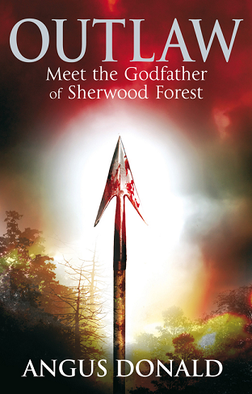
Outlaw, by Angus Donald (2009)
Find out more about this novel and the others in the series HERE.
The main character, at least in Book I, is Alan Dale, Donald’s version of a Robin Hood side character, the minstrel Alan a’Dale. This novel, as is the case with others in my series of posts this year, is historical fiction. There are no fantasy elements (well. . .a few, sort of). But it’s a rousing adventure story that changes the thigh-slapping Merry Men into disciplined foot soldiers of Robin the Mafia boss of the Middle Ages.
Actually, that click-bait-ish subtitle (“Meet the Godfather of Sherwood Forest”) does the novel a disservice. Robin is an important figure in the novel, and I found it compelling to think that an outlaw in this historical period would actually be a pretty morally gray character. But Alan’s is the voice we hear. And because Donald has done his research, I could believe it, too. Many versions of the Robin Hood legend are set in the late 12th century, the time of the Third Crusade, and Donald has thoroughly integrated this historical era into Outlaw and all the other novels in his Outlaw Chronicles series. Outlaw is the first novel that Donald published in the series, but the first book chronologically is a prequel novel. There are twelve novels in the series overall, three of them more accurately described as novellas.
I can’t speak for the others in the series. I haven’t read them yet. (I plan to!) I can tell you, though, that Outlaw is very well written and fast-paced, with none of the faux-archaic language that spoils too many novels set in the time period. The characters, especially young Alan and Robin himself, are nuanced and well-developed. Plus, scenes of torture to rival Robin Hobbes. So it’s a dark read. Beware, if you don’t like those.
Last, this post will take a look at one of the Will Scarlet books.
Will is another of Robin Hood’s Merry Men. Actually, his name in some of the old ballads is Scarlock or Scathelock or other similar names, probably because these tales were communicated orally before being written down. Also, orthography–spelling–took a long time to standardize after printing was introduced in the 15th century. The surname “Scarlet” might refer to scarlet stockings that Will wears in some of the legends (or this might be a way of justifying his surname). Conversely, the variants on “Scathelock” may refer to lock-picking or lock-smashing, a handy skill for a bandit to possess. Then again, some legends suggest that Will Scarlet and Will Scarlock are two different characters entirely, not to mention yet another Will with a surname beginning with the letter S, Will Stutely. All this confusion is actually pretty characteristic of the ballad tradition.
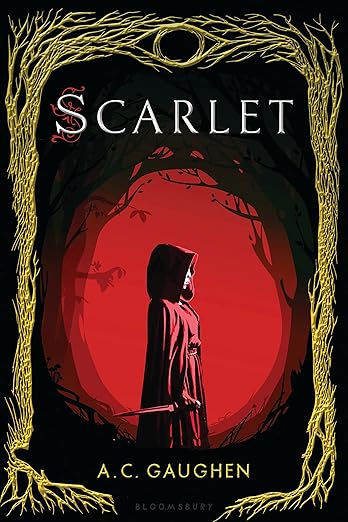
Here is a Will Scarlet book I found pretty entertaining:
I suppose it’s no spoiler to reveal that Scarlet, by A. C. Gaughen, is another one of those books that re-imagines a traditional or well-known male character as female. The book cover gives it away–and also the book’s promotional material–even though the reader doesn’t find out about this most interesting aspect of the novel’s main character until a good way into the story. In Gaughen’s reimagining of the Robin Hood legend, “Will Scarlet” is the name assumed by a young girl on the run. She disguises herself as a boy and ends up in Sherwood Forest as one of Robin Hood’s Merry Men. The main character’s story and the motives for her disguise are gradually revealed as the novel progresses.
It’s an interesting tale, handled well, but I had a little trouble as a reader. This Y.A. novel uses the typical Y.A. tactic of a first-person narration. We see the events directly through the main character’s eyes and hear her voice. Such a choice by an author allows the reader to identify more fully with the main character. It also comes with its own set of problems. For example, we readers can only know what the character knows. That makes it difficult, for example, to bring off a convincing plot surprise that the main character knows about or should know about before we readers do. This book falls into that trap.
The other problem is the language. The voice of the main character is presented to us as a certain type of dialect which sometimes leads a reader to have a hard time plowing through the book’s prose, but which also (trying hard to avoid spoilers here) leads the reader to certain conclusions, with an unconvincing rationale revealed for them, and in retrospect, an unconvincing voice overall. The author’s choices here are tricky to pull off, and for me, at least, they don’t quite work. I did find the book entertaining. It is part of a three-book series, so if you are charmed by the main character–and she is pretty charming!–you might want to read on.
Other characters have their own Robin Hood books!
I can’t possibly list all of them, but just about every Merry Man has a book of his (often her!) own–and so do some other Robin Hood mainstay characters who are not even Merry Men.
There are two or three Friar Tuck novels. Much the Miller’s Son is a minor Merry Man if there ever was one, but he has a few books too–and a webcomic!
There is even, believe it or not, at least one book from the perspective of the dastardly Sheriff of Nottingham: The Sheriff of Nottingham (1993), one of the few novels by the celebrated journalist and social commentator Richard Kluger. Writing a book from the perspective of a fictional bad guy is a trendy thing to do to a fairy tale. Gregory Maguire’s fantasy novel Confessions of an Ugly Stepsister, for example, gives the reader a lot of sympathy for one of the Cinderella fairytale’s baddies. His even more popular Wicked does the same for the Wizard of Oz baddie the Wicked Witch of the West. Reading reviews of Kluger’s novel leads me to believe, though, that he is making a serious fictional exploration of legal issues in the sheriff’s era–so this book was probably not written to fit the trend. I love historical novels that really delve into obscure historical issues and subcultures. This novel might have to go on my TBR pile.
There is even a Prince John book, The Wicked Prince: A Robin Hood Retelling, by Celeste Baxendell (2023), with alternating chapters from the prince’s point of view and Robin’s (she is a woman in this version of the story). This is part of a “clean” multiauthor fairytale retellings series with a swoony prince in every volume. The idea of Prince John, that pusillanimous villain, as a swoony prince is pretty intriguing. I doubt I’ll read this one, though, because it really does seem to be written for teens.
 Fantastes
You must be logged in to post a comment.