THE END of Valentine Week 2025: Fairytale Fantasy, Day SEVEN

This year’s theme: RED RIDING HOOD

Here we are, at the end of Valentine Week 2025.

The novels I have featured this year:

Red Rider, by Kate Avery Ellison (2019, indie-published)—reviewed HERE

Wolves and Daggers: A Red Riding Hood Retelling, by Melanie Karsak (2018, indie published–Clockpunk Press, which seems to be owned by the author)–reviewed HERE

Beauty and the Werewolf, by Mercedes Lackey (2011, Harlequin Nocturne)–reviewed HERE

Crimson Bound, by Rosamund Hodge (2015, HarperCollins)–reviewed HERE

Scarlet, by Marissa Meyer (2013, Macmillan)reviewed HERE

TODAY:

For the Wolf, by Hannah Whitten (2021, Orbit)–quick capsule review

AND

Other interesting fictions based on Little Red

First, a capsule review:

For the Wolf, by Hannah Whitten (2021, Orbit)

I reviewed this novel for my first series of Valentine Week posts, in 2022. Find my review HERE.

A quick recap and a few thoughts: The really nice cover art screams Little Red, and a few of the superficial details do, too. But for the most part, this novel is Beauty and the Beast all the way. As we’ve seen this week, Beauty and the Beast makes a natural pairing with Red Riding Hood, and elements of both fairy tales are often seen in retellings of Red Riding Hood. I think it’s interesting that in these novels–and especially in Whitten’s–the marketing all points toward Red Riding Hood. Why not Beauty and the Beast? That’s especially true of Whitten’s novel. Would a content analysis of fairytale retellings published in 2020 and 2021 reveal a surplus of Beauty and the Beast? It’s a mystery to me why marketing departments sell readers via Little Red but the story itself goes all Beauty and the Beast on us. Could the popular culture appeal of the Disney Beauty and the Beast (which I actually really like, by the way) be so overwhelming that books and their covers need to veer away?

Whitten’s YA novel, which features many of the usual YA tropes, is about two sisters, one of whom has to be given to the wolf–some mysterious creature in the woods–in a murkily-explained ritual sacrifice. The main character gets shipped off to the wolf’s castle, where she finds a tormented beast laboring under a curse. The most interesting part of this novel, in my opinion, is the sentient forest. But see my post of 2022 for a full review.

OTHER RED RIDING HOOD FICTIONS:

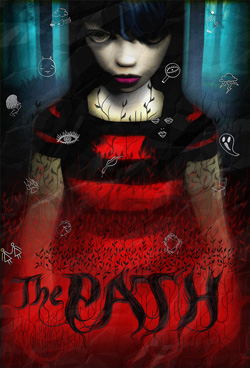
The Path, a single-player indie video game that re-invents Red Riding Hood as a parable of emerging womanhood. It is stunning, an art object all its own and a really creepy horror-themed, Freudian-infused journey. There’s only one rule to the game: “Stay on the path.” BUT in order to win the game you must: (SPOILER ALERT!) go off the path! You can get it on Steam for PC.
Into the Woods. Red Riding Hood is one of the major story lines in the wildly popular Steven Sondheim 1986 musical, and Little Red herself is one of the major characters. In 2014, Disney (did I say I wouldn’t talk about Disney in this series? I lied.) made a movie based on the musical.

Angela Carter’s amazing Red Riding Hood short stories, in her collection titled The Bloody Chamber and Other Stories (Harper & Row, 1979). There are Bluebeard retellings, Beauty and the Beast retellings, and many more, all beautiful, all strange, all completely wonderful. The main Red Riding Hood retelling is “The Company of Wolves.” It was the basis for a film directed by Neil Jordan in 1984. Two other tales in Carter’s collection are based on some version of the Red Riding Hood folktale: “The Werewolf” and “Wolf-Alice.” But “The Company of Wolves is especially superb. “See!” it ends. “sweet and sound she sleeps in granny’s bed, between the paws of the tender wolf.” Wow, what a story.

You can get this collection at Amazon in hard cover, paperback, and audiobook; in paperback at Barnes & Noble; and in ebook and audiobook formats on Apple.

HERE’S WHERE I ANNOUNCE MY FAVORITES

If we are speaking of the novels I’ve reviewed, that’s a hard one. I liked two of them–Meyer’s Scarlet and Lackey’s Beauty and the Werewolf–but I didn’t just adore any of them.

BUT I do adore that Angela Carter short story, “The Company of Wolves.” And I love the indie game The Path. If I were more of a musical comedy fan, I’d probably mention Into the Woods as well.
Valentine Week 2025: Fairytale Fantasy, Day SIX

This year’s theme: RED RIDING HOOD

A reminder–The novels I’ll review during this year’s Fairytale Fantasy series:

Red Rider, by Kate Avery Ellison (2019, indie-published)—reviewed HERE

Wolves and Daggers: A Red Riding Hood Retelling, by Melanie Karsak (2018, indie published–Clockpunk Press, which seems to be owned by the author)–reviewed HERE

Beauty and the Werewolf, by Mercedes Lackey (2011, Harlequin Nocturne)–reviewed HERE

Crimson Bound, by Rosamund Hodge (2015, HarperCollins)–reviewed HERE

Scarlet, by Marissa Meyer (2013, Macmillan)–TODAY’S REVIEWED NOVEL

For the Wolf, by Hannah Whitten (2021, Orbit)

And finally: a medley of interesting outlier pieces, all based on Little Red

TODAY’S REVIEWED NOVEL:

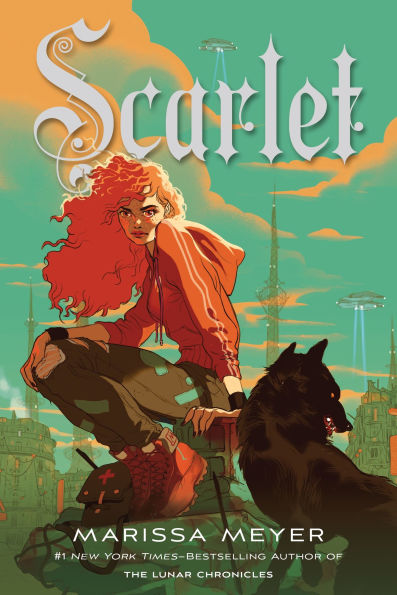
Scarlet, by Marissa Meyer (2013, Macmillan)

Buy this novel–and all the books in its series, The Lunar Chronicles–on Amazon in hard cover, paperback, ebook, and audiobook formats. If you’re a member of Kindle Unlimited, you can read it there free. At Barnes & Noble, Scarlet is available in hard cover, paperback, ebook, and audio formats, and the other books in the Lunar Chronicles as well. In addition, several of the series books (not Scarlet, though) are available in large print editions, and you can listen to the audiobook versions of several of the series books with a Barnes & Noble audiobooks subscription free–again, though, not Scarlet. Apple offers Scarlet and all the other books in the series in ebook and audio formats, and so does Kobo. For more about all these books, visit the author’s web site.

How about that, a sci-fi Red Riding Hood! This novel is set in a dystopian future where humans have settled the moon and then mutated. The moon people, led by their evil queen, want to become humanity’s new overlords. Against this setting, we have a girl with flaming red hair and a temper to match. We have a grandmother. And we have a lot of werewolf-type large buff guys. As with most of the books I’ve reviewed this week, the story may have been inspired by the Red Riding Hood folk tale, but there the resemblance ends. I keep being astonished, though, at how many of these Riding Hood retellings feature werewolves–and astonished, as I’ve said, to learn that werewolves really are part of the deep folkloric background of the tale.

Like Red Rider, the Ellison novel I reviewed on day one of Valentine Week, Meyer’s novel is set in the future, a dystopian future where werewolves play an evil role in turning the earth into a hellhole. Unlike Ellison’s novel, where the vibe is pretty much fantasy, the vibe in Meyer’s book is unmistakably SF, including all manner of SF gadgetry, including futuristic air cars and futuristic maglev trains. Scarlet is a girl who has had to learn to be tough, because she leads a tough life. When she meets a mysterious man (yep, he’s a prizefighter. . .werewolves and prizefighters. . .this must be a thing), she is drawn to him but also repelled by his strangeness. Her grandmother has been kidnapped, though, and the police are no help, so Scarlet takes help where she can find it–the help of the man named Wolf. Violence and peril ensue.

Here’s what happened when I started reading this novel. It is Book 2 of a series, and I had hoped this book, like other mid-series books, would catch me up about the doings of Book 1 in some handy little paragraph early on. Unlike the Lackey novel I reviewed a few days ago, the individual books of The Lunar Chronicles are not stand-alone novels within a larger framework, but true sequels. I soon discovered that without reading Book 1, Cinder (yep, based on Cinderella), I was at sea. Cinder, the title character of Book 1, plays a major role in this second book, too. After a lot of grumbling, I got Cinder and started all over from the beginning, Book 1, chapter 1, page 1.

I’m glad I did. The story arc of the series unfolds as a nice whole, even though Cinder’s and Scarlet’s stories, based on different fairytale tropes, have some differences. And best of all, there’s no hard cliffhanger ending at the end of Cinder. If you’ve followed this blog, you know how much I hate those. As a result, I had two great reading experiences. If I never continue to Book 3, I’ll still feel very fond of the two books I did read. And I really might continue, because the writing is good, the plot zips along, and the characters are fun. I really like Cinder and Scarlet. They are kind of anti-Disney anti-princesses. (That’s a GOOD thing.) Enjoy these books! If you do read Scarlet, though, I recommend you read Cinder first.

NEXT UP: As Valentine Week ends, I’ll do a quick mini-review of For the Wolf, by Hannah Whitten, and give you a link to my full review of a few year’s ago. I’ll also mention a whole treasure-chest of other Red Riding Hood experiences, some in book form, some not.

Valentine Week 2025: Fairytale Fantasy, Day Two

This year’s theme: RED RIDING HOOD

A reminder: The novels I’ll review during this year’s Fairytale Fantasy series

Red Rider, by Kate Avery Ellison (2019, indie-published)—TODAY’S REVIEWED NOVEL

Wolves and Daggers: A Red Riding Hood Retelling, by Melanie Karsak (2018, indie published–Clockpunk Press, which seems to be owned by the author)

Beauty and the Werewolf, by Mercedes Lackey (2011, Harlequin Nocturne)

Crimson Bound, by Rosamund Hodge (2015, HarperCollins)

Scarlet, by Marissa Meyer (2013, Macmillan)

For the Wolf, by Hannah Whitten (2021, Orbit)

And finally: a medley of interesting outlier pieces, all based on Little Red

TODAY’S REVIEWED NOVEL

Red Rider, by Kate Avery Ellison (2019, indie-published)

Find it HERE.

This Red Riding Hood-themed novel, classified as YA, is the first book of a series, The Sworn Saga. You can get it through Kindle Unlimited, if you subscribe, and in regular ebook, paperback, and audiobook formats. As far as I know, the book is available to readers ONLY on the Amazon platform, although if you get your fiction through listening, the audiobook is also available through Apple.

This novel’s marketing message claims the book is “a post-apocalyptic werewolf retelling of Red Riding Hood” and “Red Riding Hood meets the Handmaid’s Tale.” The first part of that message is at least superficially accurate. I think the second part is accurate, too, but only if you go on with the series. Since I have not, I can’t swear to that, but the novel makes it pretty clear that the story’s sequels are headed into Handmaid’s Tale territory–even though saying so is kind of like comparing My Golden Book of the Napoleonic Wars with War and Peace.

The world of this novel is set in a future where ordinary citizens have been subjugated to mutated werewolf humanoids. The werewolf females are barren, however, so the werewolf overlords mark certain human girls as mates. When the girls reach puberty, the werewolves take them for breeding stock. (Here’s where the Handmaid’s Tale comparison comes into play.) Meredith Rider is one of the unlucky girls (one of “the Sworn”) marked to be given to a werewolf mate. Werewolves kill her whole family and haul her off to fulfill her destiny. But Meredith, called Red for her red hair and the red, protective cloak her father has given her, is also plucky and resourceful, like all YA heroines. The plot proceeds from there.

The novel has other YA traits and tropes. It is written in the first person, presumably so young female readers can more readily identify with the main character. (Not judging–I’ve done it, too.) It establishes a tricky and interesting relationship situation thing between the main character and her male best friend, on the one hand, and the dominating werewolf known as the Silver Wolf, on the other. The way the author handles it becomes a fresh take on the good boy–dangerous but sexy bad boy trope common to YA novels.

The connection to the Red Riding Hood story only works at the very surface level. I thought at first the werewolf part was because werewolves have become so very popular in recent fantasy fiction, especially that subgenre called paranormal fantasy, but as I mentioned in my last post–while the paranormal fantasy angle may be very convenient marketing, it is also an undeniable and age-old aspect of the Red Riding Hood tale. A child’s casual acquaintance with the story rarely touches on this, but the folklore connection of Little Red with werewolves is sound. As for the rest: the name of the heroine, the grandmother, the red hood, the wolves–all part of the Red Riding Hood story, sure. If you read this novel, though, think about it–except for the werewolves, wouldn’t the story have worked just as well without the other Red Riding Hood trappings? I think it could have been a nice paranormal fantasy series with werewolves. So is the Red Riding Hood connection a marketing gimmick? I’m not sure. But I want to know, and not just because I’m some snarky reviewer! I am in the middle of writing a folklore-themed fantasy novel myself, so I am actually interested in the answer.

I thought the book was pretty well-written. I’m imagining a lot of YA readers will enjoy it. Unfortunately, it also has a hard cliffhanger ending to entice the reader to continue to the next book in the series, and I find that personally distasteful, a real bait-and-switch tactic. But plenty of readers must love this hook into the next volume of the series, so if you are one of them, you can ignore my prejudice here. At any rate, I won’t go on with the series. I feel cheated. I thought I was buying a novel only to discover I have bought a sixth of a novel. But if you love this kind of series, and you accept you are only reading the first installment of a super-novel, there are six installments to love, so go for it. I’m perfectly willing to accept that a long-form Netflix series will come out in seasons with cliffhangers at the end. Why can’t I accept it in books?

I’m very interested in this problem, though–not just as a reader but as a writer of fantasy series novels myself. I always try to wrap each novel up with a satisfying ending, even while suggesting there is more story to come. Am I successful? I hope so. But just stopping–as a reader, I hate that. I have been re-reading Patrick Rothfuss’s The Name of the Wind (because I’m always intrigued at how that novel works–I don’t think it really ought to, but it really, really does). Now there is a story that stops in the middle, right? Presumably, the book is a three-day marathon in which the main character, Kvothe, recounts his adventures to a scribe. Book One, The Name of the Wind, is Day One. Book Two, The Wise Man’s Fear, is Day Two. And Book Three. . . has never been published (written?), one of the big bad scandals of fantasy publishing, alongside other authors who have never finished their series, such as Scott Lynch with his unfinished Gentleman Bastards series and George R. R. Martin’s A Song of Ice and Fire. In spite of the huge compulsion of the reader to go on breathlessly to Rothfuss’s sequel (and maybe–as many fans did–scream in protest when the third book was not forthcoming), I found The Name of the Wind–and its sequel as well– to be satisfying, complete novels. I didn’t feel cheated at the end of either one, and I don’t feel cheated not to have Book Three. Sad, though. Really, really sad!

NEXT UP, TOMORROW, as Fairytale Fantasy Week continues: Wolves and Daggers: A Red Riding Hood Retelling, by Melanie Karsak