
This year’s theme: RED RIDING HOOD
A reminder–The novels I’ll review during this year’s Fairytale Fantasy series:
Red Rider, by Kate Avery Ellison (2019, indie-published)—reviewed HERE
Wolves and Daggers: A Red Riding Hood Retelling, by Melanie Karsak (2018, indie published–Clockpunk Press, which seems to be owned by the author)–TODAY’S REVIEWED NOVEL
Beauty and the Werewolf, by Mercedes Lackey (2011, Harlequin Nocturne)
Crimson Bound, by Rosamund Hodge (2015, HarperCollins)
Scarlet, by Marissa Meyer (2013, Macmillan)
For the Wolf, by Hannah Whitten (2021, Orbit)
And finally: a medley of interesting outlier pieces, all based on Little Red
TODAY’S REVIEWED NOVEL
Wolves and Daggers: A Red Riding Hood Retelling, by Melanie Karsak (2018, indie-published)
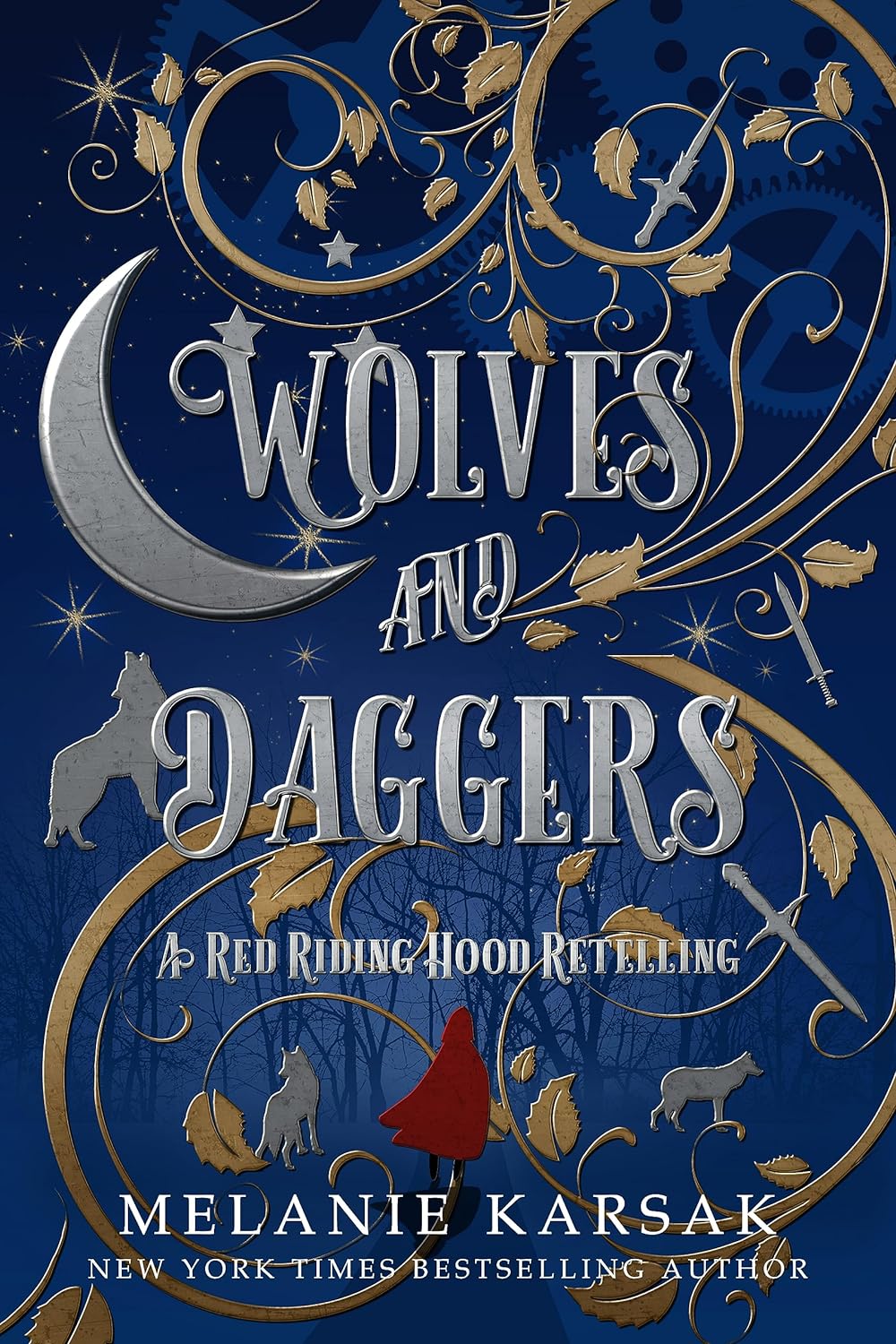
Karsak’s novel, the second Red Riding Hood-themed novel I’m reviewing during Valentine’s Week 2025, is the first in a five-book series, The Red Cape Society. From Amazon, you can buy Wolves and Daggers (book 1) in paperback and in e-book format through the Kindle app and devices, and you can also buy the whole series either volume by volume or as a box set in either format. Apple Books and Barnes & Noble sell Wolves and Daggers in ebook format. Apple sells only book 1 of the series, but Barnes & Noble will also sell you a box set–only of books 1-3, though. Barnes & Noble will sell you an audiobook version, but only Book 1. If you like to consume your fantasy via audiobook, you are out of luck if you want the whole series as far as I know. This may change, or I may have missed a source, so check for yourself.
Karsak’s novel is a very clever gaslamp retelling of Little Red Riding Hood in the form of a detective story. Little Red herself is part of a Victorian detective agency charged with reining in criminal bands of werewolves. There are also good, helpful werewolves. Of course there is a grandmother, and of course there is a red cape (“The Red Cape Society” is the name of the detective agency, as well as the title of Karsak’s series).
You may have a question, if you’ve never read one of these: What is gaslamp fiction?
This is a subgenre of speculative fiction set in a fantasy-Victorian or adjacent parallel time, with gloomy noirish settings, the iconic gaslamps, crazy mechanical contraptions (airships!), and guns typical of the era–very similar to steampunk SF. Read THIS ARTICLE for an illuminating explanation. Three great examples of the gaslamp/steampunk subgenres: Susanna Clarke’s Jonathan Strange & Mr. Norrell, Phillip Pullman’s His Dark Materials books, and China Miéville’s Perdido Street Station and the other two novels in his Bas-Lag trilogy. Karsak’s novel is very much lighter than those giants of speculative fiction (of any fiction, any time–my opinion), but her book is very short, almost novella-length, and it is a lot of fun.
As Agent Clemeny Louvel, aka Little Red, chases down the evil werewolves with the help of her detective partner and the good Knights Templar werewolf Sir Richard Lionheart, expect all sorts of in-jokes like the jokey chapter titles, an appearance by Queen Victoria herself, a continuing riff on the “oranges and lemons say the bells of St. Clements” rhyme, old-timey motorcars, jokes along the lines of “what big eyes you have” and “straying from the path.” Most fun of all, the name of the queen’s secret investigative service, The Rude Mechanicals.
Readers can also expect the usual werewolf lore involving a pack structure of Alpha and Beta wolves, silver as a surefire werewolf killer, and the like. I don’t know if the other books in the series go on to feature other members of “the unhuman,” but this first novel mentions a number of them, including goblins, vampires, and more. But what is it with werewolves and prizefighting? Is that a part of the lore I just don’t know about, or is it a coincidence that more than one of the books I’ve chosen this week uses prizefighting to underscore the feral power of werewolves? I may be too much of a werewolf novice to know.
The Red Riding Hood connection in this novel is more of a running joke than a true retelling, but it is very charming. The book is well-written but–well, I called it “light” but maybe “slight” is a better term for what I experienced. The characters aren’t terribly well-developed, and the plot is over in a flash (literally). I’m thinking the whole series develops these matters more thoroughly, though. I doubt I’ll read on–although I might, if only to see what the author does with the Rude Mechanicals, but I did enjoy this first volume, and I was very appreciative that the novel doesn’t simply stop. It forges a nice connection to the next in the series without hurling me headfirst off that annoying cliff. I’m figuring that in part this is because the series is not one huge extended uber-novel but a series of episodes nested in the overall Little Red concept.
On a personal note, I like how these first two novels I’ve reviewed are indie-published. If you don’t know a lot about the publishing industry, you may not know what that means. In the past, a writer would be published by one of the traditional publishing houses or not at all–self-publishing usually meant publication by one of the “vanity presses” that preys on clueless or disconsolate unpublished writers–still does, but back then, with even more success parting a would-be writer from her money with little or nothing to show for it. Today, four things have happened: through technology such as word processing, self-publishing has become a viable DIY way to produce a book; ebooks have become a big part of readers’ personal libraries and preferred ways of reading; emerging publishing platforms–Amazon’s Kindle and publishing-on-demand, Barnes & Noble’s Nook, Apple’s I-books, Kobo’s ebooks–accept indie-published books and present them alongside trad-published books to potential readers; and traditional publishers have undergone drastic consolidation and acquisition by conglomerates that don’t necessarily care about books. In the process, traditional publishers’ marketing and nurturing of all but their most celebrated authors have dwindled. You can read about it in this really informative blog post. A similar situation has happened in the recording industry. The problem with being indie-published (I am, so I know) is that an author doing this needs to be as good a marketer as she is a writer. There’s overlap between good writing and good marketing, but any individual author might not be equally good at both. Ask me how I know THAT!
I’m very pleased that two of the books featured in my blog this week come from indie authors. The featured writer for today, Melanie Karsak, also employs what is known as an “imprint”–a business name for her book publishing endeavor. For example, mine is Shrike Publications. But in Karsak’s case, she really does seem to have incorporated her imprint into a small business–a “boutique publishing company,” the web site calls it–Clockpunk Press. I should investigate to see if that’s how she has published all her books. There are many, and the ratings on Amazon for this first Red Riding Hood book are high.
NEXT UP, TOMORROW, as Fairytale Fantasy Week continues: Beauty and the Werewolf, by Mercedes Lackey

 Fantastes
You must be logged in to post a comment.