Valentine Week 2025: Fairytale Fantasy, Day FIVE

the day itself!

This year’s theme: RED RIDING HOOD

A reminder–The novels I’ll review during this year’s Fairytale Fantasy series:

Red Rider, by Kate Avery Ellison (2019, indie-published)—reviewed HERE

Wolves and Daggers: A Red Riding Hood Retelling, by Melanie Karsak (2018, indie published–Clockpunk Press, which seems to be owned by the author)–reviewed HERE

Beauty and the Werewolf, by Mercedes Lackey (2011, Harlequin Nocturne)–reviewed HERE

Crimson Bound, by Rosamund Hodge (2015, HarperCollins)–TODAY’S REVIEWED NOVEL

Scarlet, by Marissa Meyer (2013, Macmillan)

For the Wolf, by Hannah Whitten (2021, Orbit)

And finally: a medley of interesting outlier pieces, all based on Little Red

TODAY’S REVIEWED NOVEL:

Crimson Bound, by Rosamund Hodge (2015, HarperCollins)
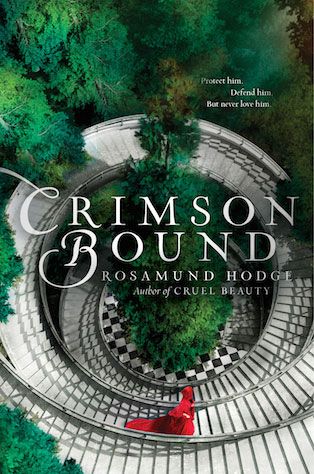
You can find this novel on Amazon in hard cover, paperback, ebook, and audiobook formats. At Barnes & Noble, get it in paperback and ebook formats, and free as an audiobook with a Barnes & Noble audiobooks subscription–otherwise the audio CD version is pretty pricey. Both Kobo and Apple offer ebook and audiobook versions. Google Play sells the ebook version. Best of all, check out the author’s web site HERE to see how you can order the ebook through Bookshop.org, benefiting an indie bookstore of your choosing while also giving a bit of a commission to the writer. Visitors to Hodge’s web site will find other goodies there, including an alternate ending and a playlist for Hodge’s curated soundtrack. You can download that on Spotify right from her web site.

Hodge is a YA writer, and Crimson Bound is a YA book “inspired by” the Red Riding Hood story and also the opulent court of 17th century Versailles. It is packed full of lore–any fantasy reader who loves a book for its lore may love this one.

But while the story may have been inspired by Red Riding Hood, this is not really a fairytale retelling, in that not much of the fairytale remains. As Hodge comments in the book’s acknowlegements, she was also inspired by a different folktale, “The Girl With No Hands.” Another source of material, she says, are the Old Norse sagas Völuspá and Vǫlundarkviða, both part of the Poetic Edda. (The quickest way to find out about that cycle of poetic narratives is to start HERE and use the bibliography to go further.)

Crimson Bound offers up some of the familiar Red Riding Hood tropes. There’s a grandmother-like figure, the main character’s aunt. The main character faces a wolf-like creature in a scary woods and must choose between two paths. There’s also a red cloak. But as the story begins, Hodge teases the reader with snatches of what looks like a different folk tale entirely–maybe a little whiff of Hansel and Gretel. This tale turns out to be part of Hodge’s own intricate lore. How completely that lore is beholden to her sources of inspiration, I can’t really say, but they seem at odds with the courtly Versailles backdrop. On the other hand, we know that a lot of fairytale material was reshaped from folk tale into literary form by Charles Perrault, Charlotte-Rose de Caumont de la Force, and others at the court of the Sun King. Whatever its exact origins, any reader of Hodge’s novel can agree it is saturated with a fairytale atmosphere.

I found Crimson Bound to be a bit overwhelming. Every time I thought I had the characters sorted out and their motives figured out, the scenario got murkier. The novel is interesting in that the main character is no damsel in distress but a hardened killer, and a person who regards herself as damned. There is a lot of lore about demonic forces here, and a lot of questing for a magic sword that will somehow save the world from those forces. This is a world where the darkness is literally encroaching on the light, and the heroine must fight to save the world against the final darkness–in spite of knowing that she can just relax and be a demon. There seems to be allegory going on, although I was never quite sure.

As in most YA fantasy novels, the heroine is also torn between a dark dangerous sexy man and a more benign man.

I should mention, too, that the language is at times very beautiful–poetic in the best sense, not the cheap trashy Hallmark card sense. I admired that.

By the end of the novel, my head was spinning trying to keep track of so many bits of lore, so many mixed motives, so many outright obscure motives, so many ornate rooms in the palace. It was an interesting book, though.

AND ANOTHER THING: HAPPY VALENTINE’S DAY!

Did Valentine’s Day really originate with Geoffrey Chaucer’s Parlement of Foules (Parliament of Fowls, Assembly of the Birds), when Chaucer envisions a day when a great congregation of birds assemble to choose their mates? “The lyf so short, the crafte so long to lerne. . .” Not only that, it’s really HARD to pick the perfect mate, especially when someone else, or some unstoppable force, or maybe peer or social pressure, is working on you to pick X when you actually love Y. Dame Nature in the end lets the beautiful female eagle make her own decision, in spite of the various pushy guy eagles who keep chirping (squawking?) “Pick me! Pick me!”

Or was the Roman fertility festival of the Lupercalia the real origin of Valentine’s Day? Or was it one of the many, many Saint Valentines of the Roman Catholic calendar?

As a lover of Chaucer, I vote for him. But I don’t think anyone really knows for sure. So eat lots of chocolates, grab yourself some fairytale fantasy, and read, read, read.

NEXT UP: A review of Scarlet, by Marissa Meyer (2013, Macmillan)

Valentine Week 2025: Fairytale Fantasy, Day FOUR

This year’s theme: RED RIDING HOOD

A reminder–The novels I’ll review during this year’s Fairytale Fantasy series:

Red Rider, by Kate Avery Ellison (2019, indie-published)—reviewed HERE

Wolves and Daggers: A Red Riding Hood Retelling, by Melanie Karsak (2018, indie published–Clockpunk Press, which seems to be owned by the author)–reviewed HERE

Beauty and the Werewolf, by Mercedes Lackey (2011, Harlequin Nocturne)–TODAY’S REVIEWED NOVEL

Crimson Bound, by Rosamund Hodge (2015, HarperCollins)

Scarlet, by Marissa Meyer (2013, Macmillan)
For the Wolf, by Hannah Whitten (2021, Orbit)

And finally: a medley of interesting outlier pieces, all based on Little Red

TODAY’S REVIEWED NOVEL:

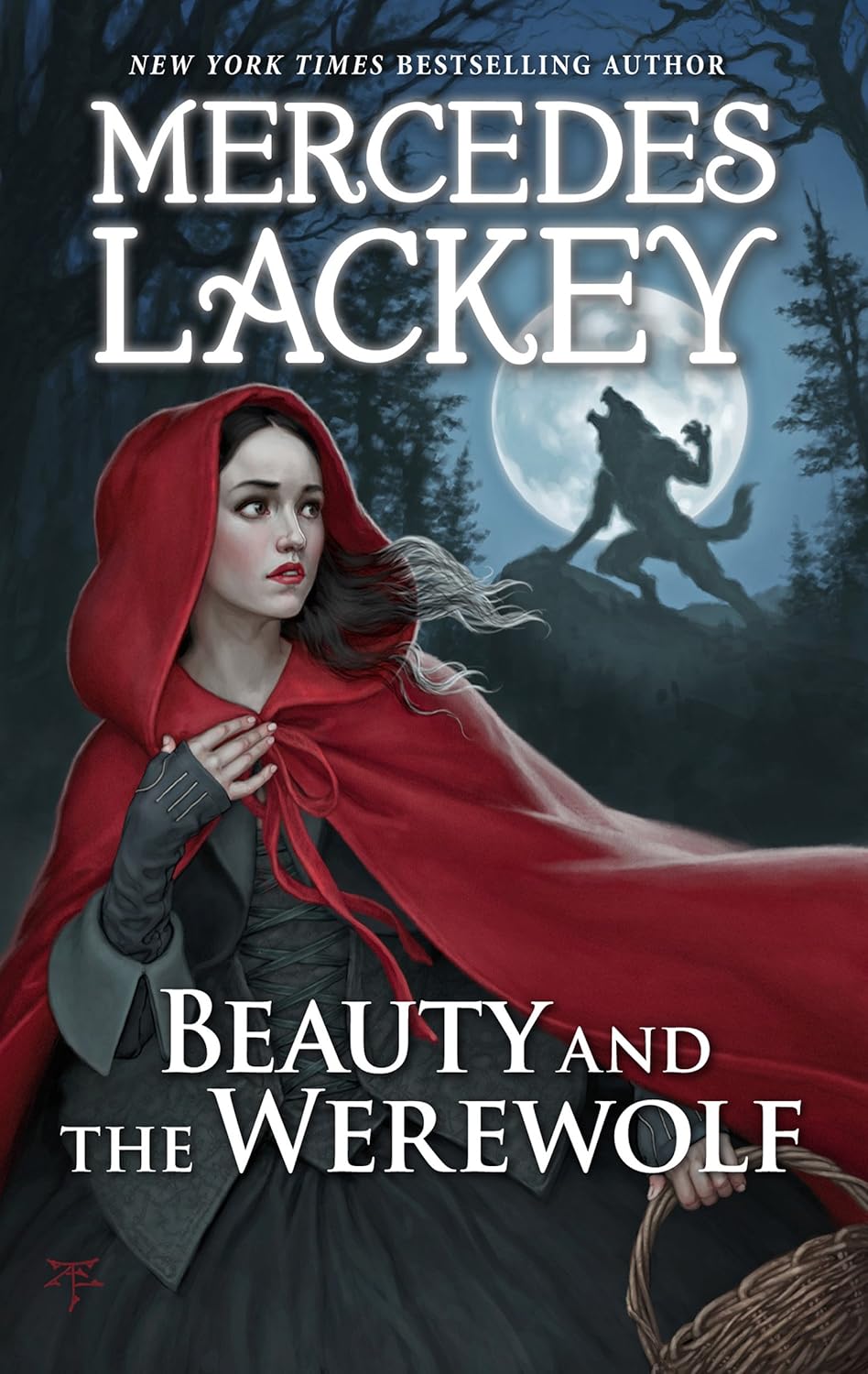
Beauty and the Werewolf, by Mercedes Lackey (2011, Harlequin Nocturne)

You can find this novel, book six in a series titled A Tale of the Five Hundred Kingdoms, on Amazon (individual title and series in hard cover, paperback, ebook, and audiobook formats). At Barnes & Noble, you can find the novel in paperback and ebook, as well as all five of the others in the series. The Apple Store is confusing on the topic–looks like they do carry this novel in ebook and audio formats. Apple also offers all or mostly all of the other titles in the series in both formats, but it’s a little hard to tell. Kobo sells the novel in ebook format, as well as a three-volume box set including all six novels in the series. And if you are a U.S. reader, don’t forget your public library and the Libby app! Also a caution: another author has published a novel with the same title, so if you want to read Lackey’s novel, be careful you don’t order the wrong book.

Mercedes Lackey is a beloved fantasy writer, so I was glad to find she had written a Red Riding Hood-themed novel. . . or so it seemed. But the title suggests it’s a Beauty and the Beast retelling instead. Or is it? I’m confused. . .

As in a number of these novels retelling the story of Red Riding Hood, there is a lot of overlap between the two tales. You have a beast. You have a young woman in peril. It’s not a book for children. . .so I suppose the overlap makes a kind of sense, especially when you add in the werewolf connection to the Red Riding Hood tale.

As I began Lackey’s novel, I confess I felt a bit underwhelmed. There were a number of familiar Red Riding Hood tropes, of course: the woman in the red cloak, the grandmother, taking a basket of comestibles to grandmother’s house through a scary forest, the warning not to stray from the path, and then the straying from the path anyway, in spite of all the dire warnings. And finally, the wolf in all its ferocity and magnificence. I couldn’t help thinking of Greta Garbo’s exclamation at the end of Jean Cocteau’s iconic 1946 Beauty and the Beast film, when beast transforms to prince: “Give me back my Beast!”

The setting was interesting, too— a kind of Regency-romance setting, even though it was clear we readers weren’t, in imagination, entering actual Regency England. With the guns and all, was this another gaslamp retelling?

There were some gaslamp trappings. Mostly, though, there was none of that gaslamp gadgety feel to the thing but rather, a gothic atmosphere—the mysterious castle exuding danger, the lonely moors, a glowering gamekeeper. So okay, I thought— another Red Riding Hood-Beauty and the Beast hybrid, with the twist that the “beauty” is no conventional pretty damsel in distress but an unconventional heroine too independent-minded for the times or the story.

And that, readers, turns out to be the point of the novel. A character too independent-minded for the story. To my shame, I have never read anything by Mercedes Lackey before, and probably shouldn’t have started with this one. Also, this novel is the last novel in of a series of interconnected stories, A Tale of the Five Hundred Kingdoms, all fairytale retellings. Admitting that, I can also tell you I found Beauty and the Werewolf very intriguing. The magic system is elaborate and pretty fascinating. Maybe if I had read some of the earlier novels in the series, I would have caught on right away. Even without that advantage, I did get the drift pretty fast, and the story itself is stand-alone.

The fun in this retelling is the magic of this fantasy world. Here magic is overseen by powerful Fairy Godmothers who are on constant alert to keep a mysterious force called the Tradition from pushing and manipulating the residents of the world into predetermined story stereotypes. So Isabella, the Red Riding Hood character, is constantly being enticed onto one or more pathways of action determined by age-old story tropes— the damsel in distress, for example. The problem then becomes how Isabella can help the young duke cursed into wolf form ( the werewolf  theme again!) and remain in her own form without falling into any fairytale stereotype. Not to mention how she will be able to decide her true feelings as they whipsaw between two different hot men. There’s a continuing narrative about stepmother and stepsister relationships, too—another Beauty and the Beast incursion, with a lot of Cinderella thrown in. What a very meta, very clever way of retelling a story positively awash in storytelling tropes! I enjoyed this novel very much.

A note about fairytale tropes: Anthropologists and folklorists study these matters! When the Brothers Grimm collected Little Red Cap and all the other folktales they preserved, they were acting out of scientific curiosity and the 18th-19th century passion for observing and classifying everything in the world: Linnaeus for plants and animals, John James Audubon for birds, Dmitri Mendeleev for elements, Wilhelm and Jacob Grimm of Germany for their country’s folkways, tucked away and preserved in stories told in villages and out on remote farms.

Later on, the American folklorist Stith Thompson classified the elements of folk tales into a system of motifs, basing his work on that of Finnish folklorist Antti Arne. You can read more about this important work HERE, but the article is behind a firewall, unfortunately. If you want to find out more and you are just beginning a study of this field, don’t discount Wikipedia as a valuable starting point, especially the article’s footnotes and bibliography. Thompson’s and Arne’s work on indexing folklore motifs or tropes has been further refined by the German scholar Hans-Jörg Uther. In the Thompson-Arne-Uther Index, Little Red Riding Hood is classified as ATU 333, a classification called “Tales of Magic–Supernatural Adversaries” (and it also overlaps with ATU 123, a classification of animal tales). Find out more HERE and HERE.

I find it fascinating that Lackey, in her fairytale retellings, doesn’t stop at dressing up the story in new fictional clothes but actually explores (in a playful and highly entertaining way!) what it means to the world and human beings to possess such a treasure trove of stories, and to explore how we readers think about them and relate to them.

NEXT UP: A review of Crimson Bound, by Rosamund Hodge (2015, HarperCollins)

Valentine Week: Fairytale Fantasy returns!

Each year, at the start of the week including Valentine’s Day, this blog reviews books based on fairytales. Yep, it’s FAIRYTALE FANTASY WEEK once more. This year’s theme:

LITTLE RED RIDING HOOD

If you thought there would not be very many novels for ADULTS based on the fairytale popularly known as “Little Red Riding Hood,” you’d be wrong. With this caution: a lot of books based on this tale actually have more to do with Beauty and the Beast than Little Red. When you think about Red’s story, you’ll see how easy it is to make the transition from one of these stories to the other. A few of these novels are more YA than adult, and one is labeled as such. But they aren’t books for children.

A note about “fairytales”

The term “fairy tale” is misleading. What we typically call “fairy tales” are more accurately described as “folk tales,” or “traditional tales,” especially one coming from the oral tradition. All of the posts in this series are about fantasy novels (and sometimes other types) based on one or more of these tales.

A few cautions for readers expecting something different:

  • In spite of the word “fairy,” these posts do not review books necessarily about fairies, or the fae in any form. Fae fiction, especially in the very popular hybrid fantasy subgenre (romance subgenre?) known as romantasy, is a completely different animal. See my post about that HERE.
  • Although Walt Disney might spring to mind, this post will not deal with anything Disney. There’s the good Disney, the bad Disney, the downright ugly Disney, and occasionally there’s the brilliantly inspired Disney. All of it has its fans. I’m not going there, even though there are a few Red Riding Hood short takes by Disney.
  • This series of posts will only review Red Riding Hood-themed novels. In previous years, though, I have blogged about novels based on: fairytales from cultures world-wide, Cinderella and Rapunzel (two literary “fairytales”), and dance-themed fairytales. Click on the links to read those.

The tale itself: LITTLE RED RIDING HOOD

This folktale is familiar to most children growing up in Western cultures: a little girl is charged with taking a basket of food to her sick grandmother. She has to go through the woods to get to grandmother’s house. Her mother sternly warns her: “Whatever you do, stay on the path.” Little Red Riding Hood (called this because she wears a red hood) skips off down the path, but a wolf lures her off it. She is wary of him and resumes her journey up the path. but the sneaky wolf speeds through the forest to the grandmother’s house, eats the grandmother, puts on her clothes, and hops in her bed. When Little Red gets there, she notices something strange about her grandmother. “Why, Grandmother, what big eyes you have!” she marvels. “The better to see you with, my dear,” replies the disguised wolf. “Why, Grandmother, what big ears you have!” “The better to hear you with.” “Why, Grandmother, what big teeth you have!” The wolf springs out of bed. “The better to eat you with!” And then. . .he either gobbles up Little Red, making this a cautionary tale about obeying your mother, or a heroic woodcutter leaps into the hut to save her, making this an iconic damsel-in-distress tale, or. . .several other possible outcomes.

THE FOLKLORIC BASIS FOR LITTLE RED RIDING HOOD is more complicated than that, though. . .

Little Red Riding Hood was first popularized by Charles Perrault in one of his collections of folk tales, but it has many antecedents and shares similarities with other folk tales, especially one collected by the Brothers Grimm in Germany much later (19th century), Little Redcap. There are also possible forebears and parallels in Greek mythology, Nordic mythology, and African folk culture. By the way–I was struck with how many of the novels on my list this year employed a werewolf and/or shifter trope. I figured this is because the trope has become so popular in the last several years. Actually, the werewolf has been part of these Little Red folktales for centuries. Another of the tale’s most interesting aspects is its aura of repressed sexuality. You can read one take on that HERE.

I’m taking a look at six fantasy novels based on fairy tale and folktale elements, all fairly recently published–and this year, all about Little Red Riding Hood. Each day of Fairytale Fantasy Week, I’ll briefly summarize how the novel connects to the Red Riding Hood theme and then explain what I liked or maybe didn’t like so much about the book. You may disagree with any or all of what I have to say! To paraphrase Emily Dickinson, the heart wants the books it wants. And doesn’t want the books it doesn’t, I suppose–but even if a book is not to my particular personal taste, I almost always find it interesting. As a writer myself, I always wonder why another writer heads in a particular direction or creates a character in a particular way, especially since I’m finishing my own folktale-themed novel (inspired by the Children of Lir Irish folktale). So I almost always finish the books I start. Unless the writing sucks. That’s a hard no for me. In the final, seventh post of Fairytale Fantasy Week 2025, I’ll point you to some interesting outlier takes on the story of Little Red.

HERE ARE THE SIX:

Red Rider, by Kate Avery Ellison (2019, indie-published)—marketed as “a post-apocalyptic werewolf retelling of Red Riding Hood” and “Red Riding Hood meets the Handmaid’s Tale.” It is classified as YA.

Wolves and Daggers: A Red Riding Hood Retelling, by Melanie Karsak (2018, indie published–or anyway, by a boutique publishing company, Clockpunk Press, which seems to be owned by the author)—a gaslamp detective story take on the tale.

Beauty and the Werewolf, by Mercedes Lackey (2011, Harlequin Nocturne)—part of Lackey’s A Tale of the Five Hundred Kingdoms interlocking series of books based on various fairytales.

Crimson Bound, by Rosamund Hodge (2015, HarperCollins)—a combination of the Red Riding Hood story, another folktale called The Girl With No Hands, and assorted mystical concepts.

Scarlet, by Marissa Meyer (2013, Macmillan)—a science fiction version of Little Red.

For the Wolf, by Hannah Whitten (2021, Orbit)—the marketing suggests this novel was based on Little Red Riding Hood, but it’s as much about Beauty and the Beast as anything else.