The Arthur C. Clarke Awards short list, continued

The novels short-listed for this major speculative fiction award include:

  • Annie Bot, Sierra Greer WINNER
  • Private Rites, Julia Armfield
  • The Ministry of Time, Kaliane Bradley
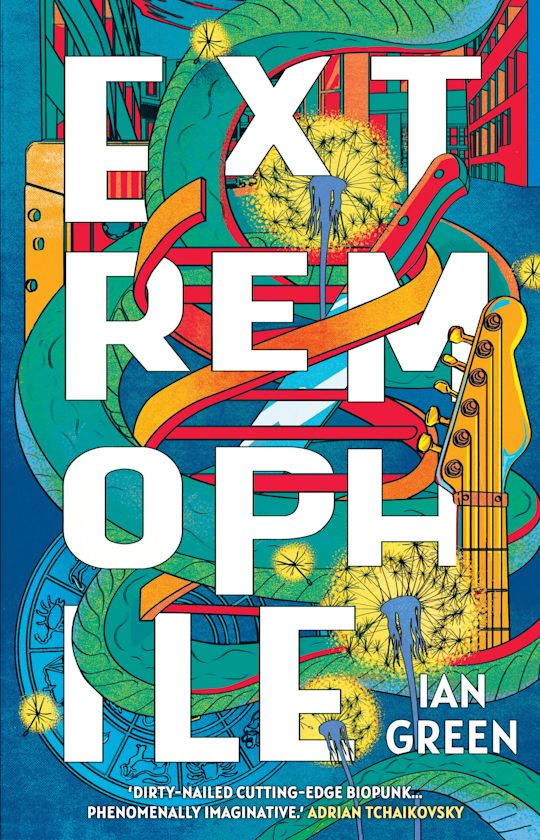
  • Extremophile, Ian Green–reviewed in this post
  • Service Model, Adrian Tchaikovsky
  • Thirteen Ways to Kill Lulabelle Rock, Maud Woolf–reviewed in this post

In my last post, I reviewed the novels by Armfield and Bradley. This post reviews the novels by Green and Woolf.

Extremophile, Ian Green (2024, Head of Zeus/Bloomsbury)
Find out more HERE. Get it HERE.

What an amazing novel. Disclaimer: I’m probably not the target audience for it–I had to look up stuff in order to read Extremophile, all the way from slang stuff like ACAB and “jilling” to science stuff like “clathrate gun.” If you know what either the slang stuff, the science stuff, or both mean without looking them up, get this book RIGHT NOW and read it. If you do have to look them up, get this book RIGHT NOW. . .etc. I started out thinking, well, if A Clockwork Orange and Snowcrash had had a baby. . . But that’s not it. That kind of pigeon-holing (talk about old slang) does this novel a huge disservice. In the end, I was thinking more about Orxy and Crake, but the book is an original.

Green has written an ingenious dystopian novel of bioterrorism, climate collapse, the punk scene of the future, and the destruction of civilization as we know it. In a London sometime after a 2038 worldwide mega-pandemic, the disaffected main character of the novel divides the world into Green, Blue, and Black. “The Greens want to save the world,” Charlie tells us, in a spectrum stretching from making your own toothpaste to the most violent acts of terrorism. The Blues don’t care about anything but profiting off the corpse of a dying world, and if that means killing or destroying or perversely toying with anyone or anything in their path, they do not flinch. The Blacks, though, have given up hope.

The three main characters are musicians with their own up-and-coming punk band, and the narrator, Charlie, is also a gifted bio-hacker much in demand for all sorts of shady projects. Charlie has a dangerous past–a mentor savagely killed by a mysterious chemical process that the novel gradually unfolds to us. Charlie’s world, inside and out, is broken, and we readers probably don’t like the chances that Charlie is going to come out of this plot intact.

Sound bleak? Not so fast. This novel is laugh-out-loud clever. In my last post, I mentioned “Chekhov’s gun,” and this novel plays in a really fun way with that concept from the title of the first chapter all the way through. It’s also an extremely violent novel, and sometimes pretty perverse, so be aware and warned if such topics put you off. The plot is a specimen of the thrill-ride heist/caper. What fascinates me about it is how much fun it is while being completely realistic about character–the way people really work inside. The supervillains have their dumb moments. So do the heroes. Charlie is a hugely engaging main character, and Parker and Zoot are admirable side-kicks. In the end, this novel is incredibly sweet-natured, with an endearing shout-out to Ursula LeGuin into the bargain. In a more cartoonish fantasy, the heroes ride to the rescue and sort everything neatly out. Instead, this novel shows us human beings with all their nuances and craziness. The world with all of its pigeons and methane bubbles and dying coral reefs. All the messiness. We are also treated to timeless words of wisdom such as: “switching lanes at the post office never got no motherfucker nothing.” So–all the messiness, plus a whole lot of fun.

The writing is superb. I always try to read a novel I’m reviewing before I read anyone else’s opinion. Then I might, especially if I don’t trust my own take on it. In the case of Extremophile, I spotted a couple of two-star reviews as I purchased the ebook. What were those readers thinking???? This novel did not win the 2025 Arthur C. Clarke Award. If I were handing out awards, I would absolutely give it one, and as many stars as they’d let me. Please do yourself a huge favor and read this book. (Unless you are prudish or squeamish. I suppose I need to say that.)

Thirteen Ways to Kill Lulabelle Rock, Maud Woolf (2024, Angry Robot)

Find it HERE.

In the near future, Lulabelle Rock is a B-list star with a sagging career. Cloning has given celebrities a handy way to extend their reach and public appeal. A star will clone herself, creating what are called Portraits, and send them out to perform any number of practical tasks, whether it be shopping, posing in designer clothes, attending splashy parties, whatever will save the star’s energy. But Lulabelle, under pressure to revive interest in her panned new film, decides her Portraits actually dilute her impact. She creates one last clone, the thirteenth, the novel’s main character. The assignment the real Lulabelle gives Portrait Thirteen: assassinate all the other fake Lulabelles.

Woolf’s novel is a stylish high-concept romp during which Number Thirteen encounters twelve different possible versions of herself. Portrait Thirteen, only minutes out of the cloning vat when we first meet her, gradually comes to understand herself. The novel drives to its inevitable end. What happens when the assassin–born for that task and that task only–turns sour on the assignment? What if she makes friends with some of the other Lulabelles? Which ones fight back, which ones succumb meekly to their fate, and which ones actually welcome it? What happens to the last Portrait Lulabelle–the lucky/unlucky thirteenth–once the other fakes have been destroyed? Most of all, how does our narrator Lulabelle, a fake herself, tell the fakery in the world–especially this world, a whole city designed for fakery–from the real? How does anyone?

The novel is entertaining. I enjoyed it. It is cartoonish, sure, but that’s what it sets out to be. I found it a bit predictable, although the various encounters with possible selves, the sleight-of-hand involving who is a good guy and who isn’t, and a twisty ending guarantee an interesting and fast-paced read.

NEXT UP: reviews of Service Model, by Adrian Tchaikovsky, and the Arthur C. Clarke prizewinning novel, Annie Bot, by Sierra Greer.

Three recent literary dystopian novels

A dystopian novel gives a cautionary and prophetic glimpse into the disastrous place the ordinary world is in danger of becoming. Often these literary glimpses are grim, because the circumstances these novels critique are grim. Some dystopian novels might be classified as “genre fiction” (example: The Hunger Games, by Suzanne Collins, clearly mines a number of popular YA tropes), whereas others are more “literary” (example: Margaret Atwood’s The Handmaid’s Tale relies on post-modern literary devices such as fractured narrative).

But what does the distinction between “genre” and “literary” even mean? Some genre fiction is just for fun, there mostly to scratch the itch of favorite tropes and storylines. Some literary fiction is so much about language and the way it works that I wonder if I’m really reading an extended poem, a piece of writing not essentially about “story” at all, even if it has some narrative bones. Plenty of novels straddle the divide, or fall to one side or the other but just barely. Booksellers might market a novel as one or the other without much reason beyond, “Okay, this will sell, if we present it THIS way.”

With that as a caveat, I’m on fire to talk about three dystopian novels I have read recently, all of them–or so it seems to me–in the “literary” camp. Whatever that means. They are:

  • Paul Lynch’s 2023 novel Prophet Song.
  • Leif Enger’s 2024 novel I Cheerfully Refuse.
  • Daniel Findlay’s 2019 novel Year of the Orphan
Find it at Amazon.

Paul Lynch, Prophet Song, Atlantic Monthly Press, 2023

This novel, which won the prestigious Booker Prize for 2023, is simply astounding. Set in near-future Dublin, Prophet Song seems at first almost a realistic novel about a family with typical ups and downs, typical conflicts. But the reader realizes almost from the outset that the family’s normal life has begun a chilling slide into the abnormal. Society is breaking down around them, at first subtly and slowly, then with increasingly cruel speed.

This is the kind of novel that forces you to recognize how easy it would be for your own supposedly normal society to take the same frightening plunge into autocracy and violence. Lynch’s novel could have been set in any number of hot spots around the world threatened by encroaching autocracy, including (as a citizen, it pains me to say) the U.S.A. But it’s not. It is set in Dublin, one of the most ostensibly sane and civilized places on the planet. That makes the devolution into chaos and violence all the more horrific. Lynch handles the writing, the characters, the situations masterfully, resulting in a chillingly realistic portrait of a society–and individual characters–torn apart.

Find it at Amazon.

Leif Enger, I Cheerfully Refuse, Grove Press, 2024

Mr. Enger, the author of Peace Like a River, a wonderful novel from 2007, has written another masterpiece. I loved Peace Like a River so much that at first I couldn’t relax into the slow rhythms of I Cheerfully Refuse, a near-future dystopian novel set in northern Minnesota on the shores of Lake Superior.

In I Cheerfully Refuse, the sunny and optimistic Lark and the bear-like musician narrator, Rainy, enjoy an idyllic relationship against the unlikely backdrop of a drastic breakdown of civil order. Their love stands in optimistic counterpoint to this broken world. As tragedy intrudes, Rainy undertakes a meandering journey fraught with danger and desperate hope, and the novel picks up the pace.

In Enger’s vision of societal breakdown, oligarchs and plutocrats have seized control of the U.S., leaving ordinary folk at the mercy of either extreme lawlessness or the punitive measures of a remorseless and cruel bureaucracy. In this dystopian vision of the U.S., any one person’s fate depends on whether the person is unlucky enough to draw the attention of the authorities or has the skills–and the luck–to fly under the radar. On the face of it, this novel seems just as grim as Lynch’s Prophet Song, and in its depiction of a destroyed society, it is. But Enger’s novel is strangely hopeful, even uplifting–and not in a saccharine or glib way, either. What a feat!

Peace Like a River had more than a touch of magical realism about it, and so does this novel. I loved this book. At least some of my emotional attachment has to be due to my love of the landscape Enger describes. I spend half my time in Minnesota, although in the Twin Cities area, not the Arrowhead, that point of land north of Duluth sticking out into the dangerous waters of Lake Superior. But every time I drive north up Highway 61, my heart lifts. Once you get to the end of that highway, you’re in Canada–and that proximity figures prominently in Enger’s novel.

Find it on Amazon.

Daniel Findlay, Year of the Orphan, Arcade, 2019

This novel isn’t as recent as the other two. Also, instead of depicting a near-future world, it shows us the horrific aftermath of nuclear war many centuries into humanity’s desperate attempt to scratch out an existence in a hostile environment. Findlay’s novel, set in a destroyed Australia, focuses on a young girl who pieces together exactly how her world turned so toxic and destructive.

I had a lot of trouble reading this book. I’d read a little and put it down, sometimes for weeks. I always came back to it, though, and recently I finished it at last. (I’m a fast reader–not my usual experience.) So yes, the pace is slow. But this novel really rewards the reader’s persistence. Like Lynch’s and Enger’s novels, Year of the Orphan offers serious insights into the human condition and the forces that drive human beings to turn into their own worst enemies.

I did wonder at myself and my lack of patience with this novel. The structure is complex, moving back and forth in time, often abruptly, and the language is difficult. That should not have stopped me. I’m used to reading books like this.

Here’s what I think went wrong for me as a reader–at least at first. When we readers choose a book to read, we’re often driven by a certain kind of impulse: “I want something serious to read.” “I want something fun to read.” “I want escape.” “I want a fictional way to confront the problems of my world.” “I want brilliant writing.” “I want to be swept along by a twisty plot.” If we open a book thinking we’re getting escape, and we get something else, we may be disappointed or at least unsettled. I think that might have been what happened to me originally as I opened Findlay’s novel and began to read.

Here’s what the promotional “blurb” on Amazon has to say: “The Road meets Mad Max” . . . “badass young female protagonist”. . . “propulsive pacing”. . .”a thriller of the future.” I’m thinking here, ESCAPE! GENRE FICTION! I love literary fiction, but I love a fast-paced fun read, too (eh. . .the two aren’t mutually exclusive. . .just saying). I felt I was promised genre fiction, and I got literary. And that threw me. Perhaps the reference to Cormac McCarthy’s The Road should have tipped me off, but no, I was focused on Mad Max. The promotional blurb’s comparison of Findlay’s book with Russell Hoban’s Riddley Walker should have absolutely tipped me off, but my reptile brain was chanting, Mad Max! Propulsive pace! Thriller! and I didn’t pay enough attention. I think marketing did Findlay’s very fine book a disservice. It’s just the truth, though, that a publisher’s attempts to sell a lot of books can drive these marketing decisions, and maybe we wouldn’t have had the novel at all if not for that.

So what did I actually find as I began to read? A slow pace. A slow build. That’s fine in a more literary work, because plot is not the be-all and the end-all there. Good writing is. Plot may be important in a literary novel, but without good writing, it’s nowhere. And this book is written very well.

Another element that threw me off is absolutely not the writer’s fault. I’m a U.S. reader, and I know next to nothing about nuclear testing in 1950s Australia. Findlay’s novel is about a girl of the future uncovering a mystery from the past in small, telling clues. But the clues–while they probably made a lot of Australian readers nod in recognition, meant nothing to me. By the end of the novel, I got it. But for me, getting it was a long time coming.

Still another element is the jumping back and forth in time. In genre fiction, too much of that loses the reader. In literary fiction, a reader who wants that experience will go with it. Atwood’s The Handmaid’s Tale in effect hands the reader a bunch of unedited tape-recorded reminiscences and tells the reader to put them together herself. I did, and I was glad I did. In the process of reading Mr. Findlay’s novel, I had to revise my thinking and expectations, and then I could do it. Mr. Findlay doesn’t give many easy-to-understand cues, either, to alert us to the leaps.

Here’s the final element that slowed me down: the language. As I say, this novel is very well-written. But its style cries out for patience. Gregory Orr’s great little book, A Primer for Poets & Readers (W. W. Norton, 2018), makes an important point about writers and how they write. He’s speaking specifically of poets, but he could be speaking of any kind of writer. He says that in every poet (writer), there’s a clash between order and disorder. Each writer has to find his or her threshold between the two–not too much order, or the piece of writing will seem stifled. Not too much disorder, or the piece of writing will seem chaotic. This moment of balance is very personal to each writer. BUT ALSO each reader has such a threshold. My tolerance for a lot of disorder in a piece of writing, or my need for a lot of order, also needs to find its own personal balance. So if a writer’s threshold and a reader’s do not match up, the reader is likely to feel unfulfilled and frustrated. Yet a writer–at least a literary writer–has the obligation to herself/himself to write at that point of personal balance, not to cater to someone else’s perceived point of balance. A genre writer, “writing to market,” may not adhere to that. A literary artist will.

Mr. Findlay’s choice of how to handle the language in Year of the Orphan strikes me as one of those artistic decisions. He thinks about what a language of the future in Australia would have to sound like, and he creates that language. Some readers will have patience with his decision and follow him there. If the decision does not meet other readers at their threshold, though, they won’t have the patience to keep reading.

I’ve been thinking about this issue for a long time. My own training is in Renaissance English literature, and in my doctoral work, I focused most on Edmund Spenser’s Faerie Queene. Spenser, like Mr. Findlay, had to make a decision about the language appropriate to the literary world he wanted to create. In Spenser’s case, he was trying to retrieve a past that had never actually existed, so he mimicked, brilliantly, a kind of faux-Chaucerian language that, for him, reflected the bygone era he was trying to recreate. His friend the poet Sir Philip Sidney begged him not to do it, suggesting he would lose readers if he more or less created his own language. Spenser did it anyway, adhering to the integrity of his own threshold. Some readers have the patience to follow him there (me!). Many don’t, especially as the centuries have rolled by, making Spenser’s language more and more difficult for regular readers.

This happens in speculative fiction, too. (In fact, I’d argue that Spenser was writing a type of speculative fiction himself, just looking back to an imagined past instead of forward to an imagined future.) Who creates an imagined language in speculative fiction? Russell Hoban, in the brilliant post-apocalyptic novel Riddley Walker, did it. Some readers are willing to follow him there, while others won’t want to. Anthony Burgess did it, although maybe not so radically, in A Clockwork Orange. Denis Johnson did it in his post-apocalyptic novel Fiskadoro. This is what Mr. Findlay did, too, in Year of the Orphan. At first, I found myself resisting and not wanting to follow him in his own world-building via language. But in the end, re-adjusting my expectations about his novel, I did. In the acknowledgments at the end of his novel, he credits Riddley Walker for inspiring him. I can see that! I’m glad my threshold as a reader and Mr. Findlay’s threshold as a writer were able to mesh, because reading this novel was very worth my time and patience.