Valentine Week 2025: Fairytale Fantasy, Day Two

This year’s theme: RED RIDING HOOD

A reminder: The novels I’ll review during this year’s Fairytale Fantasy series

Red Rider, by Kate Avery Ellison (2019, indie-published)—TODAY’S REVIEWED NOVEL

Wolves and Daggers: A Red Riding Hood Retelling, by Melanie Karsak (2018, indie published–Clockpunk Press, which seems to be owned by the author)

Beauty and the Werewolf, by Mercedes Lackey (2011, Harlequin Nocturne)

Crimson Bound, by Rosamund Hodge (2015, HarperCollins)

Scarlet, by Marissa Meyer (2013, Macmillan)

For the Wolf, by Hannah Whitten (2021, Orbit)

And finally: a medley of interesting outlier pieces, all based on Little Red

TODAY’S REVIEWED NOVEL

Red Rider, by Kate Avery Ellison (2019, indie-published)

Find it HERE.

This Red Riding Hood-themed novel, classified as YA, is the first book of a series, The Sworn Saga. You can get it through Kindle Unlimited, if you subscribe, and in regular ebook, paperback, and audiobook formats. As far as I know, the book is available to readers ONLY on the Amazon platform, although if you get your fiction through listening, the audiobook is also available through Apple.

This novel’s marketing message claims the book is “a post-apocalyptic werewolf retelling of Red Riding Hood” and “Red Riding Hood meets the Handmaid’s Tale.” The first part of that message is at least superficially accurate. I think the second part is accurate, too, but only if you go on with the series. Since I have not, I can’t swear to that, but the novel makes it pretty clear that the story’s sequels are headed into Handmaid’s Tale territory–even though saying so is kind of like comparing My Golden Book of the Napoleonic Wars with War and Peace.

The world of this novel is set in a future where ordinary citizens have been subjugated to mutated werewolf humanoids. The werewolf females are barren, however, so the werewolf overlords mark certain human girls as mates. When the girls reach puberty, the werewolves take them for breeding stock. (Here’s where the Handmaid’s Tale comparison comes into play.) Meredith Rider is one of the unlucky girls (one of “the Sworn”) marked to be given to a werewolf mate. Werewolves kill her whole family and haul her off to fulfill her destiny. But Meredith, called Red for her red hair and the red, protective cloak her father has given her, is also plucky and resourceful, like all YA heroines. The plot proceeds from there.

The novel has other YA traits and tropes. It is written in the first person, presumably so young female readers can more readily identify with the main character. (Not judging–I’ve done it, too.) It establishes a tricky and interesting relationship situation thing between the main character and her male best friend, on the one hand, and the dominating werewolf known as the Silver Wolf, on the other. The way the author handles it becomes a fresh take on the good boy–dangerous but sexy bad boy trope common to YA novels.

The connection to the Red Riding Hood story only works at the very surface level. I thought at first the werewolf part was because werewolves have become so very popular in recent fantasy fiction, especially that subgenre called paranormal fantasy, but as I mentioned in my last post–while the paranormal fantasy angle may be very convenient marketing, it is also an undeniable and age-old aspect of the Red Riding Hood tale. A child’s casual acquaintance with the story rarely touches on this, but the folklore connection of Little Red with werewolves is sound. As for the rest: the name of the heroine, the grandmother, the red hood, the wolves–all part of the Red Riding Hood story, sure. If you read this novel, though, think about it–except for the werewolves, wouldn’t the story have worked just as well without the other Red Riding Hood trappings? I think it could have been a nice paranormal fantasy series with werewolves. So is the Red Riding Hood connection a marketing gimmick? I’m not sure. But I want to know, and not just because I’m some snarky reviewer! I am in the middle of writing a folklore-themed fantasy novel myself, so I am actually interested in the answer.

I thought the book was pretty well-written. I’m imagining a lot of YA readers will enjoy it. Unfortunately, it also has a hard cliffhanger ending to entice the reader to continue to the next book in the series, and I find that personally distasteful, a real bait-and-switch tactic. But plenty of readers must love this hook into the next volume of the series, so if you are one of them, you can ignore my prejudice here. At any rate, I won’t go on with the series. I feel cheated. I thought I was buying a novel only to discover I have bought a sixth of a novel. But if you love this kind of series, and you accept you are only reading the first installment of a super-novel, there are six installments to love, so go for it. I’m perfectly willing to accept that a long-form Netflix series will come out in seasons with cliffhangers at the end. Why can’t I accept it in books?

I’m very interested in this problem, though–not just as a reader but as a writer of fantasy series novels myself. I always try to wrap each novel up with a satisfying ending, even while suggesting there is more story to come. Am I successful? I hope so. But just stopping–as a reader, I hate that. I have been re-reading Patrick Rothfuss’s The Name of the Wind (because I’m always intrigued at how that novel works–I don’t think it really ought to, but it really, really does). Now there is a story that stops in the middle, right? Presumably, the book is a three-day marathon in which the main character, Kvothe, recounts his adventures to a scribe. Book One, The Name of the Wind, is Day One. Book Two, The Wise Man’s Fear, is Day Two. And Book Three. . . has never been published (written?), one of the big bad scandals of fantasy publishing, alongside other authors who have never finished their series, such as Scott Lynch with his unfinished Gentleman Bastards series and George R. R. Martin’s A Song of Ice and Fire. In spite of the huge compulsion of the reader to go on breathlessly to Rothfuss’s sequel (and maybe–as many fans did–scream in protest when the third book was not forthcoming), I found The Name of the Wind–and its sequel as well– to be satisfying, complete novels. I didn’t feel cheated at the end of either one, and I don’t feel cheated not to have Book Three. Sad, though. Really, really sad!

NEXT UP, TOMORROW, as Fairytale Fantasy Week continues: Wolves and Daggers: A Red Riding Hood Retelling, by Melanie Karsak
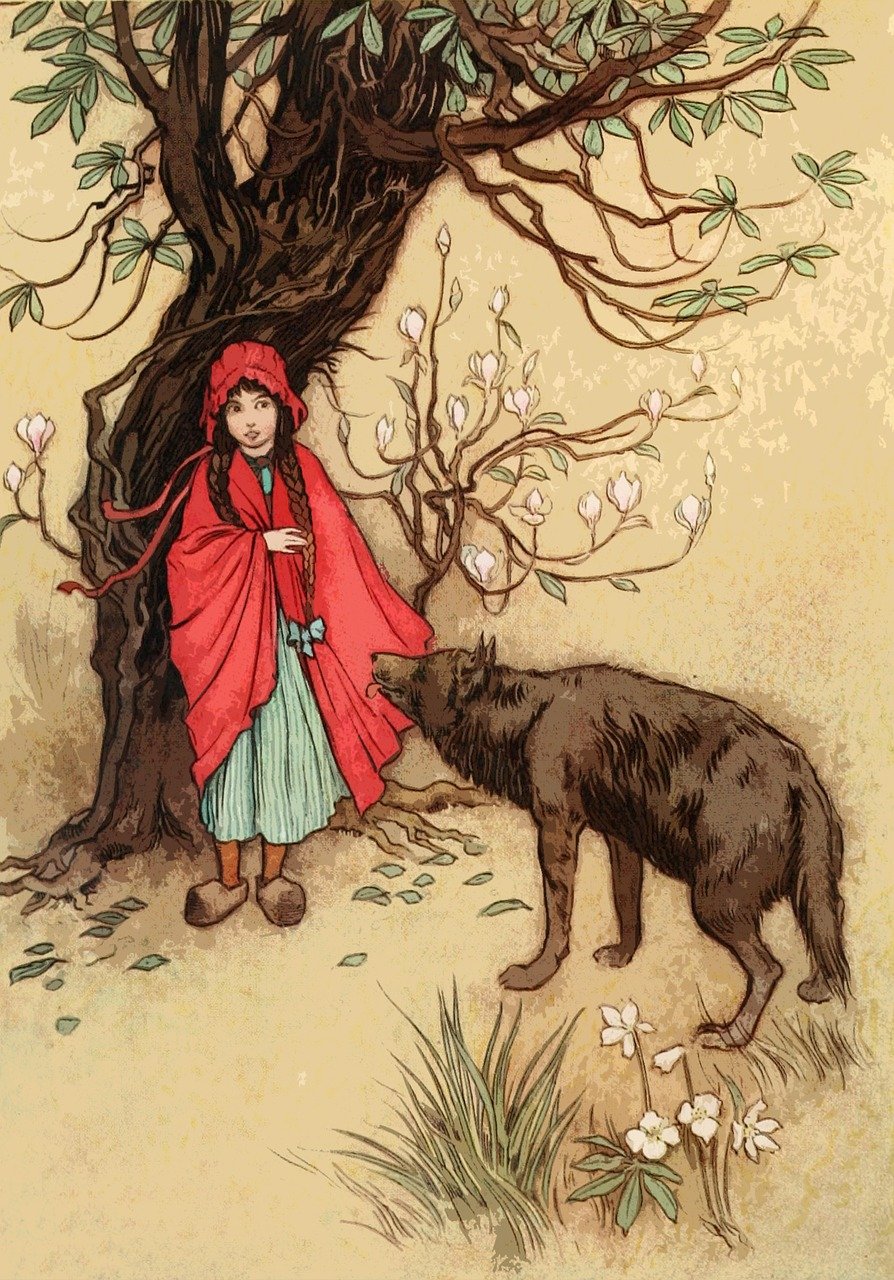
Valentine Week: Fairytale Fantasy returns!

Each year, at the start of the week including Valentine’s Day, this blog reviews books based on fairytales. Yep, it’s FAIRYTALE FANTASY WEEK once more. This year’s theme:

LITTLE RED RIDING HOOD

If you thought there would not be very many novels for ADULTS based on the fairytale popularly known as “Little Red Riding Hood,” you’d be wrong. With this caution: a lot of books based on this tale actually have more to do with Beauty and the Beast than Little Red. When you think about Red’s story, you’ll see how easy it is to make the transition from one of these stories to the other. A few of these novels are more YA than adult, and one is labeled as such. But they aren’t books for children.

A note about “fairytales”

The term “fairy tale” is misleading. What we typically call “fairy tales” are more accurately described as “folk tales,” or “traditional tales,” especially one coming from the oral tradition. All of the posts in this series are about fantasy novels (and sometimes other types) based on one or more of these tales.

A few cautions for readers expecting something different:

  • In spite of the word “fairy,” these posts do not review books necessarily about fairies, or the fae in any form. Fae fiction, especially in the very popular hybrid fantasy subgenre (romance subgenre?) known as romantasy, is a completely different animal. See my post about that HERE.
  • Although Walt Disney might spring to mind, this post will not deal with anything Disney. There’s the good Disney, the bad Disney, the downright ugly Disney, and occasionally there’s the brilliantly inspired Disney. All of it has its fans. I’m not going there, even though there are a few Red Riding Hood short takes by Disney.
  • This series of posts will only review Red Riding Hood-themed novels. In previous years, though, I have blogged about novels based on: fairytales from cultures world-wide, Cinderella and Rapunzel (two literary “fairytales”), and dance-themed fairytales. Click on the links to read those.

The tale itself: LITTLE RED RIDING HOOD

This folktale is familiar to most children growing up in Western cultures: a little girl is charged with taking a basket of food to her sick grandmother. She has to go through the woods to get to grandmother’s house. Her mother sternly warns her: “Whatever you do, stay on the path.” Little Red Riding Hood (called this because she wears a red hood) skips off down the path, but a wolf lures her off it. She is wary of him and resumes her journey up the path. but the sneaky wolf speeds through the forest to the grandmother’s house, eats the grandmother, puts on her clothes, and hops in her bed. When Little Red gets there, she notices something strange about her grandmother. “Why, Grandmother, what big eyes you have!” she marvels. “The better to see you with, my dear,” replies the disguised wolf. “Why, Grandmother, what big ears you have!” “The better to hear you with.” “Why, Grandmother, what big teeth you have!” The wolf springs out of bed. “The better to eat you with!” And then. . .he either gobbles up Little Red, making this a cautionary tale about obeying your mother, or a heroic woodcutter leaps into the hut to save her, making this an iconic damsel-in-distress tale, or. . .several other possible outcomes.

THE FOLKLORIC BASIS FOR LITTLE RED RIDING HOOD is more complicated than that, though. . .

Little Red Riding Hood was first popularized by Charles Perrault in one of his collections of folk tales, but it has many antecedents and shares similarities with other folk tales, especially one collected by the Brothers Grimm in Germany much later (19th century), Little Redcap. There are also possible forebears and parallels in Greek mythology, Nordic mythology, and African folk culture. By the way–I was struck with how many of the novels on my list this year employed a werewolf and/or shifter trope. I figured this is because the trope has become so popular in the last several years. Actually, the werewolf has been part of these Little Red folktales for centuries. Another of the tale’s most interesting aspects is its aura of repressed sexuality. You can read one take on that HERE.

I’m taking a look at six fantasy novels based on fairy tale and folktale elements, all fairly recently published–and this year, all about Little Red Riding Hood. Each day of Fairytale Fantasy Week, I’ll briefly summarize how the novel connects to the Red Riding Hood theme and then explain what I liked or maybe didn’t like so much about the book. You may disagree with any or all of what I have to say! To paraphrase Emily Dickinson, the heart wants the books it wants. And doesn’t want the books it doesn’t, I suppose–but even if a book is not to my particular personal taste, I almost always find it interesting. As a writer myself, I always wonder why another writer heads in a particular direction or creates a character in a particular way, especially since I’m finishing my own folktale-themed novel (inspired by the Children of Lir Irish folktale). So I almost always finish the books I start. Unless the writing sucks. That’s a hard no for me. In the final, seventh post of Fairytale Fantasy Week 2025, I’ll point you to some interesting outlier takes on the story of Little Red.

HERE ARE THE SIX:

Red Rider, by Kate Avery Ellison (2019, indie-published)—marketed as “a post-apocalyptic werewolf retelling of Red Riding Hood” and “Red Riding Hood meets the Handmaid’s Tale.” It is classified as YA.

Wolves and Daggers: A Red Riding Hood Retelling, by Melanie Karsak (2018, indie published–or anyway, by a boutique publishing company, Clockpunk Press, which seems to be owned by the author)—a gaslamp detective story take on the tale.
Beauty and the Werewolf, by Mercedes Lackey (2011, Harlequin Nocturne)—part of Lackey’s A Tale of the Five Hundred Kingdoms interlocking series of books based on various fairytales.

Crimson Bound, by Rosamund Hodge (2015, HarperCollins)—a combination of the Red Riding Hood story, another folktale called The Girl With No Hands, and assorted mystical concepts.

Scarlet, by Marissa Meyer (2013, Macmillan)—a science fiction version of Little Red.

For the Wolf, by Hannah Whitten (2021, Orbit)—the marketing suggests this novel was based on Little Red Riding Hood, but it’s as much about Beauty and the Beast as anything else.

Two More for the Hugos

In a previous post, I gave pocket reviews of four novels short-listed for the 2024 Hugo Award for best novel. Earlier, I had posted more extensive reviews. That’s because those four novels had already been short-listed for the 2024 Nebula, Locus, and Arthur C. Clarke awards, and two of them had won awards from those organizations. This year’s Hugo Awards committee selected two more novels to short-list:

  • The Adventures of Amina al-Sirafi by Shannon Chakraborty (Harper Voyager, Harper Voyager UK)
  • Starter Villain by John Scalzi (Tor, Tor UK)

Here are my reviews for both:

The Adventures of Amina al-Sirafi by Shannon Chakraborty (Harper Voyager, Harper Voyager UK)

Find out more HERE.

This novel is a fine swashbuckling pirate adventure full of magical creatures, good humor, and a colorful main character who describes herself as “a criminal, a sinner, a foul-mouthed middle-aged woman with a bad knee.” Sent on a dangerous quest by a rich and powerful noblewoman, the pirate Amina al-Sirafi reunites with her treacherous demon husband and sails the seas like Sinbad.  I loved the background of this novel, set in the Horn of Africa, the Indian Ocean, and other similar places, with its polyglot cast of characters. I love the idea of a novel that blithely sails past ageism, ableism, northern European fantasy tropes, and stodgy gender norms to pilot its own rolicking path. I’m really no judge, but the authentic feel of the Islamic culture lends depth and sincerity to the tale. I liked this novel as well as the first volume of the author’s popular Daevabad Trilogy–maybe better–and a lot better than the other two volumes in that trilogy.

I could easily see this book winning the Hugo Award for best novel of 2024. Do I think it is better than one of the other short-listed novels, Vajra Chandrasekera’s The Saint of Bright Doors, which won the Nebula for best novel and the Locus for best novel by a first-time author? I don’t. However, to say that is to compare apples to oranges. The Saint of Bright Doors is a serious book about deep problems of urbanization, government malfeasance, corrupt politics, cults of personality run amuck, and the like, while The Adventures of Amina al-Sirafi is a delightful romp through a Sinbad the Sailor world. I’m not saying Chakraborty’s book is a lightweight–not at all. But I’m thinking awards committees frequently tilt toward the book that possesses the gravitas. Whatever. I loved The Adventures of Amina al-Sirafi. What a book! What a read!

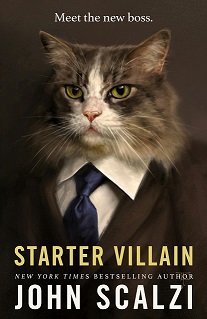
Starter Villain by John Scalzi (Tor, Tor UK)

Find out more HERE.

Another delightful read! This one reminds me quite a bit of Matt Dinniman’s indie-published LitRPG novel Dungeon Crawler Carl in its use of cat characters who upstage all the humans. The voice is really fun–a down and out man tells his own story. He has inherited his mysterious uncle’s business. Turns out the uncle was a super-villain, so the main character, who has never had a violent moment in his day, must exhibit the necessary chops. Lucky for him, the cats are in his corner. I enjoyed every page of this novel. In fact, I laughed out loud through most of it. It did seem a bit rushed at the end, though–as if, having created this marvelous set-up, the author couldn’t quite figure out how it should all go down. I thought about that. Then I put my no-doubt brilliant critical insight aside. Who cares about that when you’re having so much fun?

That wraps up all my reviews for the Hugo short-listed novels. Now it’s only a matter of waiting for the judges’ decision, which should come down any time now. In the meantime, if you haven’t read all of these books, get going! They are all great, and some of them are great fun.