DAY FOUR of Fairytale Fantasy Week 2026, and we move to revisionist takes on the Robin Hood legend. This category is a bit unfair, because almost all Robin Hood retellings in the contemporary world are revisionist in one way or another. But some novels set out to turn the Robin Hood legend on its head. Here are a few of the types I’ve seen–and I’m talking about novels and stories here, not Robin Hood tales presented in some other medium:
- The many, many books in which Robin is reimagined as a woman.–See the Maid Marion books in this series of posts, where Maid Marion takes on the Robin Hood role. But there are also books where Robin himself turns out to be a woman. The name “Robin,” historically a nickname of “Robert,” has in the past century become a very common name for a woman and less common for a man, so this makes the switcheroo pretty plausible for a lot of readers. A few of these Robin-Hood-As-Woman books seem to be about a daughter or female descendant of Robin Hood instead, a woman who takes on his mission.
- Robin set in other historical times and places. Some of these are really interesting. I’ll review two of them in this post.
- Robin turned into comedy. I mean, these men are merry, right, but that’s not the main gist of the Robin Hood stories. But it is the main gist of comical Robin Hood tales, most of them children’s books. Now, as for movies. . .! But I will talk about these in my next post.
- Robin goes contemporary. I found a few of these. I was actually surprised I didn’t find more. I also read a reviewer who considers Mario Puzo’s The Sicilian a Robin Hood retelling set in more or less contemporary times. I haven’t read that novel, but its promotional materials claim Puzo’s novel is based on a real Sicilian bandit. Maybe he is of that “social bandit” Robin Hood ilk, but I’d suggest he’s his own rogue or bandit and not really indebted to the legend of Robin Hood. I can’t say for certain, though.
- The Robin Hood tale in combination with other folk tales/fairytales. I know about a Robin Hood Meets Beauty and the Beast novel, and I believe there are others. I know there are a number of authors who do an amusing mashup of various fairytales in the same story, such as Megan Morrison’s charming middle-grade Tyme novels, but the novels I’m talking about do a kind of folktale ‘ship between Robin Hood and some other tale.
I wish I could have read and reviewed some from each category, but I didn’t have time (and I don’t review books I haven’t read. . .and tried to read carefully). But I’ll mention the variety out there, so if any of them capture your fancy, you can head over to them and read them yourself.
I had definitely planned to read and review at least one of the Robin Hood As Woman books, but in spite of searching through an enormous list of them, reading many sample chapters, etc., I couldn’t find one I felt I could do justice by. With very few exceptions, I don’t want to review a book I have to trash. I ended up reading too many sample chapters that screamed “bad writing” –OR were a bit too YA for me to review very well, even though I have reviewed a few of those–and will in this very post.
I also tried to read one of the books setting the Robin Hood story in contemporary times, but I had to give up on it. It was pretty bad. I will not name it.
Here are two reviews of books I enjoyed very much. Both take the Robin Hood legend out of Sherwood Forest and place it elsewhere. Both make this change in our expectations about the famous outlaw really work.
Wolf’s Head, by Steven McKay (2013)
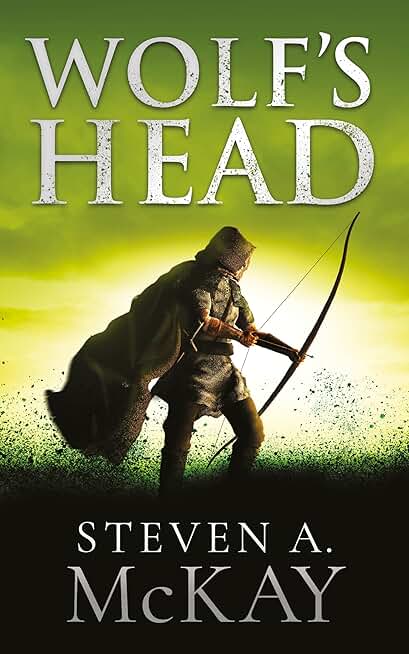
Authors of most Robin Hood retellings follow many of the ballads and much of the lore in placing Robin’s story in Sherwood Forest, in the east Midlands Nottinghamshire, and in the time period of the Third Crusade (1189-1192) and the troubled reign of Richard I. Steven McKay chooses an alternate Robin Hood for his Forest Lord series. McKay doesn’t make this change arbitrarily. There is plenty of historical precedent for his own Robin Hood vision. McKay’s Robin follows a slightly different set of lore placing the famous outlaw in Yorkshire’s Barnsdale Forest, and also in a later historical period, the reign of Edward II around the time of the rebellion of the Marcher lords against the excesses of Edward’s royal favorites, the Despenser family (1321-22). Read McKay’s take on the Robin Hood legend HERE.
I’ve only read Wolf’s Head, the first in the series, but I found it fast-paced and interesting. The writing is workmanlike, nothing fancy, but at least it’s not that flowery drek that some historical novels serve up to readers. I liked the novel for its sense of history. The characters are kind of bland. But all the Merry Men are there, even if Maid Marion is not quite the way she is depicted in the legends. These are the outlaws that the times labeled “wolf’s heads,” perhaps because killing an outlaw, like killing a wolf, wasn’t seen as an act of murder but as a civic service, ridding your community of a danger. The life of a wolf’s head, then, was nothing like romantic ballads about hijinx in the greenwood. This Robin’s life was brutish and full of dangers. McKay’s novel captures the feeling well.
The Sheriff of Nottingham isn’t in the book either, but then, McKay doesn’t set his novel there. There is a dastardly sheriff, though. McKay’s historical note at the end explains who this sheriff was historically and why this was the sheriff he chose for his Robin Hood retelling. In fact, there are a bunch of bad guys in this novel who gave me as much or more of a sense of the problems people faced in the time period than the good guys did. What motivated these baddies? What pressures were they under, and what fueled the worst of their oppressions? This novel answers questions like that–the economic hardships of uncertain climate (leading to poor harvests, leading to starvation), the political chaos during the reign of a corrupt king, the class divisions that allowed some to feel entitled to lord it over others, even to murder or sexually abuse them without facing any kind of consequences. Actually, it seems all too contemporary.
One interesting historical factoid I really liked: all the yeoman characters, because they were required by law to practice archery from the age of seven or eight, had enormously over-developed arms and shoulders–freakishly so, by our standards. I’d heard this before, but I’ve never encountered a Robin Hood character where this bizarre physique is admitted by the author. I suppose people who really, really like bodybuilders might go for such a character, and in the era of the novel’s setting, a physique like that must have seemed normal. It is also very clear that women wouldn’t have been able to compete with these highly trained male archers. Not physically likely, given the nature of women’s lives in the era–so all those Robin-Hood-as-a-woman writers might have to think twice about what their characters actually look like. I’m not saying it’s impossible. A woman given the chance to train like that from a similarly young age would have been able to take on one of the big yew longbows. I’m saying it isn’t very likely. Maybe this is where most Robin Hood retellings really do become fantasy.
McKay’s novel is not fantasy. It’s good solid historical fiction using a legendary character as its centerpiece. If you like Bernard Cornwell’s novels (I personally find the writing style pretty flat), you will probably like this Robin Hood novel.
Will I read the other five books in the series? Two of them were published just this year. I think I probably will. I am fascinated by the time period and this will be an entertaining way to find out more.
Travelers Along the Way: A Robin Hood Remix, by Aminah Mae Safi (2022)
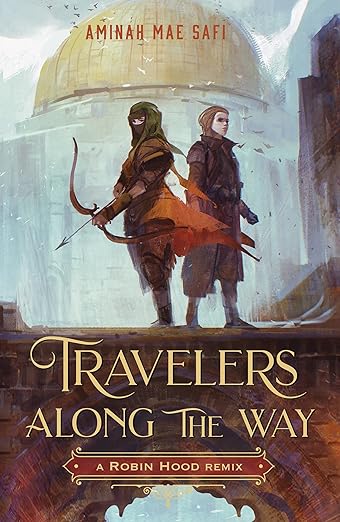
Part of the Remixed Classics series by various authors, this novel is a delight. I suppose it is YA, but it’s the kind of YA where I, at least, don’t think about that but only how clever and funny the book is–serious, too.
What is at all Robin Hood-like about this book? That was my first question. At first glance–title, cover, the cultural clues it seems to project from the beginning–Safi’s novel seems to have little to do with that most English of legendary figures, Robin Hood.
And yet–lovable rogue? Check. Band of broth. . .er. . .sisters? Check. Set during the Third Crusade? Check. Thrilling escapades, improbable shenanigans, much merriment? Check. Green hood? Check. Robbing from the rich to give to the poor? Check. All the most important features, right there. At the beginning of the novel, the author writes us readers a letter. In it she says, “The following is a story that perhaps we cannot say did happen. We have no proof that such a girl as [the main character, Rahma Al-Hud] ever existed. But neither can we say that the following did not happen.” Safi reminds us that history is a slippery thing, and that true history might exist between and among and around the facts we claim to know and might not really know at all.
This is a novel of the Third Crusade from the other side of the traditional Robin Hood story, the one where Richard the Lion Heart, the bold Crusader king, rides out to do battle with the infidel and recapture the Holy City (leaving his people–Robin, his merry men, all the rest–to suffer in his absence). In Safi’s Robin Hood novel, we see events through the eyes of two sisters, soldiers in the army of the Muslims trying to keep Richard out of that City. The terrible siege of Acre has killed almost everyone inside it, and Richard has committed an act so horrendous we’d quickly label it a war crime today.
All the sisters want to do is creep in disguise across a battle-scarred landscape and get home safely. Circumstances keep thwarting them, and at practically every step they pick up another stray, until they’ve become a merry band of travelers along the way to their destinies. The strays come in all sorts: Christian, Muslim, Jewish, Other. Man, woman. This being YA, there’s some young love in the mix as well, love of all sorts too, but it does not dominate. We come away with a sense of sisterhood and solidarity and camaraderie. If any novel passes the Bechdel Test, this one does. Love, sure. But in many different forms other than romantic–love of country, of honor and courage, of family–biological and found.
And it is so much fun! Here are some chapter titles, to give you a sense of how much: “Oo-de-lolly,” “A Horse With No Name” (the setting here being the desert, you understand), “A Pox on the Phony King of England,” “The Boy With Kaleidoscope Eyes.” What a wonderful book.
 Fantastes

You must be logged in to post a comment.