
Each year, at the start of the week including Valentine’s Day, this blog reviews books based on fairytales. Yep, it’s FAIRYTALE FANTASY WEEK once more. This year’s theme:
LITTLE RED RIDING HOOD
If you thought there would not be very many novels for ADULTS based on the fairytale popularly known as “Little Red Riding Hood,” you’d be wrong. With this caution: a lot of books based on this tale actually have more to do with Beauty and the Beast than Little Red. When you think about Red’s story, you’ll see how easy it is to make the transition from one of these stories to the other. A few of these novels are more YA than adult, and one is labeled as such. But they aren’t books for children.
A note about “fairytales”
The term “fairy tale” is misleading. What we typically call “fairy tales” are more accurately described as “folk tales,” or “traditional tales,” especially one coming from the oral tradition. All of the posts in this series are about fantasy novels (and sometimes other types) based on one or more of these tales.
A few cautions for readers expecting something different:
- In spite of the word “fairy,” these posts do not review books necessarily about fairies, or the fae in any form. Fae fiction, especially in the very popular hybrid fantasy subgenre (romance subgenre?) known as romantasy, is a completely different animal. See my post about that HERE.
- Although Walt Disney might spring to mind, this post will not deal with anything Disney. There’s the good Disney, the bad Disney, the downright ugly Disney, and occasionally there’s the brilliantly inspired Disney. All of it has its fans. I’m not going there, even though there are a few Red Riding Hood short takes by Disney.
- This series of posts will only review Red Riding Hood-themed novels. In previous years, though, I have blogged about novels based on: fairytales from cultures world-wide, Cinderella and Rapunzel (two literary “fairytales”), and dance-themed fairytales. Click on the links to read those.
The tale itself: LITTLE RED RIDING HOOD
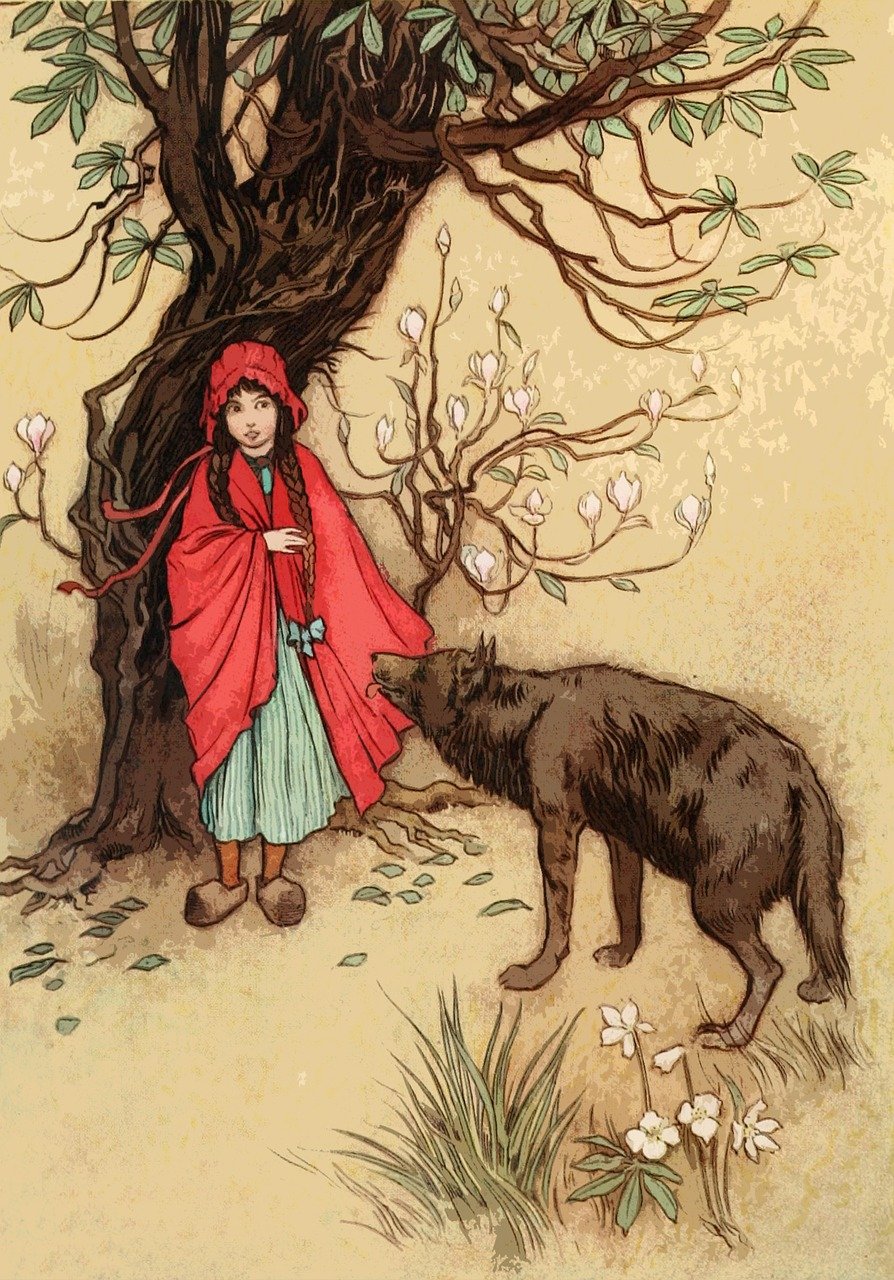
This folktale is familiar to most children growing up in Western cultures: a little girl is charged with taking a basket of food to her sick grandmother. She has to go through the woods to get to grandmother’s house. Her mother sternly warns her: “Whatever you do, stay on the path.” Little Red Riding Hood (called this because she wears a red hood) skips off down the path, but a wolf lures her off it. She is wary of him and resumes her journey up the path. but the sneaky wolf speeds through the forest to the grandmother’s house, eats the grandmother, puts on her clothes, and hops in her bed. When Little Red gets there, she notices something strange about her grandmother. “Why, Grandmother, what big eyes you have!” she marvels. “The better to see you with, my dear,” replies the disguised wolf. “Why, Grandmother, what big ears you have!” “The better to hear you with.” “Why, Grandmother, what big teeth you have!” The wolf springs out of bed. “The better to eat you with!” And then. . .he either gobbles up Little Red, making this a cautionary tale about obeying your mother, or a heroic woodcutter leaps into the hut to save her, making this an iconic damsel-in-distress tale, or. . .several other possible outcomes.
THE FOLKLORIC BASIS FOR LITTLE RED RIDING HOOD is more complicated than that, though. . .
Little Red Riding Hood was first popularized by Charles Perrault in one of his collections of folk tales, but it has many antecedents and shares similarities with other folk tales, especially one collected by the Brothers Grimm in Germany much later (19th century), Little Redcap. There are also possible forebears and parallels in Greek mythology, Nordic mythology, and African folk culture. By the way–I was struck with how many of the novels on my list this year employed a werewolf and/or shifter trope. I figured this is because the trope has become so popular in the last several years. Actually, the werewolf has been part of these Little Red folktales for centuries. Another of the tale’s most interesting aspects is its aura of repressed sexuality. You can read one take on that HERE.
I’m taking a look at six fantasy novels based on fairy tale and folktale elements, all fairly recently published–and this year, all about Little Red Riding Hood. Each day of Fairytale Fantasy Week, I’ll briefly summarize how the novel connects to the Red Riding Hood theme and then explain what I liked or maybe didn’t like so much about the book. You may disagree with any or all of what I have to say! To paraphrase Emily Dickinson, the heart wants the books it wants. And doesn’t want the books it doesn’t, I suppose–but even if a book is not to my particular personal taste, I almost always find it interesting. As a writer myself, I always wonder why another writer heads in a particular direction or creates a character in a particular way, especially since I’m finishing my own folktale-themed novel (inspired by the Children of Lir Irish folktale). So I almost always finish the books I start. Unless the writing sucks. That’s a hard no for me. In the final, seventh post of Fairytale Fantasy Week 2025, I’ll point you to some interesting outlier takes on the story of Little Red.
HERE ARE THE SIX:
Red Rider, by Kate Avery Ellison (2019, indie-published)—marketed as “a post-apocalyptic werewolf retelling of Red Riding Hood” and “Red Riding Hood meets the Handmaid’s Tale.” It is classified as YA.
Wolves and Daggers: A Red Riding Hood Retelling, by Melanie Karsak (2018, indie published–or anyway, by a boutique publishing company, Clockpunk Press, which seems to be owned by the author)—a gaslamp detective story take on the tale.
Beauty and the Werewolf, by Mercedes Lackey (2011, Harlequin Nocturne)—part of Lackey’s A Tale of the Five Hundred Kingdoms interlocking series of books based on various fairytales.
Crimson Bound, by Rosamund Hodge (2015, HarperCollins)—a combination of the Red Riding Hood story, another folktale called The Girl With No Hands, and assorted mystical concepts.
Scarlet, by Marissa Meyer (2013, Macmillan)—a science fiction version of Little Red.
For the Wolf, by Hannah Whitten (2021, Orbit)—the marketing suggests this novel was based on Little Red Riding Hood, but it’s as much about Beauty and the Beast as anything else.
THANKS!!!! to the talented artists providing their royalty-free work to this blog.
I put a red hood on her, but the fairytale woman in my header is the artistic creation of:
Image by <a href=”https://pixabay.com/users/artrose-16042123/?utm_source=link-attribution&utm_medium=referral&utm_campaign=image&utm_content=5580307″>Please support me! Thank you!</a> from <a href=”https://pixabay.com//?utm_source=link-attribution&utm_medium=referral&utm_campaign=image&utm_content=5580307″>Pixabay</a>
And for the vintage-style Red Riding Hood illustration, thanks to:
Image by <a href=”https://pixabay.com/users/prawny-162579/?utm_source=link-attribution&utm_medium=referral&utm_campaign=image&utm_content=1652550″>Prawny</a> from <a href=”https://pixabay.com//?utm_source=link-attribution&utm_medium=referral&utm_campaign=image&utm_content=1652550″>Pixabay</a>
 Fantastes
You must be logged in to post a comment.