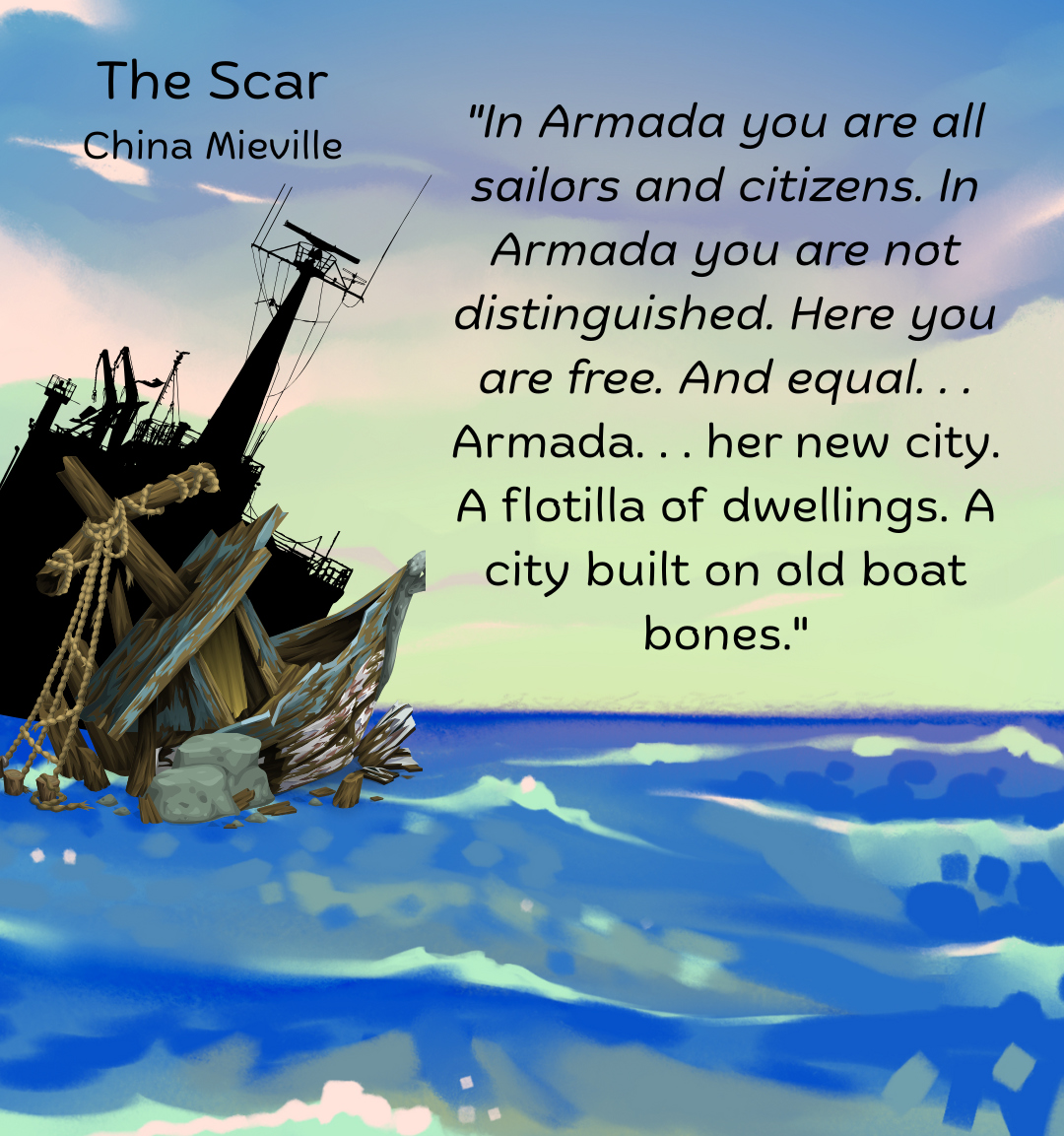
China Miéville, one of the best writers in any genre I’ve ever read, published The Scar in 2002. It may be my favorite, but that’s a hard call. Miéville writes what has been called “New Weird” fiction. This novel is weird, all right. Also absolutely fascinating, part of a trilogy set in the same fantasy world. Some of the characters overlap from book to book, but they are not sequels.
Miéville’s take on communicating with an alien species is complex and stunningly detailed, not least because Miéville himself is a philosopher–AND a brilliant writer of fiction who builds worlds we readers can imagine ourselves inhabiting. Of the six novels I have read, I found this one the most compelling (even though The Scar is my favorite!). Embassytown is also the most difficult read, at least for me, and that includes the long prose poem that is The Iron Council. Find out more about Miéville HERE. See my previous discussions of Miéville HERE and HERE.
To be clear: I am no linguistics scholar. I am no philosopher. Some other reader could make a lot more sense out of this novel for you than I can. But let me try.
(And yes, I’m extensively revising my post, because in my zeal to make my thoughts clear, I engaged in some very awkward language this novel absolutely doesn’t deserve. Hey, it’s my post and I’ll revise if I want to. Revise if I want to. You would revise too if it happened to you.)
First off, Miéville’s society of space colonists have spent generations trying to communicate with their planet’s indigenous inhabitants, the Ariekei. The attempt has produced some success. The human colonists and the Ariekei, whom the colonists term “the Hosts,” haven’t gotten very far, but at least they have achieved a careful, cordial relationship. They understand each other enough to trade with each other for the precious metals and other important goods the colonists seek, which is fine with them. This is the way they prove their worth to their far-away origin planet. If they couldn’t do that, would the home world consider them not worth the trouble? The Ariekei planet is too distant, too far out on the frontiers of the known universe, only possible to reach because the goods can travel not through regular space but through the “immer,” a kind of hyperspace. Even with the immer, the trip out and back takes years, and this includes any communication with the home world. (The answer “Is it worth the home world’s while to go to this much trouble and expense” turns out to be yes, but in an unexpected way.)
Complicating the lives of the colonists, the Ariekei atmosphere is poisonous to humans. The colonists live in a fragile bubble of breathable air surrounded by a hostile environment. Without cordial relations with the Hosts, especially considering help from the home world is so distant, any misstep with the Ariekei might doom the colonists. Good communication is everything–yet the Ariekei are so alien to the colonists in physical and neurological makeup that contact between the two species is precarious.
The colonists understand their difficult position. They consider themselves an embassy to the Ariekei from their home world and from humanity. Hence, the name of their city-state in a bubble: Embassytown.
Avice, the main character, born in Embassytown, spent her childhood plotting to get away from the place. She became a mariner of the immer and traveled the universe, but in the present time of the novel, she has returned with her husband in tow. She plans to spend her time “floaking” (a kind of loafing around) while her husband studies the fascinating and barely-understood culture of the Ariekei. Instead, she gets swept into a swiftly-changing disintegration of ties between Hosts and colonists that imperils every human on the planet. Maybe they can hold out long enough to be rescued by their home-world. Very likely not.
One of the challenges of communication between human and Ariekei is that, while the Ariekei can hear the humans speaking, they understand the sounds emanating from human mouths as only noise. Not language. Centuries earlier, through a great deal of struggle, the colonists gradually realized that only when two humans speak together in a kind of collaborative call-and-response speech (the Cut and the Turn) do the Ariekei recognize the humans are attempting sentient communication. This type of double-speaking is how the Ariekei themselves communicate. Each individual Ariekei communicates through a sort of double consciousness based on their biology. They make double paired statements and can’t understand any other noise patterns as language.
Very gradually, the humans have realized that only closely related pairs of human speakers can mimic this situation, becoming in the Ariekei view a single speaker. Back on the home world, carefully trained and genetically engineered pairs of twins were sent out to Embassytown, and now for a long time these twins speaking in tandem have worked pretty well to establish a rudimentary communication between the species.
But there’s another problem. The Ariekei take every human statement very literally. They don’t know how to lie. Yet the heart of human communication. . .HERE IT COMES, the part where it would help a reader to have a higher degree in linguistics. . .is a type of controlled lying. A human word is never the exact counterpart of a human object, or person, or concept. It is always some approximate attempt to connect the two. This is a problem of human language that has baffled human beings throughout our history. It has fueled religions (“in the beginning was the Word. . .”). Given rise to endless conflicts, misunderstandings large and small, even wars. Resulted in vain attempts to purify (think Plato driving the poets out of the Republic). Caused humans to give up and use math instead. With this enormous gulf between human and Ariekei, the attempts by the engineered pairs of speakers–the Ambassadors–results in only enough crude communication to keep trade going.
As the centuries have proceeded, however, the Ariekei have gotten curious. They understand something of the gulf between themselves and the humans, and they want to explore it. So in childhood, Avice has had a very strange and disturbing experience. In order to understand human language better, the Ariekei have started trying to learn how to lie. That is, they have begun trying to use and understand figurative language. They take possession of some human child or other and turn that child into a living simile. A simile, if you remember, is a comparison using “like” or “as.” “My love is like a red, red rose.” This is different from metaphor (“My love IS a red, red rose.”), a comparison where the “like” or “as” drops out and the comparison is made via a bald assertion THAT IS NOT LITERALLY TRUE. In other words, it’s a species of lie–if, that is, you only see the function of language as telling truth or telling lies, no middle ground. The Ariekei can’t figure out how to experience simile. Metaphor is beyond them–and by the way, there’s a huge argument in both linguistic and literary circles whether a simile is simply a type of metaphor making the comparison clear, or whether metaphor is its own separate thought process. I’m probably putting this badly, so don’t hurt me, any linguists or semioticists or literary theorists out there.
In their literal-mindedness, the Ariekei take a human child and turn it into a living simile by forcing it to enact one. So they have taken the child Avice off to a dark room and have done some (left unspecified) terrible thing to her. In their minds, they have honored her, and she gains a kind of fan-club of Ariekei because of it. Her simile is this: “The girl who was hurt in the dark and ate what was put in front of her.” Then they say to themselves, of something happening in their lives, “It is like the girl who was hurt in the dark and ate what was put in front of her.” None of the colonists quite understand what the Ariekei get out of these strange actions or what the similes mean to the Ariekei, but the humans placate their Hosts by allowing it. Avice, a slum-child, has little choice in the matter, and she can’t wait to leave the planet as she grows older.
When Avice returns to Embassytown, though, the whole simile cult has gone a step further. A few Ariekei are using these living similes to teach themselves how to lie. I won’t go into all the hows and whys of it, but as the Ariekei explore simile more and more, and as they start to edge into metaphor, their society fractures. To make matters worse, the home-world tries to test the Ambassador role by sending out a new Ambassador who is not a set of engineered twins. When this Mutt and Jeff combo tries to speak to the Ariekei, all hell breaks loose, the survival of the Embassytown humans is at stake, and Avice finds herself in the thick of it.
This book is simply fascinating. It takes some concentration to read it, but that concentration is well worth the effort. I will admit I had to read it twice to get the most out of it. But even after I had read it once, I was fascinated. Try it! If you’re already a fan of Miéville’s New Weird fiction, you’ll love it. If you’re encountering him for the first time, maybe try something a bit easier first? The City and the City would be a good choice (especially if you like police procedurals and are ready for one to go weird on you), as would Perdido Street Station (especially if you like horror). Whatever you do, don’t shortchange yourself by never discovering this amazing writer.
READY TO MOVE FROM THE SUBLIME TO THE RIDICULOUS?
This whole matter of fictions and language and whether they tell truth or lies, as I mentioned, goes back to Plato–probably past him. Plato saw how education in his day (5th/4th century BCE) depended on persuasive speakers and storytelling such as Homer’s Iliad and Odyssey, and he saw how that kind of education could be easily abused in the hands of manipulators. We see this danger in fascist states like Hitler’s regime and in the disinformation rife in our own society. It’s a real danger. In Plato’s own ideal invented society, the Republic, he simply banished all poetry (storytelling)–unless of the most patriotic type. I’m certainly ‘way oversimplifying this and maybe distorting it, so all you philosophers forgive me. I’ve always been struck by the irony, though, that the utopian society of the Republic itself is a fiction, and when Plato tried to implement it in real life, he became the tool of a despot and had to be rescued by his friends.
In the sixteenth century of our own era, Sir Philip Sidney wrote, “The poet nothing affirmeth and therefore never lieth.” What he meant by “poetry” is “fiction” in the sense of “a made-up world.” In other words–some people see the world of language divided between truth-telling and lies. Others see that the truth-lies thing is a false dichotomy. There’s a middle place: the crafting of fictions.
For a light-hearted look at the difference, take Galaxy Quest. Have you seen this brilliant and under-rated movie? Go back and watch it again. I’m begging you. As with the Ariekei, the aliens in Galaxy Quest have no concept of any middle thing between lies and truth. So when they tune in on Earth’s tv broadcasts of a kind of Star-Trek-like show, they believe it to be a documentary. And when other aliens–evil aliens–menace them, these poor credulous attacked aliens turn to the cast of the Galaxy Quest tv show for help. Then one of the actors has to explain the differences–truth vs. lies, yes–but there’s a mysterious something outside of both: fiction. This is why your local Harry Potter book-burnings are based on a fundamental misunderstanding (pun intended).


 Fantastes
You must be logged in to post a comment.