As I mentioned in an earlier post, the 2024 Locus Awards will be announced in Oakland, California, tomorrow, on June 22nd.
The list of nominees is huge and includes horror along with SF and fantasy, as well as a variety of categories. Even if I had started reading quite a while ago, I might not have read everything nominated, not even every novel–my main focus here. And I don’t usually read horror. But as it turns out, in my reading of every novel short-listed for the Nebula Awards, I have already read quite a few of the Locus nominees:
Martha Wells, Witch King (also nominated for the Hugo Awards, coming up in August)
S. L. Huang, The Water Bandits
Ann Leckie, Translation State (another nominated for a Hugo)
Annalee Newitz, The Terraformers
Vajra Chandrasekera, The Saint of Bright Doors (another nominated for a Hugo; won the Nebula)
Wole Talabi, Shigidi and the Brass Head of Obalufon
I’ll be looking forward to the results of the Locus judging!
I’ve also realized that the 2024 Arthur C. Clarke Awards given to SF published in Great Britain will be announced on July 24th. As a reader of speculative fiction written in English, that’s a list I should be paying close attention to as well. Here’s the short-list:
Nana Kwame Adjei-Brenyah, Chain-Gang All-Stars
Lavanya Lakshminarayan, The Ten Percent Thief
Martin MacInnes, In Ascension
Ray Nayler, The Mountain in the Sea
Emily Tesh, Some Desperate Glory
Isabel Waidner, Corey Fah Does Social Mobility
I’d say I have the reading for the month all laid out for me! How about you?
What better time to read this kind of book than on Midsummer Eve? The summer solstice has anciently and always been associated with the fair folk, the day the fairies all come out to play. This year–TODAY!– the magical day falls on June 19th. Tomorrow, June 20th, summer officially begins with the summer solstice.
Q&A:
Who are the fae? Isn’t “fae” just a fancy way to say “fairy”?
Fae does not necessarily mean fairy, not if you’re thinking of cute winged Tinkerbell creatures. The fae go by many names worldwide: the sidhe, the seelie, the fair folk, the sprites. In a book of mine, I’m using the Celtic name aos si. These magical beings inhabit the world alongside us ordinary folk but stay mostly hidden from us. They wield a powerful magic. They may have long pointy ears. They may be winged. They’re not necessarily good–some may be outright evil, outright scary. Novels about them form their own subgenre in fantasy, what I’m calling fae fantasy, but more and more, they feature largely in a newly-named hybrid genre, romantasy.
What is fae fiction?
Fiction that is set in the world of the fae, but not necessarily. A novel may have major fae characters, but these could be depicted as strangers or visitors to the world of the novel. An urban fantasy novel, for example, may feature a fae main character, but the setting is our own world.
What about Lord of the Rings? Huh? HUH? What about Legolas, and. . .
Well, okay, but Lord of the Rings is more what I’d consider “fantasy of the kinds.” Yes, there are fae. But there are also hobbits, orcs, wizards, whatever, and a big part of the fascination of this type of novel is seeing how all the kinds interact and cooperate with or oppose each other. Regretfully, I’m eliminating Lord of the Rings from this post. Convince me I’m wrong! (Not even touching all those other books Tolkien wrote. . .)
What is romantasy?
“Romantasy” is a recently-invented term to describe a combination of the fantasy genre and the romance genre, with favorite tropes from each (“the Chosen One saving the world” plus “enemies to lovers,” as an example). Often, this type of book features the fae, and often, this type of book is pretty steamy. Sometimes very steamy, all the way up to erotica.
In honor of the season, here are five novels of the fae to get you started.
Sarah Maas, A Court of Thorns and Roses (2015, Bloomsbury)
I could have picked just about any novel in this series by Sarah Maas, the current doyenne of fae romantasy, but if you haven’t read any of her books yet, start with this one (she has written other books in other subgenres: urban fantasy, epic fantasy). I actually didn’t like this book much when I first read it. It was too much “damsel in distress” for me. A friend urged me to continue at least to the second book of the series. I did that, and found I liked it a lot better than the first. I ended by reading the entire series. I liked the novels. I didn’t just love them. There were strange things about them that yanked me out of the fae world. For example: the fae have cozy sweaters they could have gotten at the Gap. They have nice bathrooms that gleam with fixtures seemingly by Kohler. But these books are emphatically not urban fantasy, and there’s no hint of an explanation why such world-elements are sitting around cheek-by-jowl with enormous sexy bat creatures, swordplay, poor beautiful human girls in rags who venture bravely from their hovels to cross walls into dangerous fae magical lands, and so on and so forth. On the up side, the novels have great sex scenes (graphic ones, so be warned if you don’t like that), even as each novel in the series gets more improbable and angsty than the last. These books are enormously popular.
A NOTE: In spite of the steamy sex, the novels in this series are listed by booksellers as YA, which in these times has caused a certain amount of controversy. At least here in the U.S., school librarians have taken them–or been forced to take them–off their shelves. Have these censorious folk met any actual 21st century teenagers? those willing to be honest with the adults in their lives about what they know and how they act on what they know? Just asking. Maybe these adults think they can put the genie back into the bottle, but hellooooo???? That genie has been out since we all lived in caves.
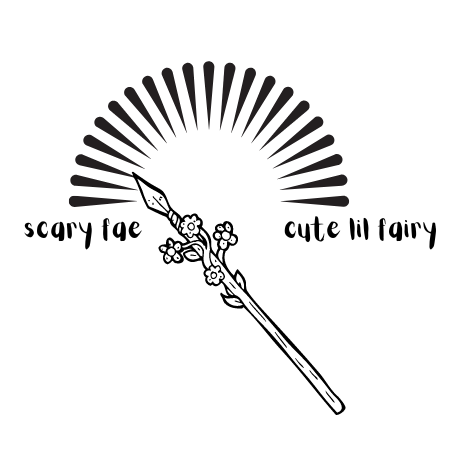
On my scientifically developed fairyometer, I’d place these fae books by Sarah Maas HERE:
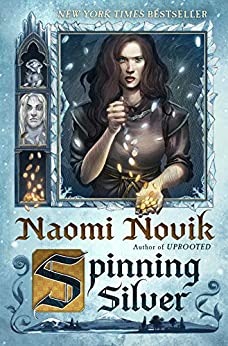
This compelling book is part historical fiction, part fae fantasy, part fairytale retelling. In this novel inspired by the Rumpelstiltskin fairy tale and eastern European and Russian folk tales, as well as by real events and cultural forces in those parts of the world, the Staryk is the name the author gives the fae, and the trope of the human girl forced into proximity with these scary otherworldly creatures is the main focus. But the book is more complex than that, and beautifully written. See my review of it during Fairytale Fiction Week 2022. Excluding the classics at the end, this novel is my favorite of all the ones I’m reviewing in this post.
Consulting the fairyometer about Spinning Silver. . . .
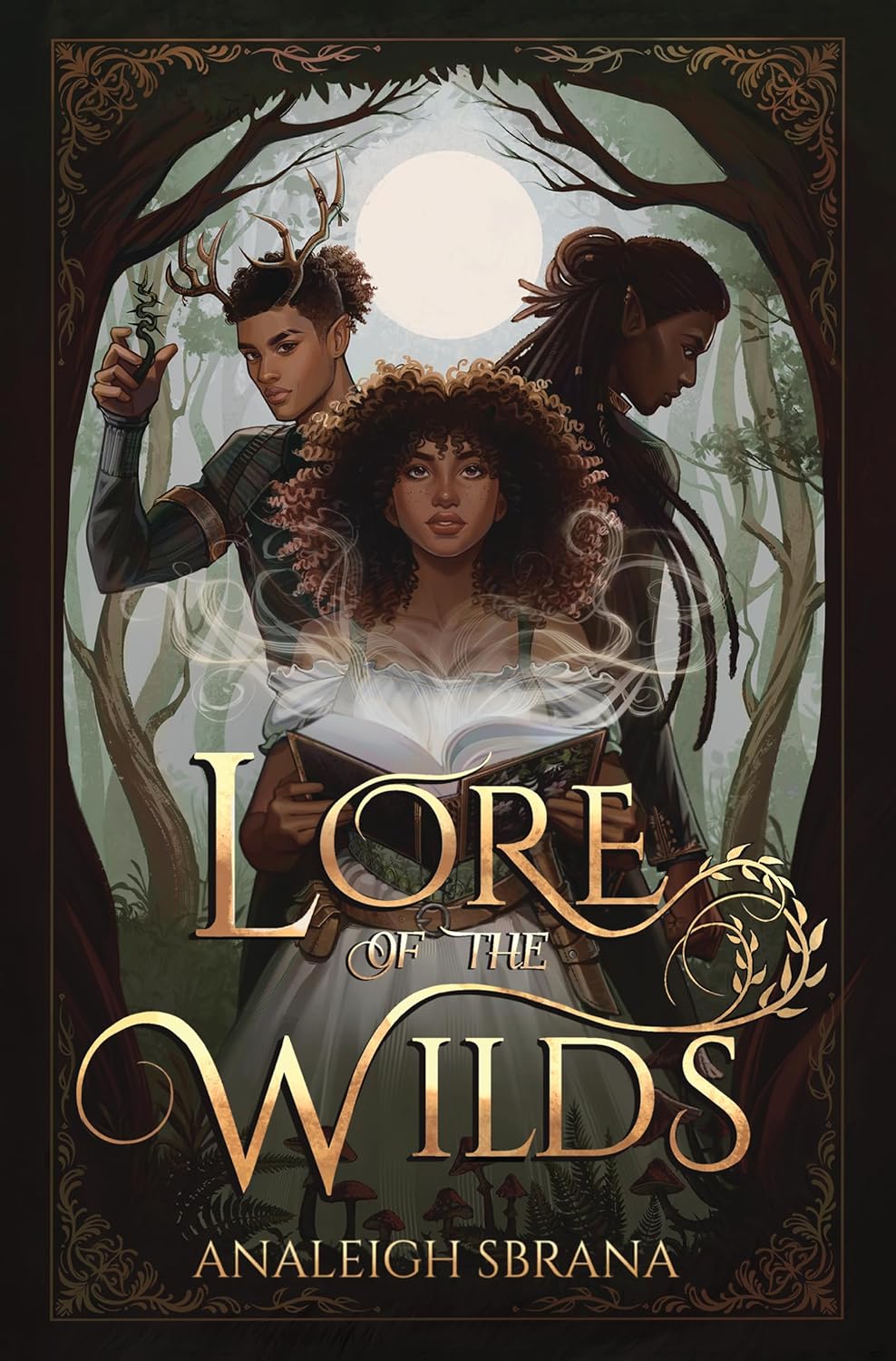
Analeigh Sbrana, Lore of the Wilds (2024, Harper Voyager)
A YA Afro-centric romantasy, casting aside the stereotype of the Eurocentric medievalistic fantasy setting. The magic system and the world-building are well-done. The novel uses the typical YA romance trope of a young woman torn between two hot young men–in this iteration of the trope, brave human woman venturing into the territory of scary but buff fae men–plus a nice male best friend. There are hints of steamy sex. Unfortunately, it crosses a line into my personal hard NO: it has a big, bad cliffhanger ending. A little cliffhanger? Okay. . . I mean, it’s part of a series. But a cliff with a drop-off this steep? As a reader, I feel snookered. I bought a novel; turns out I only received half a novel. I can only think other readers must love this stuff, because it seems like a big publishing trend. If hard cliffhanger endings don’t bother you, you might like this novel. I won’t go on with the series.
Another example of fae fiction that is not only non-Eurocentric, it’s non-heteronormative. It also straddles the line between epic fantasy and romantasy. It’s a good, exciting read about a brutal war pitting elves against fae, so it doesn’t serve up the usual humans vs. fae trope that rules the subgenre. There’s a lot to like here: sisterhood, friendship, power, loyalty, a main character anything but a damsel in distress, love, hate, magical creatures, magical battle methods. It’s the first book in a series, but instead of a cliffhanger ending, it wraps up nicely, and then there’s an epilogue with a bridge to the next book. In this reader’s opinion, that’s a good strategy for the first book in a series.
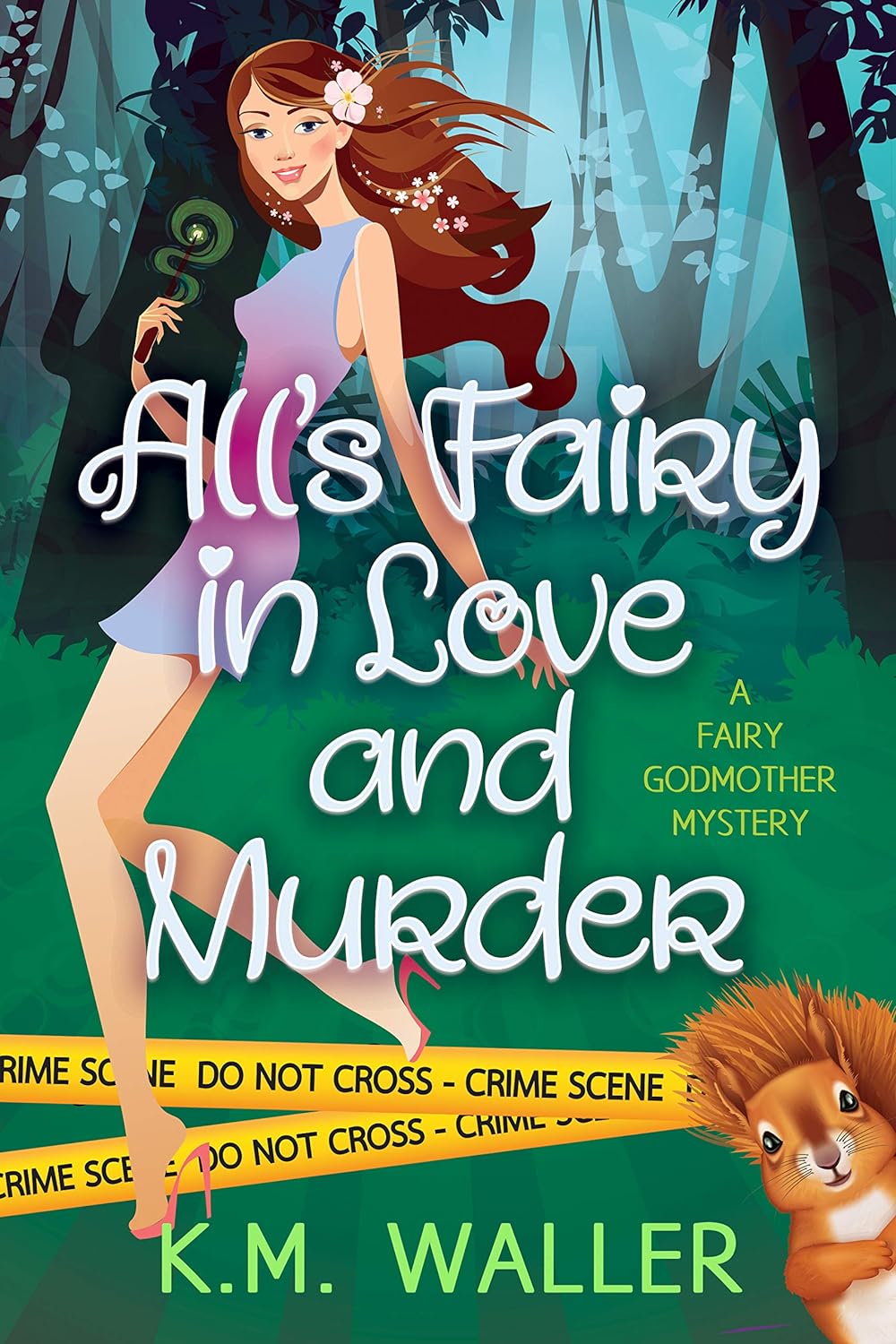
K. M. Waller, All’s Fairy in Love and Murder (2019, self-published)
As you move through this post, you may be wondering, WHERE ARE THE CUTE FAIRIES? WHERE ARE THE FUN FAIRIES? Right here! Waller’s cozy fairy mystery is a lot of fun. The main character is a fairy princess who aspires to be a fairy godmother. She gets an assignment to solve a mystery for a human. A grouchy human with a first-responder background and responsibility for a cute niece (many romance tropes there). Shenanigans and warm cozy animal vibes ensue. I love reading a good indie author, too, especially one who has produced a well-edited book (especially since I’m an indie author myself).
The fairyometer says:
SERMONETTE DU JOUR, so feel free to skip it: Well-edited books are hard to come by. I just read one of the Shardlake mystery novels so shockingly, poorly edited (published by a major imprint, too) that I wanted to throw it across the room. Luckily, since it resided on my iPad, I resisted the impulse. As a former editor, I know editing mistakes happen. It’s not IF. . .it’s WHEN. I may have made some in this very post (*shudders a little*). But when a major publisher does this, I have to wonder how fast the book was rushed into print, and why so little oversight. To be fair, I THINK (although I do not know) that this particular book was published before everything went to e-books, and I THINK this book may have been digitized without much oversight. Still shameful, but more understandable.
And for the literary-minded, three towering fae classics
(probably more in other cultures but alas, I only read English):
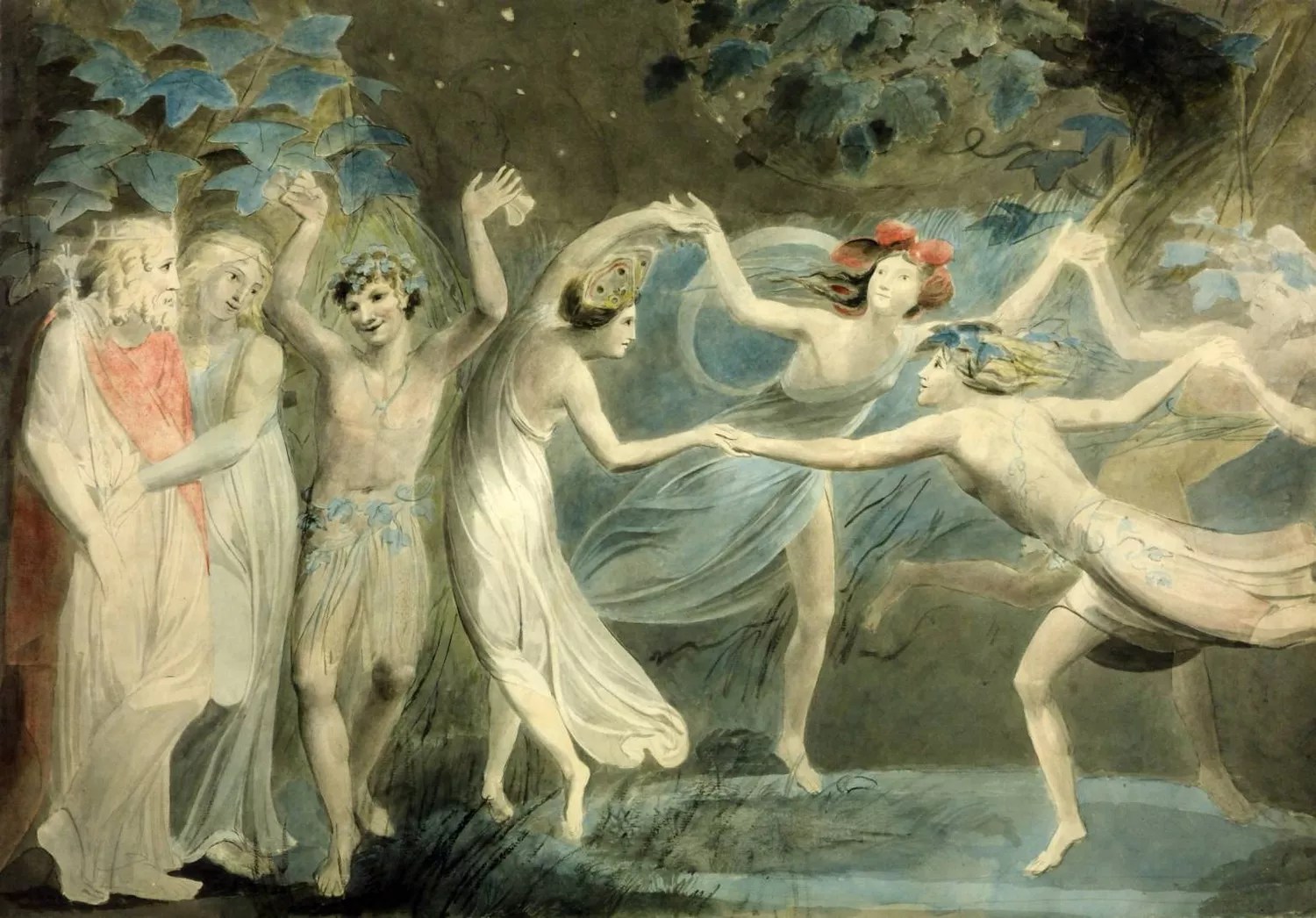
William Shakespeare, A Midsummer Night’s Dream
Source: William Blake, Oberon, Tate Britain, Wikmedia Commons, in the public domain.
Well. . .some of the fairies are cute. Peaseblossom. Mustardseed. But Titania and Oberon? definitely scary fae. “Ill-met by moonlight, fair Titania.” Brrrrr. I think the actors who play them should have big, sharp, maybe steel-tipped teeth.
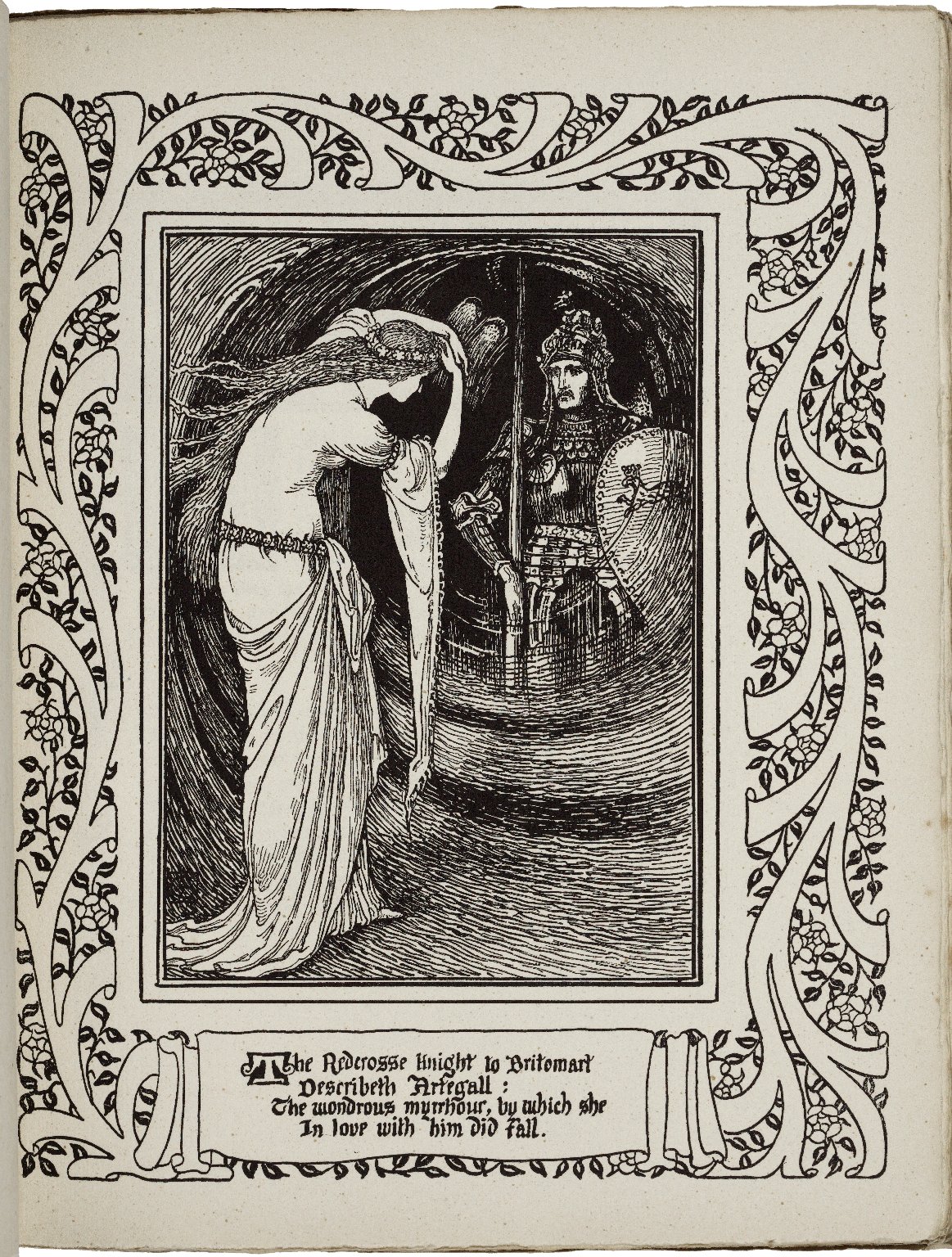
Edmund Spenser, The Faerie Queene
Walter Crane, Britomart viewing Artegal, illustration in an 1895–1897 edition.
Warning to would-be readers: don’t try this at home. Get a little help with it, all’s I’m saying, or you may flounder. In this magnificent Renaissance epic, the human and the fae are so entwined you often can’t tell the difference-“Arthur before he is king” is definitely human, the Faerie Queene is fae. . .or Queen Elizabeth, or the personification of England itself, or. . . But, on balance, I’d call this one for. . .
Sir Orfeo, by . . .nobody really knows
If you don’t read Middle English, Tolkien’s translation is nice. It appears to be hard to find right now. Amazon lists an expensive hardback and claims the paperback is no longer available, but you should be able to find it used. Tolkien published it with two other translations, of the Middle English poems Sir Gawain and the Green Knight and Pearl. In this medieval version of the Greek Orpheus and Eurydice myth, the fae in this amazing poetic narrative are absolutely
Disclaimer: Those fairy pix at the top of this post are AI generated. I can admit it. I WOULD say don’t be fooled, look at the fingers!!!! But who knows how many fingers the fae actually have? The fairyometer, though–all mine. Uh. . .with a little help (ok, a lot of help) from Canva.
LOOKING BACK AT THIS POST, I’d say the consensus in fae lit is “scary fae”–at least in books meant for adult/young adult readers. Happy Midsummer Eve!
Recently, I’ve posted reviews of the six finalists for the Nebula Award for best SF or fantasy novel. The Nebula is one of the Big Three speculative fiction awards. They are, in order of upcoming winner announcements:
The Nebula Awards–awards presentation to be made on June 8, 2024 at the annual conference of the SFWA. You can watch it online.
The Locus Awards–these awards for the best SF, fantasy, and horror of the year are voted on by subscribers to Locus magazine, one of the most notable publications for reviews and news of speculative fiction. Non-subscribers can also vote for the Locus awards, but subscribers’ votes count more. The 2024 Locus awards will be made on June 22, 2024 at its annual Locus Awards Weekend (in-person).
I reviewed the finalists for best SF or fantasy novel written in the preceding year (2023). As I mentioned in my previous post, the awards are all based on voting by the membership of the SFWA (Science Fiction and Fantasy Writers Association). See the full list of finalists on the Nebula site, and all my reviews for short-listed novels on this site. Other categories include: novella, novelette, short story, the Andre Norton award for middle grade and young adult fiction, game writing, the Ray Bradbury award for dramatic presentations. Note also the Nebula people provide a great reading list for recently-published SF and fantasy, which they update regularly. I see I’ve reviewed at least one of the novels on that list already (Leif Enger’s I Cheerfully Refuse)–you can see it on this blog.
Locus Awards categories
Here is the list of the Locus Awards finalists for 2024. Categories are broader than the Nebula list, in keeping with the Locus mission of serving as “the preeminent trade magazine for the SF/F publishing field,” and include horror as well as SF and fantasy. Categories include best SF novel, fantasy novel, horror novel, young adult novel, first novel, novella, novelette, short story, anthology, collection, magazine, publisher, editor, artist, nonfiction, illustrated/art book. This year’s Locus nominees overlap a quite a bit with the Nebula finalists. Looking only at the novels categories, I see all six of the Nebula finalists I reviewed on this blog are also Locus nominees: Martha Wells, Witch King and S. L. Huang, The Water Bandits (in fantasy). Ann Leckie, Translation State and Annalee Newitz, The Terraformers (in SF). Vajra Chandrasekera, The Saint of Bright Doors and Wole Talabi, Shigidi and the Brass Head of Obalufon (in First Novel–wow, think of that–the first novel for these two, and they are both beyond excellent). This makes me itch to read all of the finalists before June 22, but that’s too big a list–even with just the novels, even with me the fast reader–to think of doing any such insane thing. I’ll enjoy reading through the list, though. I think I’ll broaden my horizons, browsing through the Locus finalists. Look at this one, nominated for best illustrated/art book. Iain Banks fans (me! me!), rejoice!
Here is the list of the Hugo Awards finalists for 2024. Categories include: best novel, novella, novelette, short story, series, graphic story/comic, “related work” (including those Iain Banks Culture drawings), dramatic presentation–long form, dramatic presentation–short form, game/interactive work, editor–long form, editor–short form, professional artist, semiprozine, fanzine, fancast, fan writer, fan artist. In addition, the Awards include the Lodestar Award for best YA book, and the Astounding Award (sponsored by Dell Magazine) for best new writer. Three of the books I reviewed on my quest to read all the Nebula finalists for best novel are also here on the Hugo’s list of best novel finalists: Vajra Chandrasekera, The Saint of Bright Doors, Ann Leckie (also a finalist for best series–Imperial Radsch), Translation State, and Martha Wells, Witch King. I intend to read the other three finalists and report back by August 11 in this very space.








 Fantastes
You must be logged in to post a comment.