The judges for the 2024 Arthur C. Clarke Award have made their decision:
Martin MacInnes, IN ASCENSION
What a great choice! One of the judges commented that this year’s choice was in the spirit of Clarke’s best fiction, and I agree. Find my review here.
It’s a wonderful novel, very deep, exceptionally well-written. I blitzed through it when I read it last month–just couldn’t put it down, in that best of all reading highs. I think it will really reward a careful re-reading, so I plan to do that.
First, though, I’m speeding ahead to consider the short-listed novels for the 2024 Hugo Awards. They will be announced on August 11. Luckily for me, I’ve already read them by now, so I’ll have plenty of time to think about which ones I liked best, and why.
The short-listed novels are:
The Adventures of Amina al-Sirafi by Shannon Chakraborty (Harper Voyager, Harper Voyager UK)
The Saint of Bright Doors by Vajra Chandrasekera (Tordotcom)
Some Desperate Glory by Emily Tesh (Tordotcom, Orbit UK)
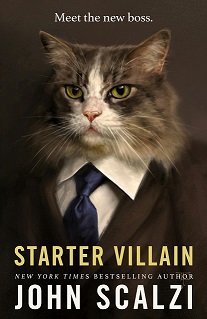
Starter Villain by John Scalzi (Tor, Tor UK)
Translation State by Ann Leckie (Orbit US, Orbit UK)
Witch King by Martha Wells (Tordotcom)
If you’ve been following my blog posts, you’ll notice some of these novels were also short-listed for other awards, including two winners, The Saint of Bright Doors (Nebula, Locus) and Witch King (Locus).
Here’s my own quick take. If you’ve read these books, you may have a very different opinion.
If any of these three were to win the award, I’d feel perfectly happy and satisfied: Chain-Gang All-Stars, In Ascension, The Mountain in the Sea. If I were one of the judges, I’d find it really difficult to pick one among those three. I might be especially partial to Chain-Gang All-Stars, because the dystopian society it describes is based on a very real U.S. problem, and I’m a citizen of the U.S. Both In Ascension and The Mountain in the Sea have backgrounds in the deep ocean, and both address towering concerns for life on the planet. What is communication? What constitutes a person? Is “a person” the same thing as “a human being”? What is an “alien”? Macinnes’s novel seems more personal to me, building a character from childhood into maturity, and it takes a more lyrical tone. Naylor’s novel tackles a number of important issues head-on, yet the characters are compelling as well. The octopus characters are wonderfully developed, and the character named Evrim is hugely affecting.
I also Iiked Emily Tesh’s novel, Some Desperate Glory, and I don’t usually like novels with tricky, tricky little plots. (The gush of such novels throughout the publishing world suggests I’m in the minority there, what a curmudgeon.). But Tesh’s novel is no fool-the-reader cheap trick. She makes a serious point in an ingenious way.
I was hugely intrigued by Isabel Waidner’s Cory Fah Does Social Media. It is innovative, crazy, and published by my favorite home-town press, Graywolf Press here in Minneapolis. It’s a real literary tour-de-force. I’m thinking I’m probably too old to appreciate it fully–it seems written for an emerging generation of readers, and more power to them.
Unfortunately, Lavanya Laksminarayan’s The Ten Percent Thief left me cold. It seems all concept. I know some SF readers like that, but for me, a successful novel has to have more than that: some combination of great characters, voice, maybe a really great plot although not always, absolutely amazing world-building, and above all–because any good novel has to have this–great writing.
So now we’ll see what the judges have to say tomorrow!
In earlier posts, I’ve described my quest to read all the short-listed novels for the major speculative fiction awards: the Nebula, the Locus, the Arthur C. Clarke, and the Hugo. I only decided to take on this arduous task in May, though, which didn’t give me enough time to read the entire lengthy roster of Locus nominees before the award was announced. I did read all the Nebula nominees, and now I’ve read all the novels nominated for the Arthur C. Clarke Award, to be announced in a few weeks on July 24th. Here are the novels short-listed for the 2024 Arthur C. Clarke Awards, which honor the year’s best science fiction published in the U.K. On the web site, you’ll find other information about this year’s awards, as well as all the nominees in other categories.
Now I’ve read every one of the short-listed novels. Look HERE for my reviews of the first two I read, Emily Tesh’s Some Desperate Glory and Nana Kwame Adjei-Brenyah’s Chain-Gang All-Stars. Look HERE for reviews of the next two, Lavanya Lakshminarayan’s The Ten Percent Thief and Martin MacInnes’s In Ascension.
In this post, I review the final two candidates:
Ray Nayler, The Mountain in the Sea (MCD/Farrar, Straus and Giroux, 2022)
Isabel Waidner, Corey Fah Does Social Mobility (Graywolf Press, 2024)
What a great read, a real novel for our times! And what a dilemma for the award-givers: two amazing novels with ocean and marine biology underpinnings. But just as Martin McInnes’s In Ascension wasn’t only about that, so this novel by Ray Nayler is about much more than frightening creatures of the deep: the nature of intelligence, the nature of communication, how to define “alien.” How to define “human.” It’s an impressive and important book. Among other accolades, it has also already won the Locus Award and has already been short-listed for the Nebula–except for 2023. It’s kind of a mystery to me why a book published in 2022 should be considered for “the best science fiction novel first published in the United Kingdom during the previous year”–unless, of course, the novel was published later in the U.K. than in the U.S.
Nayler works for a scientific institute at George Washington University. Previously, he joined the Peace Corps, did a stint at the State Department, and worked for NOAA. He clearly knows what he is talking about. I loved this book, absorbing and powerful–a warning about climate collapse, all-powerful soulless corporations, Machiavellian politics, the dangers of AI, and especially the qualities that make us human. And the amazing intelligence rivaling ours on this planet: the octopus.
What a contrast! Waidner’s novel–if the book really is a novel–is worlds removed from Nayler’s in just about every way. Full disclosure: I’m probably not the demographic for this book. It’s very intriguing, though. I spent the first pages feeling annoyed that it wasn’t some kind of huge novel like Nayler’s that I could dive into and stay fully immersed there (sorry for all the marine metaphors!) without coming up for air. Instead, I had to read Waidner’s book in painstaking short gasps. That, it turns out, is a very unfair way to think of the book. It’s a different animal, and it demands a different reading.
Well, then. What is this book? That’s what occupied me for the next chapter or two. Is it an example of the New Weird? Is it Bizarro? Is it slipstream? Graywolf Press is known for publishing innovative literature, and Weidner’s book is nothing if not innovative. It is arch, it is political, it is extremely meta. After all, it’s about a working-class queer writer who has won a major literary award that turns out to be more of a menace than an honor. In an interview with PEN America, Waidner discusses their award-winning novel Sterling Karat Gold by stating, “I write as a working-class, queer novelist. . ., and my perspective shapes everything in the novel.”
In the interview, Waidner notes the blending of fantasy and reality in Sterling Karat Gold–an insight that works for Corey Fah as well. Abandoning my struggles to define what I was reading, I relaxed and went with it. Among the characters in this latest of Waidner’s highly-lauded novels, I found a giant spider that is somehow connected to Bambi, the Disney fawn who loses his mother and breaks the hearts of generations of children. I found worm holes sucking the characters into a time-travel Groundhog Day loop. I found oppressive, magically proliferating fast-food restaurants. I found an extended riff on the actual murder, in 1967, of gay working-class British playwright Joe Orton by his lover.
The main character, Corey Fah, keeps all these improbable narrative balls in the air via a first-person narration communicated to us in some sort of truncated syntax that raises even more questions about the absurd universe the reader has wandered into: is this the language of the vaguely dystopian future that Corey Fah and their lover Drew inhabit? Is it the author’s stylistic tic? What is it? What is this object I am holding and reading and turning the pages of? In the end, I found myself fascinated by the reading experience. Whatever that is. However I might define it. In the end, it seemed a lot more like some experimental poetry I’ve read than any of the novels on the Arthur C. Clarke Awards or any other short-list, but since it’s about a writer given an award that eludes them repeatedly, infuriatingly (I mean physically–it zips away from the pursuing winner), I can imagine at least some of the judges feeling nudged by an irresistible surreal voice: give the award to THIS.
You must be logged in to post a comment.