A final two Nebula Award finalists

In my quest to read all six of the novels short-listed for the 2024 Nebula Awards, I’ve made two posts so far about four of the novels. This post rounds out the six. When I began this series of posts, I have to say I scoffed. The Nebula Award winners will be unveiled on June 8th, and I only decided I’d do this thing a bit past mid-May. Was I crazy???? And now that I’ve actually done it (except for one–full disclosure, I read it earlier this year), have I ever read such an impressive collection of novels? If I have, I’ve never blitzed through them this fast. But they were so absorbing it was hard to stop. Okay, I’m a fast reader. But I’m not a fast reader of boring stuff. So there’s that.

I read these novels in no particular order, by the way–just grabbed one and dug in. It also didn’t hurt–in fact helped a lot–that I’m on a month’s DYI writing retreat in Portugal, where I am perched five stories above the beautiful Largo de São Domingos in Porto. Wafting through the windows along the balmy breezes are fantastic performances by the street musicians in the square below, especially the music of the superb soprano jazz saxophonist who bills himself as Andre Luis. Was there ever a more perfect writing/reading environment? I’ll go home to the U.S. soon and find out who won the Nebula this year for best novel, but I’ll leave a big part of my heart here in Porto.

Here are my final two reviews: The Terraformers, by Annalee Newitz, and The Water Bandits, by S. L. Huang.

Find out more HERE.

Annalee Newitz, The Terraformers (Tor, 2023)

How do I even begin? And what is this novel, anyway? Is it green lit/eco lit? Yes. Is it something called “noblebright“? Yes. Not dystopian. Not utopian, either. Is it structurally set up to fail as a novel? In my opinion, yes. Does it fail? No, no, a thousand times no. It is superb. Please read this book.

The novel covers a thousand years–enough, according to the author, to encompass a full terraforming cycle of the potentially Earth-like exoplanet Sask-E. That means, however, that you don’t get to follow one protagonist, or even several co-protagonists, over the course of the novel. So what happens when you switch main characters like this? In some cases, your novel functions like a series of novellas bound together into a single book. In some cases, you end up with a mess. Some writers succeed at doing this. In the SF realm, I’m thinking of Walter Miller’s A Canticle for Leibowitz, or Isaac Asimov’s The Gods Themselves (which I found very unsatisfying–others obviously disagree). Another example might be David Mitchell’s Cloud Atlas, which I found very annoying, especially because I think he’s a great writer (again, many, many others disagree). Against all odds–or anyway, against my own reading history and prejudices, Newitz’s novel brilliantly succeeds, perhaps because one of the main “characters” is Sask-E itself, or–maybe the whole Sask-E terraforming enterprise, based on the philosophy of a society of rangers whose job it is to protect the planet. The author’s interview for The Stranger explains their thinking.

The rangers’ communitarian and ecological principles run up against stiff opposition by commercial enterprises with a much different vision of Sask-E’s future. These interests have the financial and political clout to prevail. If I were to tell you my favorite kind of novel is one with a strong message overwhelming the characters, I’d be lying. I find that kind of novel trying. I’m thinking of the (very much lauded) novel The Tortilla Curtain, by T. C. Boyle (1996). At the end, I felt the characters were cardboard cutouts standing in for ideas, and I also felt resentful that I hadn’t spent the time instead reading a good nonfiction book about the problems of immigrants. A few chapters into Newitz’s book, I wondered if I were in for another experience like that. I wasn’t. This novel is thrilling–as a novel of ideas, but a real novel, not just a long, disguised essay.

The first chapter or two almost made me think we were about to embark on a fun adventure story, maybe of the cowboys-in-space variety, the good-guy farmers vs. the evil ranchers. After all, the novel begins with a ranger named Destry, riding their faithful moose Whistle. But pretty soon the reader is in the deep weeds of how a fair regulatory climate and carefully-maintained ecological balance are essential to justice and a decent life. If this description makes the novel seem drab, don’t be fooled. It’s anything but.

Far into the novel, I had to laugh at the minor character Cimell, a failed game designer who is very earnest but whose games are essentially unplayable. Cimell tries to explain to the main characters in this part of the book (a smart, savvy cat–is there any other kind?–and a sentient train) (Yes, train. A train is one of the main characters. A gamer-train.):

Maybe. . .battles are more exciting. They make for better superhero stories. . .But the revolution is actually happening in the boring details, like how you manage housing and water, or who is allowed to speak.

Please tell me the author hasn’t stuck Cimell into the novel to speak wryly for theirself. This novel is anything but boring. This game–this novel–is anything but unplayable. (Because what is a novel, anyway, but an elaborate game played with words?)

The Terraformers is an extremely important novel, and I am so glad it’s a Nebula finalist. The more of us who know about this book, the better. The more of us who read this book, the better. The planet needs us to. In addition, it’s a great reading experience. Did I mention sentient worms? And the much-maligned naked mole-rats finally get their due.

Find out more HERE.

S. L. Huang, The Water Outlaws (Tor, 2023)

What a fun, exciting novel this one is! I enjoyed it immensely. It’s a re-imagining of Ming-dynasty writer Shi Nai’an’s Water Margin, considered one of China’s “Four Great Classical Novels” and a precursor to later wuxia fiction: stories (movies, games, etc.) heavily involved with martial arts, magic, and underdog characters fighting for justice. This re-imagining is set in the Song dynasty (960-1279 CE), although it doesn’t adhere slavishly to historical facts. Huang’s acknowledgments page at the end of the novel gives a good overview of what parts are historical and what parts are made up.

I don’t know enough about wuxia, just that one of my favorite movies ever is Crouching Tiger, Hidden Dragon (2000, directed by Ang Lee). For the hard-core wuxia fan, I’m sure Huang’s novel presents even more delights than it does for me. Even so, I found it thrilling. It’s a tale of women who are thrust to the margins of society. These outcasts band together in a sisterhood considered a pack of bandits by the authorities but freedom-fighters by themselves and the villagers they protect. A fascinating subplot concerns a woman forced to participate in a sort of proto-Manhattan Project to create a weapon of mass destruction–some of it based on wuxia tropes about magic and the magical arts, but a lot of it on actual Chinese experimentation with gunpowder. This part of the plot reminds me somewhat of Joe Abercrombie’s The Blade Itself. The characters are compelling, and the moral dilemmas they face give them depth.

A serious message about the nature of justice and the dangers of messing with dark destructive forces undergirds this exciting tale. I had a blast ending my Nebula Finalists reading binge with this one.

COMING UP NEXT:

I have some thoughts about who I’d vote to win.
Two More Nebula Finalists

Continuing my previous post on the short-listed novels for the 2024 Nebula award, here are two more reviews of the finalists, Ann Leckie’s Translation State and Vajra Chandrasekera’s The Saint of Bright Doors:

Find out more HERE.

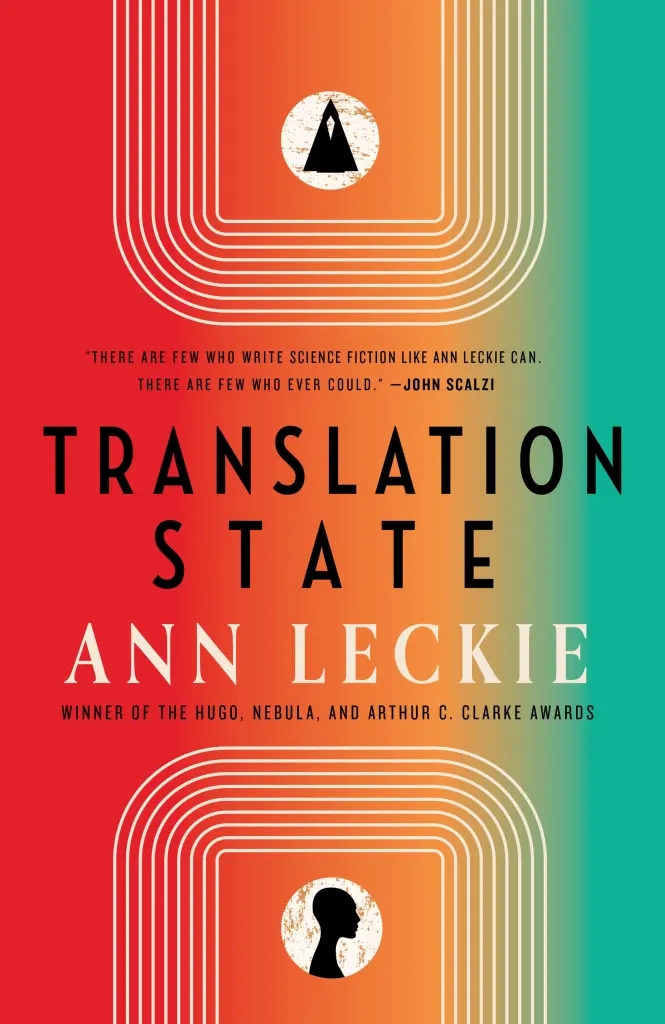
Ann Leckie, Translation State (Orbit, 2023)

A compelling read from Leckie, who returns to a familiar setting, the interstellar empire of the Radch. Some time ago, I read the first of her Imperial Radch trilogy, Ancillary Justice, and reviewed it for this blog. At the time, I found the book hard to penetrate, but by the end of the novel, pretty fascinating. I was unsure whether I’d continue the series, and in fact didn’t. Now, with Translation State, I’ve returned to Leckie’s complex world of intrigue and danger and exotic species. The characters, the plot, the ingenious, very organic and natural-seeming use of pronouns to delineate a gender-fluid universe of peoples and cultures, are all outstanding. This novel is billed as a stand-alone novel in the Radch universe, but I agree with many reviewers who point out that the more a reader knows about that universe, the better the reading experience with this most recent novel.

Throughout Translation State, I was in awe of Leckie’s world-building. The Radch are not the main focus of this book, although their influence pervades the complicated politics that drive the plot. This novel focuses on the mysterious Presger and the intermediate forms some of them take to bridge from their alien consciousness to the humans with whom they exist in an uneasy alliance. A too-fragile treaty may be the only barrier standing between humanity and annihilation, so the stakes are high. I was reminded of Iain Banks’s great Culture novels.

To inhabit the mind of a species this removed from the human is quite a feat, and Leckie pulls it off. I’m thinking of other novels that accomplish something similar, such as William Golding’s The Inheritors, or Isaac Asimov’s The Gods Themselves (which itself won the Nebula in 1972). I guess I could mention China Miéville’s great Embassytown, too, but that novel is in a class by itself.

Is it mean-spirited of me to say that in the end, I was a bit let down by Leckie’s tale of found family? On the other hand, while it may be fascinating to imagine the politics and treaties that stitch the universe together, in the end, at least for the novel (for readers? for human beings?), it all comes down to the personal. Only connect. Translation State is actually a very sweet-natured novel, and I enjoyed it immensely. And I think now I’ll return to the Ancillary books and start reading them in order.

Find out more HERE.

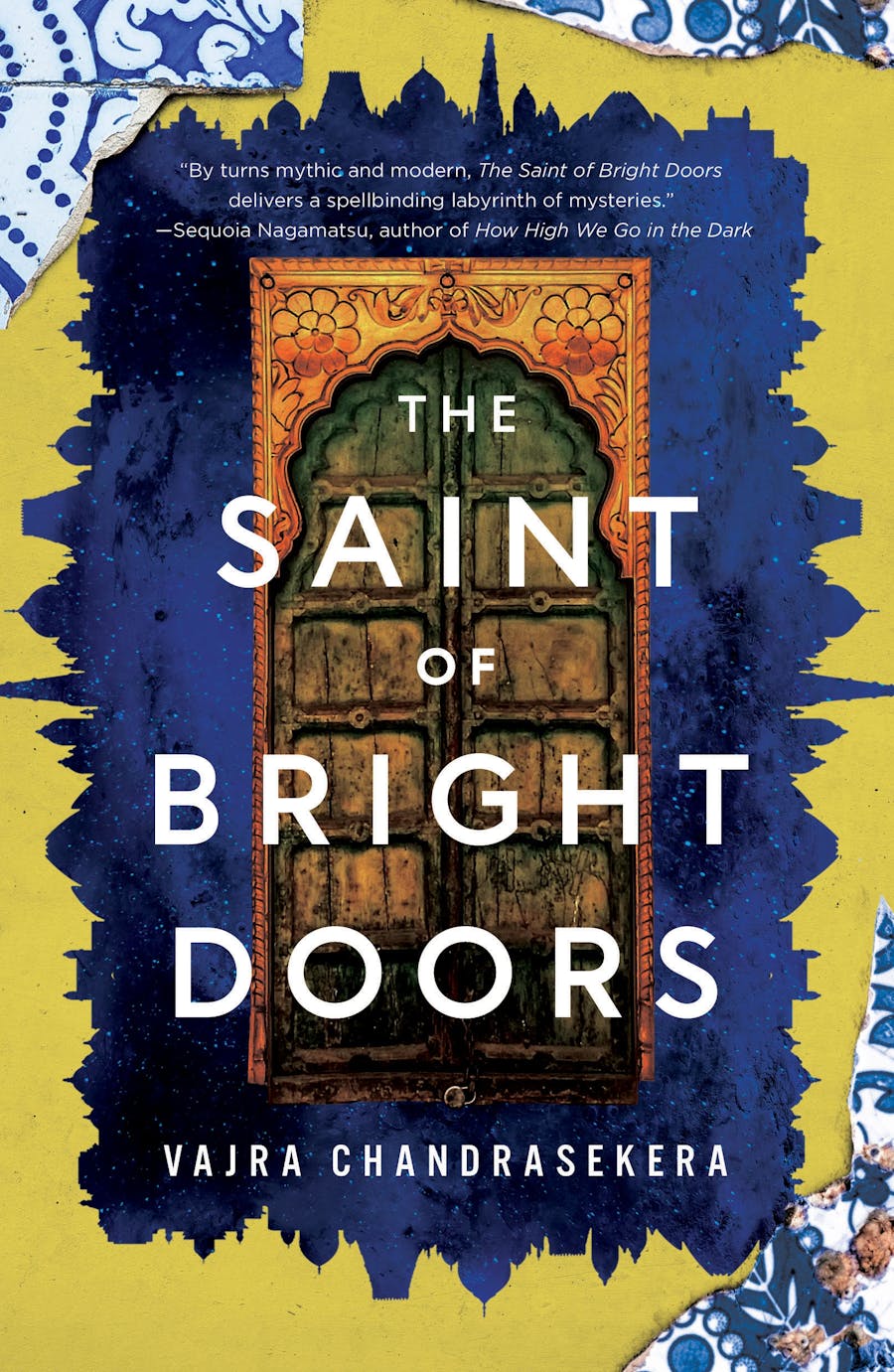
Vajra Chandrasekera, The Saint of Bright Doors (Tordotcom, 2023)

This novel, by Sri Lankan writer Chandrasekera, is simply astounding, a sweeping tale of power and the structures that drive power, loosely based on a legend about Siddhartha. The novel has received wide acclaim, nominated for the Locus award and short-listed for the Lambda award, among other accolades. Chandrasekera imagines a hybrid world of the fantastic (gods and anti-gods and spirits and demons and messiahs abound, as well as the mysterious “bright doors” of the title) and the realistic–shoddy apartment blocks in a steamy South Asian city, civil unrest, unfathomable and obscure caste distinctions, corrupt politics, and more–a heady mix. This is a characteristic Chandrasekera’s novel shares, at least a bit, with his fellow nominee Talabi’s Shigidi and the Brass Head of Obalufon (reviewed in my preceding post), except that in Talabi’s novel, the spirit world and the regular world, while they may intersect, are clearly separate–that’s even a huge plot point in Talabi’s novel. In Chandrasekera’s novel, the spirit world’s and the ordinary world’s objects and personae and passions and concerns are all jammed and mashed together in a dizzying stew that defies any attempt (reader’s, chararacters’) to pry them apart.

This novel is infused with the historical and political concerns of Sri Lanka, matters pretty completely opaque to me. I refer readers of this blog to this great review and analysis published recently on the Strange Horizons magazine site. The reviewer, New Zealand writer Tehnuka, has a far greater understanding of these issues than I ever will. That said, even without the deep background of readers like her, I can tell you I found Chandrasekera’s novel as compelling a read as anything I’ve come across lately.

Its political concerns are not just local and regional, either. Many readers, from many parts of the world, will resonate with this aspect of the novel. Great quotation, too frighteningly true in too many parts of the world, not excepting my own:

the law might do anything, at any time, to anyone, and justify itself any way it likes–it is feral, like the invisible laws and powers of the world of which it is a pale imitation.

Three recent literary dystopian novels

A dystopian novel gives a cautionary and prophetic glimpse into the disastrous place the ordinary world is in danger of becoming. Often these literary glimpses are grim, because the circumstances these novels critique are grim. Some dystopian novels might be classified as “genre fiction” (example: The Hunger Games, by Suzanne Collins, clearly mines a number of popular YA tropes), whereas others are more “literary” (example: Margaret Atwood’s The Handmaid’s Tale relies on post-modern literary devices such as fractured narrative).

But what does the distinction between “genre” and “literary” even mean? Some genre fiction is just for fun, there mostly to scratch the itch of favorite tropes and storylines. Some literary fiction is so much about language and the way it works that I wonder if I’m really reading an extended poem, a piece of writing not essentially about “story” at all, even if it has some narrative bones. Plenty of novels straddle the divide, or fall to one side or the other but just barely. Booksellers might market a novel as one or the other without much reason beyond, “Okay, this will sell, if we present it THIS way.”

With that as a caveat, I’m on fire to talk about three dystopian novels I have read recently, all of them–or so it seems to me–in the “literary” camp. Whatever that means. They are:

  • Paul Lynch’s 2023 novel Prophet Song.
  • Leif Enger’s 2024 novel I Cheerfully Refuse.
  • Daniel Findlay’s 2019 novel Year of the Orphan
Find it at Amazon.

Paul Lynch, Prophet Song, Atlantic Monthly Press, 2023

This novel, which won the prestigious Booker Prize for 2023, is simply astounding. Set in near-future Dublin, Prophet Song seems at first almost a realistic novel about a family with typical ups and downs, typical conflicts. But the reader realizes almost from the outset that the family’s normal life has begun a chilling slide into the abnormal. Society is breaking down around them, at first subtly and slowly, then with increasingly cruel speed.

This is the kind of novel that forces you to recognize how easy it would be for your own supposedly normal society to take the same frightening plunge into autocracy and violence. Lynch’s novel could have been set in any number of hot spots around the world threatened by encroaching autocracy, including (as a citizen, it pains me to say) the U.S.A. But it’s not. It is set in Dublin, one of the most ostensibly sane and civilized places on the planet. That makes the devolution into chaos and violence all the more horrific. Lynch handles the writing, the characters, the situations masterfully, resulting in a chillingly realistic portrait of a society–and individual characters–torn apart.

Find it at Amazon.

Leif Enger, I Cheerfully Refuse, Grove Press, 2024

Mr. Enger, the author of Peace Like a River, a wonderful novel from 2007, has written another masterpiece. I loved Peace Like a River so much that at first I couldn’t relax into the slow rhythms of I Cheerfully Refuse, a near-future dystopian novel set in northern Minnesota on the shores of Lake Superior.

In I Cheerfully Refuse, the sunny and optimistic Lark and the bear-like musician narrator, Rainy, enjoy an idyllic relationship against the unlikely backdrop of a drastic breakdown of civil order. Their love stands in optimistic counterpoint to this broken world. As tragedy intrudes, Rainy undertakes a meandering journey fraught with danger and desperate hope, and the novel picks up the pace.

In Enger’s vision of societal breakdown, oligarchs and plutocrats have seized control of the U.S., leaving ordinary folk at the mercy of either extreme lawlessness or the punitive measures of a remorseless and cruel bureaucracy. In this dystopian vision of the U.S., any one person’s fate depends on whether the person is unlucky enough to draw the attention of the authorities or has the skills–and the luck–to fly under the radar. On the face of it, this novel seems just as grim as Lynch’s Prophet Song, and in its depiction of a destroyed society, it is. But Enger’s novel is strangely hopeful, even uplifting–and not in a saccharine or glib way, either. What a feat!

Peace Like a River had more than a touch of magical realism about it, and so does this novel. I loved this book. At least some of my emotional attachment has to be due to my love of the landscape Enger describes. I spend half my time in Minnesota, although in the Twin Cities area, not the Arrowhead, that point of land north of Duluth sticking out into the dangerous waters of Lake Superior. But every time I drive north up Highway 61, my heart lifts. Once you get to the end of that highway, you’re in Canada–and that proximity figures prominently in Enger’s novel.

Find it on Amazon.

Daniel Findlay, Year of the Orphan, Arcade, 2019

This novel isn’t as recent as the other two. Also, instead of depicting a near-future world, it shows us the horrific aftermath of nuclear war many centuries into humanity’s desperate attempt to scratch out an existence in a hostile environment. Findlay’s novel, set in a destroyed Australia, focuses on a young girl who pieces together exactly how her world turned so toxic and destructive.

I had a lot of trouble reading this book. I’d read a little and put it down, sometimes for weeks. I always came back to it, though, and recently I finished it at last. (I’m a fast reader–not my usual experience.) So yes, the pace is slow. But this novel really rewards the reader’s persistence. Like Lynch’s and Enger’s novels, Year of the Orphan offers serious insights into the human condition and the forces that drive human beings to turn into their own worst enemies.

I did wonder at myself and my lack of patience with this novel. The structure is complex, moving back and forth in time, often abruptly, and the language is difficult. That should not have stopped me. I’m used to reading books like this.

Here’s what I think went wrong for me as a reader–at least at first. When we readers choose a book to read, we’re often driven by a certain kind of impulse: “I want something serious to read.” “I want something fun to read.” “I want escape.” “I want a fictional way to confront the problems of my world.” “I want brilliant writing.” “I want to be swept along by a twisty plot.” If we open a book thinking we’re getting escape, and we get something else, we may be disappointed or at least unsettled. I think that might have been what happened to me originally as I opened Findlay’s novel and began to read.

Here’s what the promotional “blurb” on Amazon has to say: “The Road meets Mad Max” . . . “badass young female protagonist”. . . “propulsive pacing”. . .”a thriller of the future.” I’m thinking here, ESCAPE! GENRE FICTION! I love literary fiction, but I love a fast-paced fun read, too (eh. . .the two aren’t mutually exclusive. . .just saying). I felt I was promised genre fiction, and I got literary. And that threw me. Perhaps the reference to Cormac McCarthy’s The Road should have tipped me off, but no, I was focused on Mad Max. The promotional blurb’s comparison of Findlay’s book with Russell Hoban’s Riddley Walker should have absolutely tipped me off, but my reptile brain was chanting, Mad Max! Propulsive pace! Thriller! and I didn’t pay enough attention. I think marketing did Findlay’s very fine book a disservice. It’s just the truth, though, that a publisher’s attempts to sell a lot of books can drive these marketing decisions, and maybe we wouldn’t have had the novel at all if not for that.

So what did I actually find as I began to read? A slow pace. A slow build. That’s fine in a more literary work, because plot is not the be-all and the end-all there. Good writing is. Plot may be important in a literary novel, but without good writing, it’s nowhere. And this book is written very well.

Another element that threw me off is absolutely not the writer’s fault. I’m a U.S. reader, and I know next to nothing about nuclear testing in 1950s Australia. Findlay’s novel is about a girl of the future uncovering a mystery from the past in small, telling clues. But the clues–while they probably made a lot of Australian readers nod in recognition, meant nothing to me. By the end of the novel, I got it. But for me, getting it was a long time coming.

Still another element is the jumping back and forth in time. In genre fiction, too much of that loses the reader. In literary fiction, a reader who wants that experience will go with it. Atwood’s The Handmaid’s Tale in effect hands the reader a bunch of unedited tape-recorded reminiscences and tells the reader to put them together herself. I did, and I was glad I did. In the process of reading Mr. Findlay’s novel, I had to revise my thinking and expectations, and then I could do it. Mr. Findlay doesn’t give many easy-to-understand cues, either, to alert us to the leaps.

Here’s the final element that slowed me down: the language. As I say, this novel is very well-written. But its style cries out for patience. Gregory Orr’s great little book, A Primer for Poets & Readers (W. W. Norton, 2018), makes an important point about writers and how they write. He’s speaking specifically of poets, but he could be speaking of any kind of writer. He says that in every poet (writer), there’s a clash between order and disorder. Each writer has to find his or her threshold between the two–not too much order, or the piece of writing will seem stifled. Not too much disorder, or the piece of writing will seem chaotic. This moment of balance is very personal to each writer. BUT ALSO each reader has such a threshold. My tolerance for a lot of disorder in a piece of writing, or my need for a lot of order, also needs to find its own personal balance. So if a writer’s threshold and a reader’s do not match up, the reader is likely to feel unfulfilled and frustrated. Yet a writer–at least a literary writer–has the obligation to herself/himself to write at that point of personal balance, not to cater to someone else’s perceived point of balance. A genre writer, “writing to market,” may not adhere to that. A literary artist will.

Mr. Findlay’s choice of how to handle the language in Year of the Orphan strikes me as one of those artistic decisions. He thinks about what a language of the future in Australia would have to sound like, and he creates that language. Some readers will have patience with his decision and follow him there. If the decision does not meet other readers at their threshold, though, they won’t have the patience to keep reading.

I’ve been thinking about this issue for a long time. My own training is in Renaissance English literature, and in my doctoral work, I focused most on Edmund Spenser’s Faerie Queene. Spenser, like Mr. Findlay, had to make a decision about the language appropriate to the literary world he wanted to create. In Spenser’s case, he was trying to retrieve a past that had never actually existed, so he mimicked, brilliantly, a kind of faux-Chaucerian language that, for him, reflected the bygone era he was trying to recreate. His friend the poet Sir Philip Sidney begged him not to do it, suggesting he would lose readers if he more or less created his own language. Spenser did it anyway, adhering to the integrity of his own threshold. Some readers have the patience to follow him there (me!). Many don’t, especially as the centuries have rolled by, making Spenser’s language more and more difficult for regular readers.

This happens in speculative fiction, too. (In fact, I’d argue that Spenser was writing a type of speculative fiction himself, just looking back to an imagined past instead of forward to an imagined future.) Who creates an imagined language in speculative fiction? Russell Hoban, in the brilliant post-apocalyptic novel Riddley Walker, did it. Some readers are willing to follow him there, while others won’t want to. Anthony Burgess did it, although maybe not so radically, in A Clockwork Orange. Denis Johnson did it in his post-apocalyptic novel Fiskadoro. This is what Mr. Findlay did, too, in Year of the Orphan. At first, I found myself resisting and not wanting to follow him in his own world-building via language. But in the end, re-adjusting my expectations about his novel, I did. In the acknowledgments at the end of his novel, he credits Riddley Walker for inspiring him. I can see that! I’m glad my threshold as a reader and Mr. Findlay’s threshold as a writer were able to mesh, because reading this novel was very worth my time and patience.