And don’t I feel silly! I know I said I’d turn to the Hugo Awards short-listed novels next. Meanwhile–how, I’m not sure–I completely misunderstood the Clarke Awards timeline. The decision has already been made and the winner is:
Annie Bot, Sierra Greer (Borough)

The other novels on the short list include:
- Private Rites, Julia Armfield
- The Ministry of Time, Kaliane Bradley
- Extremophile, Ian Green
- Service Model, Adrian Tchaikovsky
- Thirteen Ways to Kill Lulabelle Rock, Maud Woolf
As with all of these short-listed novels, I plan to post capsule reviews. Unlike the Nebula Award, Hugo Award, and other short lists, I’m writing these reviews after the judges have made their choice, so my posts won’t have as much of a horse-race vibe to them! All that drama about which book will be chosen–gone. But these awards lists are fantastic ways to explore some of the best recent speculative fiction, so I’ll just post my reviews and proceed as usual–and postpone the reviews of the Hugo short list.
Luckily, I had already started reading the novels on the Clarke list, so here are my first two reviews, of Private Rites, by Julia Armfield, and The Ministry of Time, by Kaliane Bradley.
Private Rites, Julia Armfield, 2024 (Macmillan/Flatiron)

Except for two aspects, this is simply a realistic novel about three squabbling sisters. They quarrel for several hundred pages, their disagreements made even worse by the terrible weather, and then they stop. However, the setting is in near-future London, where climate change has put the city mostly underwater, so the incessant rain isn’t simply a depressing backdrop to the depressing account of the sisters’ difficulties. Instead, I suppose the sisters’ difficulties and the rain become an intertwined emblem of the terrible times that have come upon the world.
There’s another aspect to the novel, too. The opening is extremely disturbing and gory, making me wonder if I were about to embark on a horror novel. Then that opening gets seemingly dropped. Now, we all know about Chekhov’s gun, don’t we? The great playwright Anton Chekhov famously said that if he puts a gun in the first act of his play, he’d better have that gun go off by the third act. So I waited patiently (and then, sorry, impatiently) through hundreds of pages of sniping and fussing and rain for the payoff promised by the gory opening. In retrospect, I can see that the seeds of the developing plot are there. But they are so muted that nothing much actually happens for a long, long time–or so it seemed to me as a reader. There’s not much rising tension, just the low-level grinding tension we may all feel when we are trapped with family members or other close acquaintances with whom we are having a long-standing, toxic set of disagreements and misunderstandings. I did admire the realistic characterizations of the sisters.
I’m thinking maybe it would have been good if at least one of the three siblings captured our sympathy, but I do appreciate how skillfully they were drawn–and I’m not a reader who has to identify with or even like any or all of the characters in a novel. Every book doesn’t have to have sympathetic characters. Some books don’t need them or would be ruined if they had them. A book like this, with a message like this, frequently does have at least one character who works as an explaining presence, though, and all of these characters seem equally, evenly confused and deluded. The message about climate change is of course sorely needed, and yes, I’m sure it will be as depressing as it seems in this novel. When the novel’s payoff finally comes, though, it is kind of too little too late for me as a reader, and–maybe I’m dense–but how and why the novel’s final events happen is as murky as the dystopian weather.
The Ministry of Time, Kaliane Bradley 2025 (Simon & Shuster)
NOTE: Corrected post, with the right link to Bradley’s novel. Apologies!
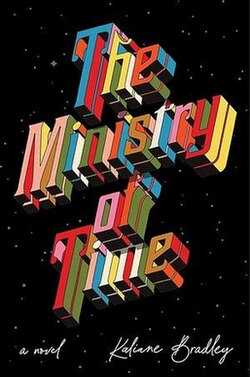
I had read Bradley’s novel at the beginning of the year, but its details had faded a bit in my memory, so I recently re-read it–not just because of this list, either. The novel is on a number of lists recommending great recent speculative fiction. It is an immensely entertaining and skillful novel, and I enjoyed it just as much the second time as I did the first. It’s a time-travel novel drawing partly on a real incident, the fate of the English ships Erebus and Terror when the 1845 Franklin expedition to the high Arctic is lost with no survivors. But only one of the time travelers comes from that past event; others come from other pasts. The seaman from the Franklin expedition disaster is the most important but also a woman from the plague-ridden 16th century, another whose husband was guillotined in the French Revolution, several war-scarred combatants from different eras, and more. There’s even a really fun, really subtle cameo almost-appearance by the World War I poet Wilfred Owen. These voyagers from other times disconcertingly pop through a time portal into a near-future London. The novel’s main character, part of a secret government team helping the disoriented time-travelers assimilate into the present, begins to question herself and her employers as the details of the project grow ever more sinister.
Bradley’s plot and narration are intricate, the characters are fascinating, and the slow burn of evolving love is compelling. Underneath it all lurks a dangerous plot to use the unmoored, traumatized time-travelers in a scheme the main character only thinks she understands. Suspense mounts: will she puzzle out what is really going on underneath all the gaslighting, will she be able to avert the looming terrible damage to people she has come to admire and even love, and will she be able to do it all in time? We readers hurtle through a dizzy and skillfully managed amalgam of thriller plot, love story, search for identity, lost history, and threat of disastrous future. The twisty plot–unlike some–really earns its stripes.
I hate feeling manipulated by a plot with unexpected zigs and zags. Not here. Bradley gives us just enough breadcrumbs to begin figuring out, with the main character, the chilling direction of the novel’s events. The main character stands in for us, the readers, as the plot’s trap snaps shut. If that were not the case, I wouldn’t have enjoyed re-reading the novel. A twisty ending that springs itself on the reader with cheap tricks will not reward re-reading. This novel works as much because of the characters and the hows and whys of the plot as for the way the plot ends.
I have been thinking of this novel as a serious contender for prizes like the Arthur C. Clarke Award. It didn’t win this one, but it would have been a worthy choice. And it is also on the Hugo Awards short list!
Next up: Extremophile, by Ian Green, and Thirteen Ways to Kill Lulabelle Rock, by Maud Woolf.
 Fantastes
You must be logged in to post a comment.