Six novels take a serious look at alien communication: Part 5, The Three-Body Problem

In this series of posts, I review six novels with alien communication as a main plot point:

  • Ursula LeGuin, The Dispossessed
cover of Cixin Liu's science fiction novel, The Three-Body Problem
Find out more HERE.

The Three-Body Problem, Cixin Liu, 2006 (English translation by Ken Liu published in 2014)

This novel by the Chinese writer Liu Cixin (using the family name first here and then the given name, as is the Chinese practice) was lauded in China, where the writer is known admiringly as “Da Liu” (Big Liu). The Three-Body Problem, the first book in the trilogy Remembrance of Earth’s Past, was translated by American speculative fiction writer Ken Liu. It went on to win the 2015 Hugo Award for Best Novel.

Liu Cixin’s life, how he came to write science fiction, what his experience as a writer in China has been like–all these are very interesting. I had trouble with the novel, though, and I should admit this up front. Possibly this is because I found the translation very flat. Translations are their own art form, and it is hard for a reader who is not a native speaker of the author’s language to know whether her reaction comes from the novel. The second problem I encountered was confusion over what was happening when and to whom, and why. I am a pretty experienced reader of convoluted fiction time lines, and I had a lot of trouble. This may be because the novel was originally serialized and then stitched together, or possibly because the writing lost my interest right away and so I had trouble paying attention.

To address that second problem first: speculative fiction readers go about their reading with more variety of motives than other types of readers (just my guess). One type of science fiction reader is all about the ideas. Another type is all about the plot. I’m all about the writing, because I’m a reader first and a science fiction reader second. I am puzzled by readers for whom the reading experience is all about the ideas. Why not read an essay about the ideas instead? Why not just look over a PowerPoint of the ideas? I know I’ve said this before in this blog, and I know many readers disagree with me.

About those ideas. As I painfully pieced them out, I found that the novel is about a survivor of the Maoist intellectual purges, an astrophysicist who is allowed to rehabilitate herself and practice her discipline in a very small, controlled way at a backwater research station. That part I really enjoyed, because I knew little about the historical background. By the way, the translator Ken Liu’s footnotes were invaluable to me as an ignorant American reader. The scientist, Ye Wenjie, makes an important discovery, which she carefully keeps to herself and only a few she trusts: her research station has received a message from an alien culture on the planet Trisolaris, orbiting in a complex pattern around the double-star Alpha Centauri a and b, and their third companion (the closest star to the sun) Proxima Centauri.

The Trisolarans have a big problem. Their planet’s erratic orbit exemplifies a dilemma in the mechanics of motion, the “three-body problem” of the novel’s title. The solution to this problem has stymied physicists for centuries, all the way back to Newton. The novel is pretty clear about this problem, which I the non-scientist reader appreciated, but I also found it useful to find out more. THIS is a good general discussion. For the Trisolarans, this means a wildly unpredictable climate. The inhabitants of Trisolaris go through stable periods, but then chaotic periods follow, during which whole civilizations rise and fall. When they make contact with Earth, they covet Earth’s stable orbit and hence stable climate, eventually resolving to colonize Earth and migrate their whole civilization to our planet. This is all really fascinating, especially when the Trisolarans realize the trip to Earth will take them 450 years, even with their advanced spaceflight technology–meanwhile Earth, behind Trisolaris technologically, will have time to catch up and oppose the would-be colonizers.

Ye is fed up with Earth’s self-destructive ways. She joins forces with a powerful oil magnate to keep the Trisolaran plans secret while the two of them and their fellow conspirators collaborate with Trisolaris in the takeover of Earth. To draw recruits to their cause, the conspirators have developed an elaborate virtual reality game that Earth game players are enticed to try out.

This immersive game allows human gamers to imagine themselves into the Trisolarian dilemma–an endlessly repeating succession of Stable and Chaotic eras that re-set civilization to zero each time the Trisolarians fail to save their civilization from the erratic influences of their planetary system’s three suns. The game simulates the wildly fluctuating stable and chaotic eras, while Ye and her colleagues scrutinize the game-players for sympathy with the fate of Trisolaris and then recruit any sympathizers to the conspiracy to aid Trisolaris’s plans of Earth domination. The game, by the way, is where I lost interest. Many, many iterations of the game are described early in the novel, stopping Ye’s story cold and substituting a lot of farcical, heavy-handedly satirical conversations with such Earth luminaries as Einstein, Confucius, and Galileo.

I found this section of the book, which takes up quite a lot of its territory, pretty tedious. I have seen this problem before in other novels. Why do we need to hear practically every faux-Shakespearean line in Scott Lynch’s otherwise delightful The Republic of Thieves?–to use a speculative fiction example. Why do we hear much too much about ‘way too many productions of Our Town in Ann Patchett’s Tom Lake?–to use a non-speculative fiction example. (Random thought–interesting that these tedious interludes often feature some type of performance.)

Once I got out of the weeds of the gameplaying (disclosure: I’m a gamer myself but that didn’t help me appreciate the novel–when it comes to games, guess I’d rather play them than read about other people playing them), the plot picked up steam and became pretty entertaining. One big issue, the topic of this blog post, is how the Earth scientist Ye communicates with an alien civilization. The answer appears to be something very mysterious called a “self-translating code,” perhaps using quantum entanglement carried by something called “sophons.” The Trisolarans also use sophons to embed a kind of malware that will disrupt Earth’s technological and scientific progress.

There’s an entire Reddit thread devoted to this Trisolaran communication method and whether it is possible. The Redditor consensus says it’s not, but see for yourself HERE. Don’t worry about the spoilers–they are hidden unless you choose to un-redact them. Not being a physicist myself, I wouldn’t know, but the novel is coy about how the process works. As in, very very vague. At first blush, it appears the aliens of Trisolaris are calling Earth in perfectly understandable Chinese. But a closer read reveals that Ye creates her first message to the Trisolarians in the above-mentioned “self-translating code,” whatever that might be, even though we readers get it in Chinese (well, English in my case, because I don’t read Chinese and had to settle for the Ken Liu translation). A good bit of smoke and mirrors seems to be involved.

Okay for space opera. But a novel like this? Maybe I’m too dense to get this book, but I just didn’t. . . get. . . it. (That said, all the parts about the Chinese Cultural Revolution were fascinating.)

This novel reaches for a solution to the alien communication problem only a bit more sophisticated than the usual space opera hocus-pocus. Don’t get me wrong, I love space opera. But this book purports not to be, and I want a solution I can believe, or at least willingly suspend my disbelief to accept. A lot of these First Contact SF fictions are very careful about how the alien-to-human communication happens, and this one doesn’t do it for me in a believable way. I’m thinking of the 2016 film Arrival, for instance–I wasn’t totally convinced of the way the communication problem was solved, but the film tried hard, and a film has to compress these matters into a shorthand without the leisure to explore a complex issue at length, as in Embassytown or Translation State or The Mountain in the Sea.

Sorry, Three-Body Problem fans. Maybe my experience is simply a cautionary tale about how every reader is a different animal from every other. Maybe something gets lost in translation. It’s a mystery, and it’s what makes reading a fascinating de-coding communication problem all its own.

A note about the Netflix streaming series:

Out of curiosity, I just watched the first episode of season 1, and it was pretty intriguing. I don’t know if I will continue, or if I will read the other books in the trilogy. From a very brief look, I can say that, for me, the depictions of the game in the streaming series are much more compelling than the first book’s description, the acting in general gives me a better take on the characters than the (translated) writing, and the sequence of scenes gives me a better idea of where the plot is heading. This might be a case where I’d enjoy the streaming adaptation more than the book. I don’t really know that to be true, though, and knowing me, I’d want to read the other two books in the trilogy first, which I don’t think I’ll do. I always want to experience the first iteration of a fiction before I go on to an adaptation, whatever medium that may be. (For example, I played Fallout 76 before I watched the streaming show–good decision–and I regretted watching the streaming show of The Last of Us before I played the game.) It might be interesting to read on, though–two different translators for the three books of the series. What will that do to me the reader? Above all, I hold to this principle: The book is not always better than the movie. Substitute for book and movie whatever medium is appropriate.

But anyway, to do The Three-Body Problem a little more justice than you may think I have, here’s a fascinating quotation from the book for my next. . .

Speculative Fiction Advent Calendar of quotes. I give you the quotation for Day Four, Dec. 4, 2025:

Six novels take a serious look at alien communication: Part 4, Children of Time book 1

In this series of posts, I review six novels with alien communication as a main plot point:

  • Cinxin Liu, The Three-Body Problem
  • Ursula LeGuin, The Dispossessed
cover of Children of Time, science fiction novel by Adrian Tchaikovsky
Find out more HERE.

Quick Note: I am writing these reviews so fast that mistakes inevitably crop up. As I spot typos and worse, I will issue corrected posts.

Children of Time bk 1, Adrian Tchaikovsky, 2016

Children of Time, winner of the 2016 Arthur C. Clarke Award, is the first of four books in the series also titled Children of Time (short-listed for Best Series by the 2023 Hugo Awards). They are Children of Time (the novel I am reviewing in this post), Children of Ruin, Children of Memory, and coming in March 2016, Children of Strife. Each novel is part of a complex story-arc, but each one can be read stand-alone. Confession: I have only read Book 1.

In Children of Time (novel, not series), Tchaikovsky addresses the question of alien communication with an answer similar to Ray Nayler’s The Mountain in the Sea (reviewed in my preceding post). Nayler quotes the philosopher Thomas Nagel, who in an influential essay in 1974 had asked the question, “What is it like to be a bat?” The answer, for human beings, appears to be: We can’t know. In Children of Time, Tchaikovsky asks, “What is it like to be a spider?” How does a spider think, anyhow? how does it communicate with its fellow arachnids? And therefore, when a race of sentient spiders encounters a human mind it believes to be God, and when it decides it desperately needs to communicate with the Deity, how does that happen?

An insoluble problem, especially since the Deity is actually an entrapped human named Avrana Kern, a scientist who has evolved into more machine than woman in her eons of orbiting over the the spider planet and attempting to guide its long evolutionary history. Kern needs to communicate with her spiders as desperately as the spiders need to communicate with her.

Dr. Kern takes immense pride in her terraforming experiment and is immensely protective of “her” planet’s pure environment, denying an earth ship in distress access to it even though her denial might mean the death of the remnant of humanity riding inside. For Kern, the integrity of her experiment is paramount.

Here’s the irony: Kern thought she was releasing (to use the first chapter’s title) a barrel of monkeys into a pristine environment. She planned to enable them to evolve toward intelligence and become even greater than the bickering primates of the human race, in the process of destroying itself. For Kern, her monkeys will be the redemption of the human race, and the ragged remnants of humanity begging for sanctuary will corrupt it. As Kern orbits above what she believes to be her evolving monkeys, she devises a simple mathematical test of intelligence, escalating in difficulty to gauge where they are in their march toward sentience, and beyond.

I hope it’s not too much of a spoiler to reveal that her dream is thwarted (I won’t reveal how), and that the sentient evolving beings on the planet below–which she hubristically thinks of as Kern’s World–are not primate but arachnoid. Kern’s simple little mathematical puzzles need to change.

Like Nayler, Tchaikovsky asks us to imagine how a species common to us on earth but utterly alien might communicate with us, and how we might try to communicate with it. How do spiders actually move and see, how do they experience texture, how do they experience gender? These questions and more drive the plot, especially when the human beings on the escape ship from earth come back to Kern’s World and create a crisis for Kern, for the spiders, and for themselves.

One especially interesting technique Tchaikovsky uses: how time expands and contracts in the experience of the characters. Kern has been orbiting her planet for eons, and her view is becoming less and less human. The spiders, with much shorter lives, much briefer epochs of arachnid history, have a very different experience of the world they inhabit, so we readers gain insight into their thinking through various archetypal spiders in their march through time: thinker, warrior, hunter, inventor. Over the epochs of spider history, the individuals occupying these roles change, but the roles and names stay essentially the same. That was a difficult move to bring off in a novel, and I thought Tchaikovsky handled it in an interesting and convincing way. The refugee human experience changes over their own eons and generations, as well. Most of these characters are in hypersleep, roused for the good parts of the plot (or their children or grandchildren), but one character gives the reader some continuity to hang onto, dragged out of his long nap for every major conflict.

I enjoyed this novel very much. Its promotional blurbs describe it as “space opera,” but I disagree. There are some fascinating, fleshed-out, thorny concepts here. Explored, though, with all of the thrill of good space opera. Full disclosure, I have arachnophobia, so maybe I’m not the best reader for this book, since I constantly felt something crawling on me as I read it. Trigger warning for fellow arachnophobes: the web page for this series on Tchaikovsky’s site has a photo of a big hairy specimen crouching at the top of it, probably a member of the Portia jumping spider species, source of the main spider character’s name. I’m not sure, though–I didn’t look too close. 😱

I should say that I found Tchaikovsky’s stand-alone novel Alien Clay (short-listed for both the 2025 Hugo Award for best novel and the Locus Award) much more convincing about the problem of alien communication than this one. In that novel, communication is architecture, biology, spatial relationships. It’s made up of the way a culture manipulates its physical space and inhabits its biological niche. Communication is the way the individuals of a culture and an ecosystem (maybe the same thing?) fit into the whole. I found that very intriguing, and the process the characters undergo to reach that conclusion very intriguing too, because it made me ponder what makes us human. See my quick review of that book HERE, but in that review, I paid too little attention to this fascinating communication aspect. I hope I’m rectifying that by mentioning it here. And I will also use Alien Clay for my next. . .

Speculative Fiction Advent Calendar of quotes. I give you the quotation for Day Three, Dec. 3, 2025:

Coming up next (yes, really!): my review of Cinxin Liu’s The Three-Body Problem

Six novels take a serious look at alien communication: Part 2, Translation State

In this series of posts, I will discuss six novels of alien communication I find convincing and satisfying:

  • Ray Nayler, The Mountain in the Sea
  • Adrian Tchaikovsky, The Children of Time
  • Cinxin Liu, The Three-Body Problem
  • Ursula LeGuin, The Dispossessed

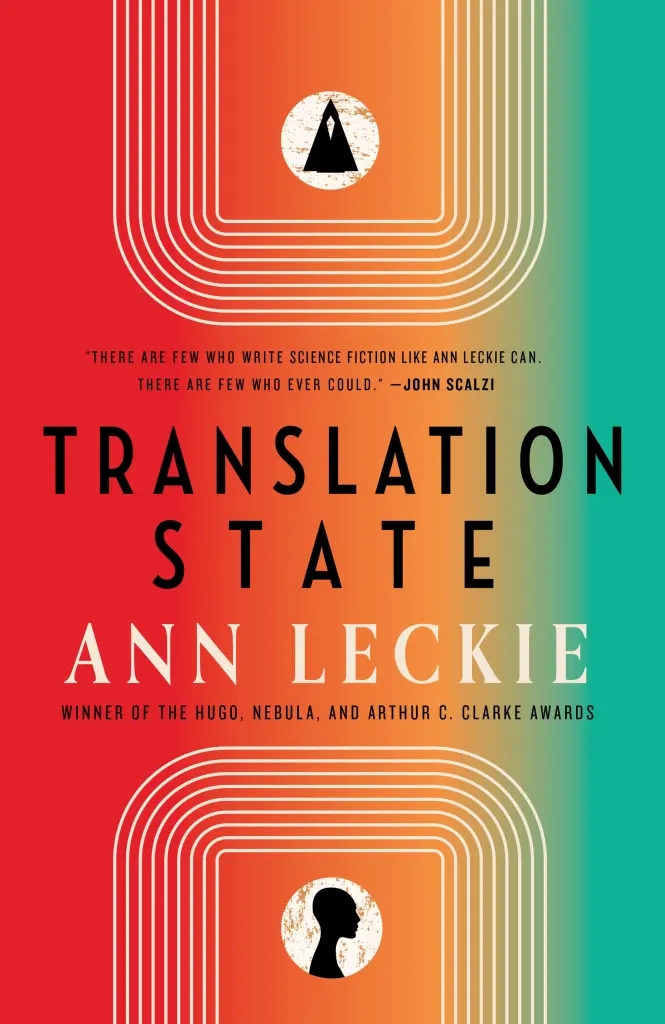
Translation State, Ann Leckie (2023)–note: fixed a typo if you are reading the revised post

Book cover of Ann Leckie's SF novel "Translation State"
Find out how to get it HERE. (And if you are reading this around Black Friday, Orbit seems to be offering a discount code on its site.)

Leckie’s answer to the problem of human/alien communication is pretty brilliant, I think, and close to Miéville’s (see my last post). The characters in Translation State are embroiled in a politically very precarious situation, one so fraught it could easily lead to an extinction event for all the sentient species of the universe. The sentient species, I should say, which consist of individual species members.

These species on their various planets and in their differing cultures and biologies (or other constituent parts!) have enough trouble just dealing with each other, but at a time before the novel begins, they have encountered a radically different species, the Presger, who are so alien that communication with them seems impossible. Worse, the Presger are so much more advanced than the other species that they have the power to wipe out all the other species and think no more about it than a person stomping on a bug. Worse than even that, the Presger don’t recognize individuals or individual striving, pain, thought processes, inherent value–only the collective. How does a universe full of jostling, quarreling individuals communicate with THAT?

A very fragile truce has been struck before Translation State begins, and as with Mieville’s Ariekei/human communication dilemma, holding onto the truce depends on a jury-rigged and barely adequate bridging of the communication divide. As the novel begins, interspecies infighting imperils the truce.

Reader: It helps to understand the political (and legal!) quagmire in the back story of this novel if you have read Leckie’s wonderful Imperial Radch series (see my post HERE), and also her other Imperial Radch-adjacent novel Provenance, but it’s not necessary. Translation State, a lovely novel of found family, short-listed for the 2024 Hugo Award, can stand on its own.

In Leckie’s imagined world (universe), there is no way the Presger mind and a more human-like mind will ever fathom each other. But it’s crucially important to do so, because, on a mere whim, the Presger could end the other species at any time. In their inscrutability, the Presger themselves have understood the need for a treaty with the other species, and they have the vast intelligence to go about it. They have deliberately crafted an intermediate type of creature explicitly designed and educated to translate between themselves and the others.

Leckie’s imagined solution intersects in a very satisfying way with the individual personalities of her characters and their emotional needs. So her novel avoids that all-too-common SF trap of creating essentially an enormous PowerPoint of “what-if.” Her book is actually a novel, not a disguised diagram or tract. Her characters are actually characters, not bullet points. The characters of the novel occupy a translation state, and so does Leckie the author, between us readers trying to imagine the unimaginable, and that object of unimaginability.

What if you were one of those members of the interspecies “translation state,” her novel asks the reader. How would you understand yourself and live your life? What if the biological imperatives built into your physical and psychological fabric mean that your own agency is limited; that even though you are a thinking, sensing, feeling individual, you will die if you don’t fulfill a biological mandate? What if the fate of the treaty depends on your putting aside your own needs and fulfilling the fate you were specifically designed for? And so–what if the fate of all other sentient species in the universe depends on it?

This is a thrilling twist on the “Chosen One” trope. It is also a sensitive exploration of what it means to be different, what it means to suffer abuse, what it means to lack and then find a family and community. We readers shuttle between the thoughts and feelings of two young people caught up in an impossible situation. A third character becomes the catalyst bringing them together. But, the novel asks, along with the third character irself (no, not a typo): is this a good thing? Or a dangerous thing imperiling everyone?

A lot of questions here, but the novel is full of them and feels its way to its conclusion, just as we readers do. This is an SF book that engages the reader and takes the reader along for the ride.

I was struck with the differences between novels like Leckie’s and Miéville’s on the one hand, and some of the space opera solutions to alien communication on the other (see my previous post). Leckie and Miéville both deal with imperfect solutions to near-impossible communication problems–a very real possibility if a human-like species ever did come into contact with an alien one. But both Leckie and Miéville, interestingly, don’t deal with first contact. Their novels both look back to an imperfect solution and then ahead to a crisis point in that communication–also a very real possibility in such a communications attempt. Miéville wants to examine how language works in the context of a real impasse between species. Leckie is more interested in the conflicts among the characters when the impasse happens, and more interested in the way biology shapes communication. For example, Miéville does delve a bit into how the twin pairs are engineered to communicate with the Ariekei and what in the Ariekei biology might account for their need for the double messaging of their language, but he appears to be more interested in how language itself works, and then how it might work under extreme circumstances. Leckie takes us straight into the nitty-gritty and sometimes gut-churning details of how the translation state is physically achieved.

An inspired space opera like (pick any one of) Iain Banks’s Culture novels posits a universe where all these thorny communication problems have already been worked out. We don’t need to think about them or talk about them much. They just ARE. Don’t ask why Cinderella’s glass slipper doesn’t cut her foot. By the rules of the fairy tale game, it just doesn’t. Willingly suspend your disbelief, space opera tells us. With delight (if the novels are good enough, like Culture), we do. Such novels are content to let that problem alone. They are after other conflicts. (The heart of any good novel being: conflict. If all you are after is ideas, just go write an essay. Go format your PowerPoint.)

Novels like these by Leckie and Miéville want to poke the bear. How is communication between a human-like species and an alien being/consciousness even possible? How could it possibly come to be? And then–what happens when it all unravels?

Next up: Ray Nayler, The Mountain in the Sea