Fairytale Fantasy Post #6

Valentine’s Day + 1

Here’s the 6th in my series of fairytale fantasy posts!

TO REPEAT from fairytale fantasy post #1: the term “fairy tale” is misleading. What we typically call “fairy tales” are more accurately described as “folk tales,” or “traditional tales,” especially one coming from the oral tradition. I’m also not necessarily posting about the fae, although one of the books in this series of posts does have a strong fae presence. “Fairy”—“Fae”—They are synonyms (of a sort), and tales of the fae are an important fantasy subgenre, but again, I’m not using “fairy” necessarily in that sense. AND I’m not dealing with anything Disney (although I guess I kind of lied about that in the last few posts).

The fairytale fantasy novels

My top picks:

Spinning Silver, by Naomi Novik. Based on the Grimms’ Brothers fairy tale Rumpelstiltskin. Reviewed in post one of this series.

Redemption in Indigo, by Karen Lord. Based on the Senegalese folk tale Ansige the Glutton. Reviewed in post two of this series.

More fairytale fantasy:

She Who Became the Sun, by Shelley Parker-Chan. Influenced by Chinese ghost lore. Reviewed in post three of this series.

Alice, by Christina Henry. Horror-fantasy re-imagining of Alice in Wonderland. Reviewed in post four of this series.

Confessions of an Ugly Stepsister, by Gregory Maguire. Re-imagining of the French fairy tale Cinderella. Reviewed in post five of this series.

Black Sun, by Rebecca Roanhorse. Influenced by the mythology and folklore of Mesoamerica. REVIEWED IN THIS POST.

Shadow of the Fox, by Julie Kagawa. Influenced by the folklore of Japan.

For the Wolf, by Hannah Whitten. Based on Little Red Riding Hood? More on Beauty and the Beast.

Today’s fairytale fantasy review:

Black Sun, by Rebecca Roanhorse
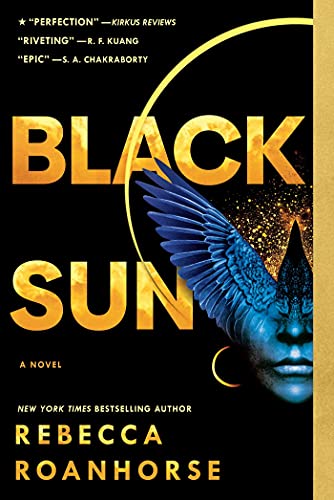
Find it on amazon.com HERE.

Rebecca Roanhorse’s 2020 novel, Black Sun, published by Gallery/Saga Press, is the ingenious and often riveting epic tale of three people caught up in a rebellion against the established order in a society inspired by the civilizations of the Pre-Columbian Americas.

The folkloric basis of the novel:

In an interview with NPR’s Petra Mayer, Roanhorse explained that in spite of her love for the usual kinds of epic fantasy, she wanted to set a fantasy novel in a world inspired by Pre-Columbian civilizations. She explained that these civilizations have fascinated her all her life. “For this book I really dug into everything from Polynesian sailing methods to what we know of the Maritime Maya to the habits of corvids,” she told Mayer. In an interview with Arly Sorg for Clarkesworld Magazine, Roanhorse explained that while she took liberties with the details of the magic and religious beliefs of the people in the Black Sun world, she mingled them with the cultures of the historical era. I’d say a woman with a B.A. in religious studies from Yale and an M.A. in Theology from Union Theological Seminary possesses more than the necessary chops to bring this off.

As a woman of color and Native heritage, she deplores the double standard she has experienced. “I wanted to celebrate the various cultures of the Indigenous Americas by embracing their architecture, science, diversity of cultures and worldview, and then going fantastical with it. I dislike how marginalized authors are so rarely allowed to be fantastical, to have limitless imaginations and to break boundaries,” she told Sorg. “I recently saw a review complaining that Black Sun did not meet the reader’s understanding of one of the historical cultures it draws from, and I wanted to shake that reviewer and point to the giant corvids and mermaids in the story and ask if they failed to notice the book was fantasy. I don’t think white writers have to deal with that expectation.”

One of the issues here, it seems to me, is summed up in the #ownvoices movement. Here’s a great discussion of the matter, with all of the attendant angst. Bottom line, Roanhorse has the background and therefore the standing to write Mesoamerican, Pre-Columbian fantasy, and I was thrilled to read a novel not only about that part of the world and that era of history but from that informed perspective.

A personal note: I’ll tell you why this aspect of Black Sun especially resonates with me. I write historical fantasy myself. My own background is white cisgender American with ancestry in the British Isles. Most of my interconnected Stormclouds/Harbingers series of novels is set in a fantasy British Isles/Western/Northern Europe, like a lot of fantasy. Like Roanhorse, I felt that wasn’t enough. After all, I’m an American, not a European. BUT (I’m sure you see the problem!) I’m from ancestors who came to colonize, not the ones who were already here. In my novel Ghost Bird, my characters sail from an alt-Viking Age environment in an alt-Northern Europe to the alt-Americas, where they of course encounter the indigenous peoples of those lands. Ghost Bird imagines a fantasy-Cahokia and a fantasy-Chichen Itza, among other cultures. I tried: 1. to stay in the perspective of my characters, who encountered native peoples and environments as essentially intruders in a land not their own, and 2. to be respectful of the Native American/First Nations peoples and environments I drew upon for my fantasy “America.” It was a real balancing act. Did I succeed? I hope so. I certainly tried. But I do believe very strongly that in these times, that balance must be one of a writer’s most important goals. A writer, especially of fiction, has to be able to imagine herself into circumstances alien to her own experience and background. The process of imagining comes with the territory. Otherwise, maybe stick to memoir. But the fiction-writer’s imagining must be conducted with all possible respect and sensitivity.

Roanhorse’s novel

The three main characters of this novel fascinated me from the beginning, and so did the treacherous fantasy world they inhabit. For the most part, I found the story absorbing, the characters well-done, and the writing fine.

In the middle of the novel, I did find myself losing interest in Zataya, the girl who has struggled out of the slums and into the highest reaches of the Tovan priesthood. I kept wanting to go back to my two favorite characters, the swashbuckling sea-captain Xiala and her intriguing passenger, the blind crow-man Serapio. By the end of the novel, though, I was invested in Zataya’s fate as well. At first she just seemed like a victim, much too naive, and that struck me as a bit unrealistic. In order to rise in her world, she had to have needed a sense of self-preservation and a keen nose for hypocrisy and back-stabbing, and she seemed to lack that necessary trait. Toward the end of the novel, though, she rallied and found her spine.

I found the world-building and the plot very absorbing and fast-paced. I did have a little trouble with the time-stamps on each chapter. At first they didn’t make much sense to me. As the novel progressed, though, I began to understand what was happening when, and why, so that problem went away by the end of the book, too.

With all of its positives, and such an exciting read, this novel would have become one of my favorite fantasy novels in recent memory. Except for one thing.

I’m actually very interested in how other readers react to this one thing. It’s this: the novel ends on a stark cliffhanger. I find that a deal-breaker–as in, I won’t go on with a series when I feel the author has snookered me into caring and then pulled the rug out from under me at the end. I write series, too, and I try always to get to some kind of major closure at the end, even if there are loose plot threads. But not just. . .stop. Aargh.

Now–I’m thinking other readers may not agree with me on this. I actually tried to find out. I belong (belonged, I should say) to a big Facebook group of fantasy readers, so I tried posting the question to that group: do you or do you not like cliffhangers? For whatever reason (I phrased it respectfully, I mentioned I was interested as a blogger and writer but I didn’t “self-promote” by mentioning the name of this blog or the titles of my books, and I’ve seen the same question raised by other posters in the group), my post was disallowed, so I can’t give you any good sense of this matter as I’d hoped I’d be able to. I can only say how I personally feel.

As an aside, in belonging to that group, I did feel I learned a lot about what other fantasy readers do and don’t like in a fantasy read–so I really recommend joining one. You’ll get some great recommendations for books you may have missed. There are several groups like this, and I’m not going to trash my former group by mentioning its name. Just be careful when/if you post, because there seems to be a double-standard involving who can say what in the group–at least the one I belonged to.

I’d really like your comments on this cliffhanger matter, if you have an opinion, and I will publish the comments. And now that I’m thinking about it, I’ll also post guidelines for making these comments, so if I DON’T publish your comment, you’ll know why. Very briefly they are: I won’t publish comments not on the topic of this blog, I won’t publish comments that are disrespectful in language or tone, and I won’t publish comments that self-promote or try to sell anything.

Hoo-boy. This review is getting too much about me and not enough about the book. So here are my final thoughts: It’s a wonderful book. Read it if you don’t mind cliffhangers. If you do, beware. Just saying.

Oh–P.S. Then I’ll shut up. In that same fantasy readers’ group, I discovered that a lot of people buy a fantasy book IF and ONLY IF the cover intrigues them. I’m not one of those people, but wow, Roanhorse’s book has one of the greatest fantasy covers I’ve ever seen.

Fairytale Fantasy post #5

HAPPY VALENTINE’S DAY!

Here’s the fifth in my FAIRYTALE FANTASY posts!

TO REPEAT from fairytale fantasy post #1: the term “fairy tale” is misleading. What we typically call “fairy tales” are more accurately described as “folk tales,” or “traditional tales,” especially one coming from the oral tradition. I’m also not necessarily posting about the fae, although one of the books in this series of posts does have a strong fae presence. “Fairy”—“Fae”—They are synonyms (of a sort), and tales of the fae are an important fantasy subgenre, but again, I’m not using “fairy” necessarily in that sense. AND I’m not dealing with anything Disney (although I guess I kind of lied about that in the last few posts).

The fairytale fantasy novels

My top picks:

Spinning Silver, by Naomi Novik. Based on the Grimms’ Brothers fairy tale Rumpelstiltskin. Discussed in my fairytale fantasy post #1.

Redemption in Indigo, by Karen Lord. Based on the Senegalese folk tale Ansige the Glutton. Discussed in my fairytale fantasy post #2.

Other fairytale fantasy novels:

She Who Became the Sun, by Shelley Parker-Chan. Influenced by Chinese ghost lore. Discussed in my fairytale fantasy post #3.

Alice, by Christina Henry. Based on Alice in Wonderland. Discussed in my fairytale fantasy post #4.

Confessions of an Ugly Stepsister, by Gregory Maguire. Based on the French fairy tale Cinderella. DISCUSSED IN THIS POST.

Black Sun, by Rebecca Roanhorse. Influenced by Mesoamerican folklore and myth.

Shadow of the Fox, by Julie Kagawa. Influenced by Japanese folklore.

For the Wolf, by Hannah Whitten. Maybe influenced by Little Red Riding Hood, but more closely based on Beauty and the Beast.

Today’s fairytale fantasy review:

Confessions of an Ugly Stepsister, by Gregory Maguire

Find it at Amazon.com. Click HERE.

Gregory Maguire’s 1999 reimagining of the Cinderella story, published by Regan Books (now reissued by William Morrow), is the second novel in which he used that technique. The first, Wicked, a reimagining of the Wicked Witch of the West character in The Wizard of Oz, is probably his best-known of these novels.

I figure a Cinderella-based novel is the best choice for Valentine’s Day! What’s a more iconic fairy tale, at least for Americans, than that, and it is the classic tale of a certain type of “happily ever after” love.

The fairy tale basis of the novel

Cinderella, as most American readers know it, has filtered through to them through (shhh. . . Walt Disney’s animated movie version from 1950) a number of English language versions. The real ancestor of the English-speaking world’s Cinderella, though, is Charles Perrault’s French version of the story from 1697, Cendrillon ou la petite pantoufle de verre (Cinderella, or The Little Glass Slipper). Through the Perrault version, the story acquired the pumpkin coach, the fairy godmother, and especially that glass slipper. (Why doesn’t the glass slipper break and cut Cinderella’s foot? It’s magic! It’s fiction! Don’t ask!) You can read a translation of the Perrault version HERE.

But the story is truly ancient. Scholars have traced it back to ancient Greece and the tale of Rhodopis (“Rosy-cheeks”). Think only scholars know that one? Nope. It makes an appearance in the MMORPG Everquest II as one of the sillier quests in the Rise of Kunark expansion pack. Among others, there’s an Italian version, a German version (the Brothers Grimm collected that one, Aschenputtel), and a number of Asian versions. A lot of versions, a lot of variations on the story and its details. Folklorists classify it as Aarne–Thompson–Uther type 510A, ” The Persecuted Heroine.”

Whatever its true origins, the tale really resonates for generations of young women, especially those who long to become a “Disney princess.” The implications of this longing were explored most famously by the feminist theorist Colette Dowling, in The Cinderella Complex: Women’s Hidden Fear of Independence (Summit Books, 1981). The book discusses the Cinderella fairy tale as the template for contemporary women’s longing to be swept off their feet by some powerful male and taken care of.

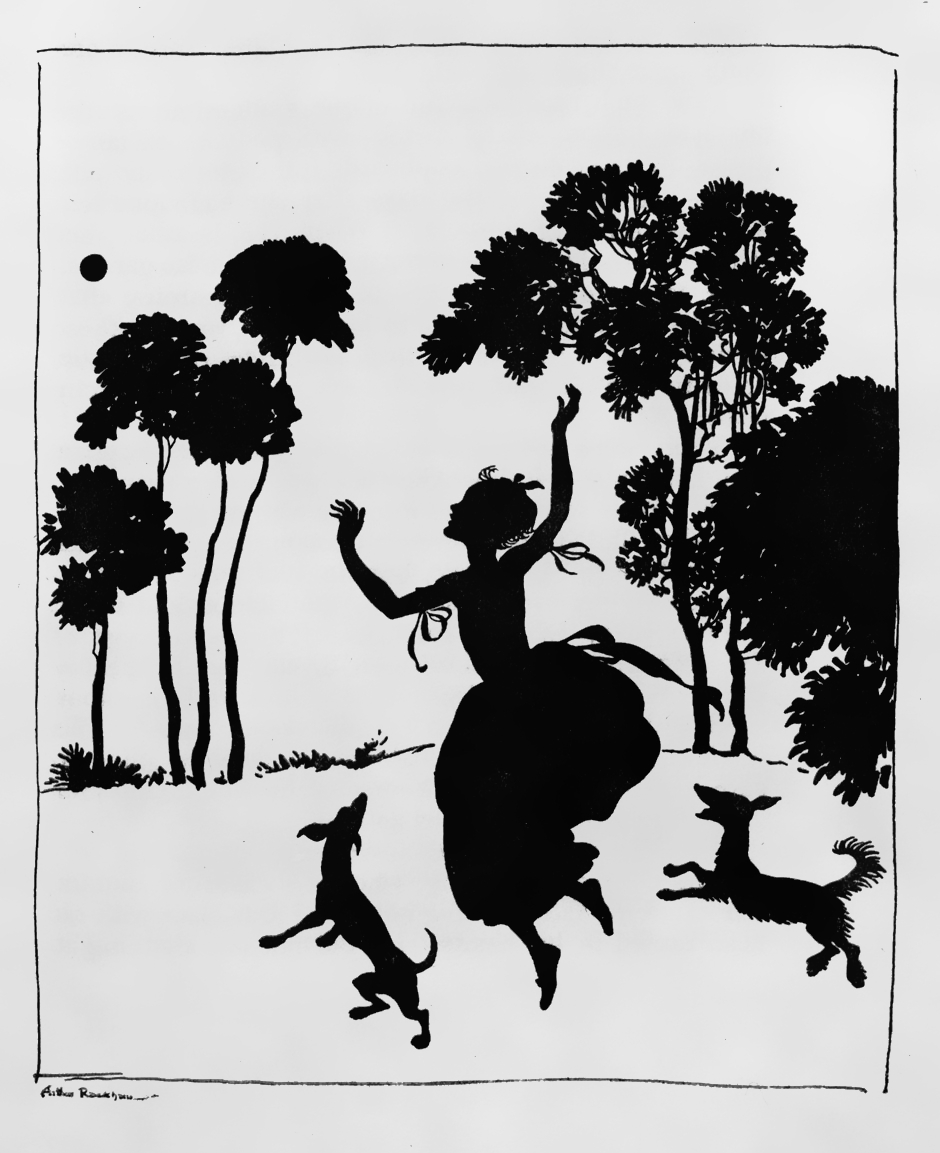
The famed fantasy illustrator Arthur Rackham’s illustration for a 1919 version of Cinderella (in the public domain).

Maguire’s novel

One of the reasons I really like Gregory Maguire’s take on the Cinderella story in Confessions of an Ugly Stepsister is how he stands that “Cinderella complex” material on its head. As the title signals, Maguire’s novel isn’t from Cinderella’s point of view and doesn’t cast her as the protagonist. Rather, he focuses his novel on an ordinarily despised character, one of the “ugly stepsisters” who torment the beautiful and virtuous Cinderella in most versions of the fairy tale. This is Maguire’s signature schtick, so maybe that accounts for some of the features I don’t admire so much, as well.

For maybe half of Maguire’s book, we’re reading an historical novel about the 17th Century Netherlands in the grip of its famous Tulip Bubble. In the 1600s, the mania for tulips was so extreme that tulip bulbs were selling at crazy-high prices. Then, as with all such economic bubbles, there came a tulip bust, and all the tulip speculators who had made tidy fortunes were reduced to poverty practically overnight. This strange incident out of history has achieved iconic status among economists. Maguire’s novel and its characters are very skillfully drawn, and he depicts their world with equal power. The experiences of English immigrants to Holland during this period, the tulip speculators, and especially the artists of the 17th century Dutch city of Haarlem are brought to fascinating life. Maguire depicts the lives of the women of that time with special sensitivity and power. As second-class citizens, they must be careful of their reputations and their economic status. Marry for love? Pffft. That’s a course that will lead a young woman to disaster.

BUT. (I suppose if you’ve been reading this blog, you may suspect where I’m going with this. . . ) But Maguire abandons this well-written and absorbing historical novel around midway through to layer the Cinderella story in there with a heavy hand. What a disappointment, especially since I think he could have easily alluded to the Cinderella story and its themes without going for some literal-minded recreation of the fairy tale. His writing is so good that I know he could have brought it off. And there’s an especially egregious and improbable twist at the end, too. So I have very mixed feelings about this novel.

Cinderella is such an iconic fairy tale that many people have taken a crack at it, including many revisionist cracks like this one, and in many different forms. I don’t have room to list them all. For starters, think of opera. Both Rossini (1817) and Massenet (1899) composed Cinderella staples of the opera repertoire, and they’re not the only composers to take on the tale. Prokofiev composed the music for a Cinderella ballet (1940-44), and he’s not the only composer or choreographer to use ballet to explore Cinderella‘s power. Rodgers and Hammerstein produced a musical theater version on Broadway (1957), and since then, the musical has been revived in three other later versions based on their original. The pandemic willing, Andrew Lloyd Webber will bring his own Cinderella musical to Broadway in 2022. (cough) Disney (cough) is not the only filmmaker to bring Cinderella to the big screen (in animation and live action); there have been many others. In fact, a certain type of romance is frequently referred to as a “Cinderella story”–rags to riches in a particularly female form, the riches being acquired by proxy through some prince of a fellow. The movie Pretty Woman (1990), starring Julia Roberts and Richard Gere, is a prime example.

Fairytale Fantasy post #4

Tomorrow is St. Valentine’s Day, all in the morrow betime, and I a maid at your window, to be your valentine!

W.S.

Here’s the fourth in my FAIRYTALE FANTASY posts!

TO REPEAT from fairytale fantasy post #1: the term “fairy tale” is misleading. What we typically call “fairy tales” are more accurately described as “folk tales,” or “traditional tales,” especially one coming from the oral tradition. I’m also not necessarily posting about the fae, although one of the books does have a strong fae presence. “Fairy”—“Fae”—They are synonyms (of a sort), and tales of the fae are an important fantasy subgenre, but again, I’m not using “fairy” necessarily in that sense. AND I’m not dealing with anything Disney (although I guess I kind of lied about that in post #3).

THE FAIRYTALE FANTASY NOVELS

My two top picks:

Spinning Silver, by Naomi Novik. Based on the Grimms’ fairytale Rumpelstiltskin. Reviewed in post #1.

Redemption in Indigo, by Karen Lord. Based on the Senegalese folktale Ansige the Glutton. Reviewed in post #2.

Other fairytale/folktale fantasy:

She Who Became the Sun, by Shelley Parker-Chan. Incorporates Chinese ghost lore. Reviewed in post #3.

Alice, by Christina Henry. Horror-fantasy based on Alice in Wonderland. Reviewed in this post.

Gregory Maguire, Confessions of an Ugly Stepsister. Based on the French fairy tale Cinderella.

Shadow of the Fox, by Julie Kagawa. Based on Japanese myth and folklore.

For the Wolf, by Hannah Whitten. Based on Little Red Riding Hood? For sure on Beauty and the Beast.

Black Sun, by Rebecca Roanhorse. Influenced by the folklore and mythology of Mesoamerica.

Today’s fairytale fantasy review:

Alice, by Christina Henry

Find it at amazon.com.

Christina Henry’s horror-fantasy novel was published by Ace Books in 2015. “Christina Henry” is the pen name of an author who has written several fantasy reimaginings of popular older fantasy, including several Alice books. Featuring Henry’s book in this blog series is kind of a stretch, because Alice in Wonderland is not a classic fairy tale and doesn’t come from folkloric origins. The beloved children’s book, which was titled Alice’s Adventures Underground, or Alice’s Adventures in Wonderland, was written in 1865 by Charles Dodgson, a Victorian-era English mathematician. Dodgson used a pen name himself: Lewis Carroll. Alice has entered popular culture, though. Even people who have never read it are likely to know the story. It has become a kind of latter-day fairytale.

Admittedly there’s no fairytale or folkloric basis for this book. But there is a fascinating backstory. Dodgson was a shy bachelor whose family friends had a young daughter, Alice Pleasance Liddell. Dodgson and a friend rowed Alice and her two sisters up a river, and during this excursion, Dodgson made up a fanciful story for the girls. Alice wanted a copy, so Dodgson wrote it down for her. Eventually, Dodgson published it as a children’s book, with famous illustrations by John Tenniel.

The 1898 edition of Alice in Wonderland, with John Tenniel’s illustrations.

Fleets of literary critics have worked overtime to analyze this seemingly simple but actually very complex tale. Some have considered the characters to be fantasy versions of Dodgson and people he knew; others write about the puns and wordplay, and especially the mathematical puzzles and concepts that Dodgson inserted into the story. Still others have explored the Freudian aspects of the story. Most acknowledge that Alice changed children’s literature, taking it away from preachy tomes and into the realm of nonsense and fun. This article gives a good quick introduction to the whole Matter of Alice.

Henry’s novel

Henry’s version of Alice begins with blood and screaming. You know instantly that you’re in the world of horror, but probably not yet that you’re in the world of Alice in Wonderland. Let me backtrack. Yes, you do, because the cover tells you that. But the first chapter places you in a horrifying Victorian madhouse, where Alice is mistreated by the attendants. Aside from them, her only human contact is a fellow patient, Hatcher, an axe-murderer. She has communicated with him for years through a hole between their locked rooms–essentially cells. She soothes him through his most deranged episodes, and he gives her companionship. It’s soon clear that Alice has been locked up as “insane” because of behavior unbecoming a properly brought up young Victorian woman. Things heat up (literally) when the asylum catches fire and Hatcher helps Alice escape into the “Old City.” At that point, the reader realizes that while the setting seems Victorian, the novel takes place in some alt-Victorian dystopia.

Unfortunately, after that promising and intriguing start, the novel goes downhill into a series of mechanically-plotted adventures that slavishly adhere to horror versions of Alice in Wonderland characters and situations. Some of it really has to stretch to fit the Alice tropes. Meanwhile, I was getting annoyed, because I wanted more about Alice the character and her relationship with Hatcher. Oh, well.

Many readers love these books, so don’t take my word for it that this one is somewhat of a disappointment. Here’s a glowing review. And here’s another one. But some think the characterization is thin, the magic not very convincing, and the writing not very developed. Here is one of those. I’m afraid I’m in their camp.

Other readers have reservations about these books for a different reason. Several reviewers think Alice is too full of violence against women. Here’s one of those reviews. I would not put Henry’s novel in this category, myself. Although I never approve of gratuitous violence against women (or anyone), this kind of violence does happen in actual life, and fiction–unless it’s completely sanitized–does deal with the hard parts of life. And should. So if it’s well-written and it honestly confronts the situation it depicts, I don’t care what the content is, or how tough. In addition, part of the horror genre involves body-horror of all types. You may not enjoy horror. I’m not the biggest fan. But well-done horror is its own delight.

Digression: As I say, I don’t mind violence in fantasy IF it is well-done and necessary to story and characterization. That’s a big IF, though. I know one fantasy novel highly regarded by a lot of fantasy readers (Lord Foul’s Bane, if you’re interested) that I just can’t admire–and won’t finish the series. I’m amazed I finished the novel. Even though the novel has some interesting features, the rape in that book is gratuitous, the protagonist unrepentant or not very, and the reader apparently intended to shrug the whole disgusting episode off. Not cool in my book. (Its purple prose also annoys me.) On the other hand, Cormac McCarthy’s Blood Meridian, while one of the most unpleasant novels I’ve ever read (and studded with some pretty purple prose), is also one of the most brilliant. So there you go. That’s what you need to know about me the reader.

Related works and fantasy-related fictions:

Henry’s Alice is the first book of a series, so there’s more Alice material if you end up liking the novel. I’m not continuing it. Henry has also taken on other well-known children’s classics, such as Peter Pan. Re-imagining literary classics is a whole subgenre, and not just in fantasy. Underneath the fantasy tent, though, many successful novels have taken on similar material. I’m thinking especially of Gregory Maguire’s Wicked, a re-imagining of The Wizard of Oz‘s Wicked Witch of the West–probably because my next post is about another novel of his.

Alice in Wonderland, as I’ve mentioned, has left its origins to spread out into numerous genres and forms. It has inspired a ballet, a stage play, toys and games and products of all types, and a number of movies (including several. . .shhhh. . . Disney versions, one of them the iconic animated version of 1951–probably the version from which most Americans get their visual impressions of the characters, not the famous Tenniel illustrations).

Alice has been issued as a children’s book with illustrations by many different artists, in many different styles. I find these pretty intriguing. Here are a few:

a Salvatore Dali version!

Yayoi Kusama’s pop art version