
Danger! Danger! Bards at the Crossroads

Several of my own fantasy novels (Blackbird Rising, Halcyon, A Gyrfalcon for a King, The Call of the Shrike) are tales of bards with magical powers. Fantasy literature is full of bards! The most famous bard in recent fantasy has to be Kvothe, in Patrick Rothfuss’s wonderful The Name of the Wind. Strangely, although Kvothe is a bard with magic powers, those powers don’t really extend to his music. He exercises those in different ways. Kvothe’s amazing musical talent is akin to the famous joke about musicians and Carnegie Hall. Man asking for directions: How do I get to Carnegie Hall? Musician: Practice! There are several bards in the novels of the great Canadian fantasy writer Guy Gavriel Kay.

But bards–minstrels, skalds, troubadours, whatever you may call those wandering musicians that populate fantasy and folklore–are persons of magic and superstition. The magic associated with bards comes in two forms.

First, a bard’s music is a useful but dangerous thing. In ancient Ireland, bards were employed as “rat-rhymers,” an early medieval form of pest control. The idea was, the bard played music that exerted power over the rats, and then the bard could do what he liked with the dazzled creatues, such as march them out of town where they couldn’t eat the townspeople’s grain. If you want the scholarly background of it all, look it up here: Fred Norris Robinson, “Satirists and Enchanters in Early Irish Literature,” Studies in the History of Religons Presented to Cawford Howell Toy, ed. D. G. Lyon and G. F. Moore (New York, 1912), pp. 95-130. That’s hard to find, especially if you don’t have an academic library. You can find the article reprinted in Satire: Modern Essays in Criticism, ed. Ronald Paulson (New Jersey, 1971). THAT may be hard to find, too, but it’s probably easier than the original.

Very obscure, huh? EXCEPT everyone knows the story of the Pied Piper of Hamlin. The story originates in an old German medieval folktale about a disgruntled bard, cheated of his fee, who marched all the children of the town off to perdition, instead of the rats. The main character is a piper–a musician who plays a pipe, such as a bagpipe or some kind of wind instrument–and he is “pied”–that is, he dresses in multicolored clothing, like the typical idea of the court jester.
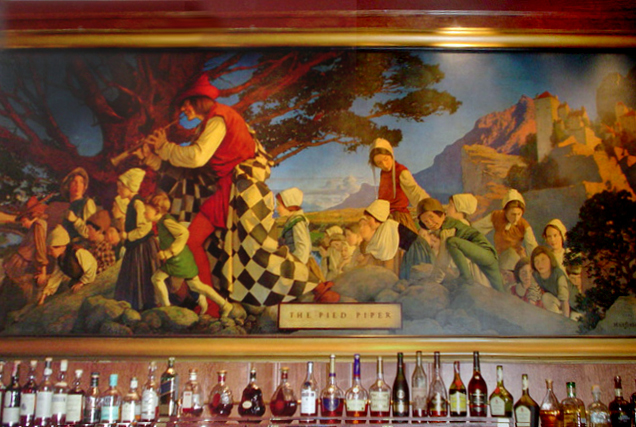
The great illustrator Maxfield Parrish (1870-1966) painted this mural depicting the Pied Piper for the bar of San Francisco’s Palace Hotel. Source: Wikimedia Commons. In the public domain.

So the music and songs of bards act as magic spells. They have their uses (pest control! well. . .okay. . .and entertainment), but they are also very dangerous.

Music has always been seen as something otherworldly or standing between worlds, connecting the spirit world with the ordinary world, so musicians have always been looked on with a kind of awe and reverence–but sometimes with fear.

In line with that thinking, sometimes the ordinary folk wonder about the source of a bard’s uncanny power. Folklore from around the world emphasizes this–everything from the Greek myth of Orpheus getting the power of his music directly from the god Apollo to much more sinister stuff. (Although, actually, the Orpheus tale is pretty sinister.)

How sinister? A lot of folk tales emphasize that a bard’s musical talent may be associated with crossroads. Why crossroads? Crossroads themselves were sources of magic in the ancient world. The place where roads crossed each other was a place many ancient cultures believed the ordinary world touched the sacred, or the spiritual, or (shiver) the Underworld. Think about the Greek tale of Oedipus. Where does his tragedy begin? At a crossroads. In ancient Rome, religious societies maintained each crossroads in the city, making sure they placated the gods in charge of each crossroads so the city would stay safe. In medieval Europe, suicides were frequently buried at crossroads instead of in the consecrated ground of regular churchyard cemeteries. In these societies, suicide was considered an unholy act, so the suicide was buried at a place where roads cross, in hopes of confusing the soul and preventing demons from making use of it.

And a bard or minstrel or any kind of musician frequently gets power from an encounter at a crossroads.

What kind of encounter? In the American folklore of the South, an encounter with the devil! Here’s a great blog post that explains the whole thing. The fabled bluesman Tommy Johnson, for example, supposedly made a pact with the devil in exchange for his musical talent (not Robert Johnson, as popularly supposed, although he has a famous song about a crossroads). The musician who makes a pact with the devil can also be found in European and African folklore.

Brrr. Bards are scary folk!
Free fantasy for July

Check out these for new fantasy reads!

https://books.bookfunnel.com/summerfantasyescapes/19p3uqoqjl

On cruelty to your characters and Joe Abercrombie

First off, I love Joe Abercrombie’s novels. They are brilliant, and very well-written. But with the latest, The Wisdom of Crowds, the last book in his A Little Madness series, he has gone too far, even for me. Even though he IS Lord Grimdark.

The Wisdom of Crowds is no more bloody, no more morally gray, no more disturbing, no more grim, no more dark than all the others. But. . .but. . . I don’t know. There’s something about it that hit me wrong. I’ve been struggling with what it is. I do admire authors who don’t pull their punches with their characters. Think of George R. R. Martin and the Red Wedding. I ended up getting tired of A Song of Ice and Fire, even the HBO series (that bad last few episodes!), but not because the books were too grim. Around Book Three or Four, they just sounded tired to me. Come to think of it, maybe that’s why Martin has never finished the series. Maybe he’s sick of them, too.

I don’t demand an ending that’s all roses and unicorns. Far from it. Maybe it’s unfair to make this comparison, but after finishing The Wisdom of Crowds, my mind flicked back to Hilary Mantel’s brilliant Thomas Cromwell trilogy (Wolf Hall, Bring Up the Bodies, The Mirror and the Light), especially that last book. Reading the last hundred pages of The Mirror and the Light left me, frankly, devastated. And I knew what was going to happen, because it’s history! Mantel presents the politics of Henry VIII’s regime as every bit as corrupt and convoluted as the politics in The Wisdom of Crowds. Sure, bad things happened to her characters in real life, but she could have softened them up a bit, right? And she didn’t. Plenty of other historical novelists writing about the same events have. At the end of The Mirror and the Light, though, I felt actual grief, and pretty profoundly, too. At the end of The Wisdom of Crowds (spoilery here), I felt cheated.

I thought about another historical novelist, too, the Australian novelist Colleen McCullough. Long ago, I had read The Thorn Birds. My impression was that it was kind of soapy. But she wrote a mammoth series of historical novels about ancient Rome, The Masters of Rome series, based on extensive research into the period, that have made a very different impression on me. I’m through three of the five or six novels in the series, and they are nowhere near as satisfying as Mantel’s, mostly because they wear their research on their sleeve, and Mantel skillfully avoids this pitfall. The ol’ information dump, bane of world-builders in whichever genre they write. Nevertheless, McCullough’s talent for characterization is pretty astonishing. You’re deep into a particular character, you see what motivates the character, and you come to admire that character even while seeing how ruthless the person can behave. In the very next chapter, the character is doing something so viciously amoral–massacring whole villages for mere expedience, or out of mere pique, or assassinating your best friend, say–that it snatches all your sympathies away. Yet you keep believing the character. A writer able to do that has a real gift.

So are these apt comparisons to Abercrombie and the way he treats his characters? Mantel is an acknowledged master of contemporary literature with a Man-Booker Prize under her belt, for one, and Abercrombie is a writer of genre fiction. Maybe not a fair comparison there.

I think it is. I don’t think of so-called genre fiction as inferior. I think of the label “genre fiction” as a trick of marketing and publishing, and the stigma that accompanies it is sometimes deserved, sometimes not. But for the sake of argument, I restricted my thinking to fantasy novels. I thought about other fantasy novels without unicorns&roses endings (a bit spoilery, but not if you know Abercrombie, who never has these!). I thought about Guy Gavriel Kay’s Tigana, for example. That novel left me in a puddle on the floor, and not because it was sentimental.

So why? I keep asking myself this. Why was I left so cold at the end of Abercrombie’s trilogy? I came up with several reasons. The first is expectations. I had heard from other readers of fantasy that they didn’t like the book as much as some of his others, so I had that impression planted (unfairly–but realistically) in the back of my mind as I began to read. But once I had gotten several chapters in, I had already decided those readers were wrong, and that The Wisdom of Crowds might be shaping up to be one of my favorite Abercrombie novels ever.

Let me digress here by telling you why I liked it. Because, in spite of a perhaps negative tone in this post, I really did. The great age of heroes is over in this book. We’ve seen it coming for a long time, we who have faithfully read all of the Abercrombie books. The high drama and romance of the North is a relic by the time we open The Wisdom of Crowds. Abercrombie never caters to that sense of romance–on the contrary–but in the earlier trilogy and the related books (full list here–READ THESE if you haven’t) we see a world shaped by those notions of heroism and glory, and characters who struggle to live up to them, even if they mostly fail. In The Age of Madness, the last trilogy (at least so far, and excluding the Shattered Seas books) from book one (A Little Hatred) through book two (The Trouble With Peace) and into this last one, book three, we see a world transitioning away from that heroic age to an alt-Industrial Revolution with all its growing pains and all its sordidness. That can be a hard sell in fantasy-land, where a lot of readers WANT all the romance and glory, so I wondered if that’s why some readers don’t like this culminating book.

That’s not why I had my misgivings about The Wisdom of Crowds. I loved that part of the novel. It’s as if Abercrombie took bits of the French Revolution, bits of the Russian Revolution, maybe a dash of Pol Pot, and HUGE prescience about the way things are shaking out in the world we’re actually living in right now–its greed, its heartlessness, its by turns power-mad and gutless politicians, its manipulated people (by disinformation merchants!)–and put them into this novel. I’ve heard it said that once guns become ordinary implements of war, fantasy is over, but Abercrombie’s books have cannons, and it’s clear his warriors, who might use “flat-bows” (I take these to be crossbows), are probably going to see their entire way of warfare destroyed by military technology in the coming generation. And his novels, especially the ones in this last trilogy, do show industrial technology, social ideas, the distribution of wealth, and so on in the process of undergoing radical change.

BIG SPOILER, so look away if you haven’t read this book:

That ending, though. There’s no justice. No heroism, except a last unexpected (very touching) demonstration of courage by one of the least likely characters to exhibit it–immediately undercut, because it leads to absolutely no effect, no redemption. Nothing but cynicism remains in the world of this novel. It’s not like King Lear (another work of literature where nothing remains but cruelty–and another very unfair comparison) because Lear’s fall is tragic, while the characters who fall here are just pathetic. As a result, I the reader am left feeling flattened and bitter, feeling Abercrombie was cruel to his characters because he could. It’s like Lear with only the “flies to wanton boys” part. Hmm. . .maybe we should think Jacobean tragedy here and not Elizabethan.

At the end of my post, I’m left feeling I’ve probably made an unfair criticism of Abercrombie’s novel. My reaction could very well rest squarely on me, the terrified reader. Considering world events, maybe the vision of humanity at the end of The Wisdom of Crowds, and the unpleasant experience of having our noses rubbed in it, is exactly what we all deserve.

And then again, if I could write half so well, I’d be a happy woman.