Valentine Week: Fairytale Fantasy #2

fairytale fantasy

RAPUNZEL RETELLING NUMBER 2

Measha Stone’s Tower

If you missed the introduction to this year’s Fairytale Fantasy series of posts, find it HERE.

This is the second of the Rapunzel-themed novels I’m discussing during this year’s Valentine Week. The novel, published in 2018, is Book 2 in Stone’s Ever After series. The novels in the series all seem to be fairytale-themed, although Tower is the only one of the four I’ve read. The others seem to be (very loosely, if Tower is any indication) based on Beauty and the Beast, Little Red Riding Hood, and the Fox and the Hound.

Two important things to know about this novel:

This is not a work of fantasy. It is romance.

The fairytale elements are more or less a gimmick on which the romance plot hangs.
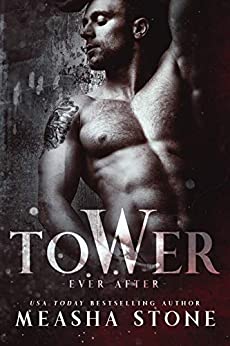
Find it at Amazon.

So. . .considering this is romance and not fantasy, why am I writing about it in a fantasy blog? Themes drawn from fairy tales are really interesting to me, and when they are present in contemporary fiction, they usually send the novel in a fantasy direction. This novel, though, is not a re-telling of the Rapunzel story, in spite of its subtitle, “A Dark Romance Rapunzel Retelling.” The Rapunzel elements seem to be a fun way the author has chosen to get into her story; a fun way to stand out from the romance novel crowd, maybe? I found the decision to write not just one romance novel but a series of them with a fairy tale hook to be a very interesting choice the writer made.

If you are the kind of reader who enjoys romance as well as fantasy, read on. If you hate romance novels, maybe give this post a miss. I was kind of fascinated with how the Rapunzel element threads through this story, though.

BIG WARNING: This novel is BDSM, and it is very steamy. I won’t say it’s outright erotica, where the whole point of the book is the sex, just a bunch of sex scenes strung along on a bare-bones plot–and not porn, either. But the sex scenes are very explicit, they are a huge part of the book, and the BDSM parts may seem disturbing to some readers.

What are the Rapunzel themes here? The main character Azalea’s last name is Gothel, which is the traditional name of the Rapunzel witch. She has blonde hair which her . . .um. . . SPOILER ALERT. . .”mother” insists she wear very long. The place where she may or may not be imprisoned is a BDSM club named The Tower. The plot involves a power struggle over who will possess Azalea–actually, which place they will imprison her, the male main character’s sex club or the mother’s forbidding house. Azalea has a plant-themed name. And that’s it. It’s a steamy romance novel with a few Rapunzel references stuck to it.

As these kinds of novels go, it’s pretty well-written. The plot is ridiculous, but then, so are fantasy plots, if you really think about it. All fiction requires, as Samuel Taylor Coleridge put it, “a willing suspension of disbelief.” The real question is how willing we readers become due to the skill of the novelist in getting us to buy into the craziness. I mean, think of Coleridge’s own Christabel. Readers of genre fiction, whether it’s fantasy, romance, or whatever else your reading drug of choice might be, glom onto a book because the tropes are ones they love, even crave. Tropes that beckon to them. “Come on in. . .willingly suspend your disbelief. . .let us sweep you away into a different type of world.” That’s the promise of genre fiction.

The real tropes in Stone’s novel are romance tropes, not fantasy tropes. They are (and I may be missing a few): bad boy romance, billionaire romance, bdsm romance, enemies-to-lovers romance, alpha-male romance, a whiff of “mafia” romance (in that the MMC’s business appears to be some sort of mob activity), grumpy vs. sunshine. . .uh. . . I’m probably leaving some out. If you like reading this kind of book, will get a kick out of spotting the Rapunzel references, and don’t mind that the MMC (main male character) is a controlling jerk, go for it. Okay, to be fair, the author works hard to convince us that the MMC is actually a sweetheart at the core. (Was I convinced? Not really.) The BDSM is fairly skillfully handled, though, unlike that supremely stupid, embarrassingly poorly written novel Fifty Shades of Gray. The final tip-off that Stone’s novel is romance, if anyone had a doubt: the requisite “man-chest cover” (see above), which is the usual marketing message to readers that they can expect a hot, sexy between-the-covers experience about hot, sexy under-the-covers activities.

Full disclosure: I actually read romance novels, and have been known to write a few myself (under a pen name), although mine probably don’t tick all the boxes the way Ms. Stone’s do. I also like it that this book appears to be indie-published, which is something I do myself. So I have some real professional admiration here and hope this review doesn’t come off too snarky. I guess if I were going to read a BDSM romance for fun, I’d have liked it better without Rapunzel.

NEXT UP: My discussion of Kate Forsyth’s Bitter Greens, my favorite of the Rapunzel picks.
Valentine Week: Fairytale Fantasy, #1

post about a Rapunzel re-telling

RAPUNZEL RE-TELLING NUMBER 1

Megan Morrison’s Grounded: The Adventures of Rapunzel

If you missed the introduction to this year’s Fairytale Fantasy series of posts, find it HERE.

Of the Rapunzel-themed novels I decided to discuss this year, Morrison’s Grounded, Book I of her Tyme series (2015), is the YA book of the three. It skews a young YA, too, so a thirteen-year-old could comfortably read it. In fact, the publisher, Scholastic, suggests it for grades 5-9, so it’s appropriate for even younger readers. As an adult reader, though, I’m here to tell you that it is a fun and happy read, and I enjoyed it immensely.

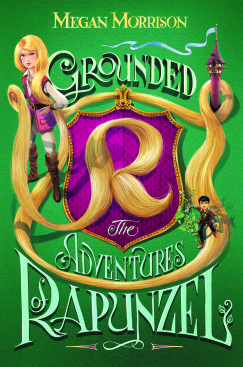
Megan Morrison's cover for Grounded: The Adventures of Rapunzel, book 1 of the Tyme YA fantasy series.
See Morrison’s web site, https://meganmorrison.net/books/ for more about the book and where to find it.

Grounded starts with the classic “once upon a time” beginning, but from there, Rapunzel is nothing like the princess you expect to see in the story. We readers can tell the imprisoned Rapunzel is a spunky girl, even though she has been thoroughly gas-lit by the witch (whom she knows only as Witch) into believing her life is perfect. As in the story, Rapunzel has freakishly long hair, and the only way to get into her tower is by climbing up her braid. Witch calls out, Rapunzel lowers her hair via an ingenious little wheel device, and Witch climbs up. But one day, a strange boy appears instead. Exciting adventures ensue, and the result is. . .well, you know the fairy tale, so you know roughly how it turns out. But you’re probably not counting on all the twists and turns Morrison takes you on the pathway to solving Rapunzel’s mystery and fulfilling her quest.

Morrison’s ingenuity is one of the book’s many pleasures. All the tropes are there, but often fractured and stood on their heads. Witch, for one–is she thoroughly wicked? What motivates her? The complications of the wicked witch trope are by now pretty familiar. Gregory Maguire’s Wicked, for example, retells the Wizard of Oz story through the witch’s point of view, and other writers have done similar things with wicked witches. Morrison is able to take this potentially tired newish twist in delightful new ways.

Another device Morrison uses with aplomb is the combination of the Rapunzel story with other fairy tales. In this novel, the most important of these is the Jack and the Beanstalk story, another tale of a plucky main character with a tall structure to climb. Not to mention one of the most endearing of all the features of this endearing book, the fairy tale of the Frog Prince.

The characters themselves are part of the fun. They don’t talk and act like cardboard cutouts from some stereotyped story. They are fully developed and very human (or amphibian). The magical parts are skillfully sifted into the human parts, often with comic effect. Rapunzel’s hair, for example. She does get out of her tower and goes on an elaborate quest, but who could do that and at the same time manage yards and yards of heavy hair?

The world-building is pretty ingenious, with plenty of interesting fairy lore. I’m guessing the other books in Morrison’s Tyme fantasy series do even more with it. If anyone has read them, report back!

There’s a flirty hint of romance, too, but nothing too strenuous. Most important, nothing that takes away from Rapunzel’s determination and ingenuity and grit. She is a great girl role-model, no swooning princess waiting in a tower to be rescued. There’s a whole lotta rescuing going on here, but a lot of the rescuing is by Rapunzel herself.

I really enjoyed this book and highly recommend it. I haven’t read the others in the series, but if they are anywhere close to this ingenious, they’d make a great gift for anyone in grades 5-9. Or. . .for someone older. Someone a whole lot older. . . /wink

COMING UP NEXT: My discussion of Measha Stone’s Tower. NOT a book to give to a kid. Be warned.

Heading into Valentine Week!

THE RETURN OF FAIRYTALE FANTASY

LAST YEAR: fantasy based on fairytales from around the world.

THIS YEAR: three books each from two beloved fairytales, RAPUNZEL and CINDERELLA

FAIRY TALE: This term is confusing. Frequently, tales we call “fairy tales” don’t involve fairies at all, and the books I pick for this Valentine feature may or may not include fairies–fae–the fair folk–whatever you call them. Besides, fae fantasy is a subgenre all its own. As I use the term here, “fairy tale” is a synonym for “folk tale,” stories from anonymous tellers of tales, passed around orally, often for centuries, before they are written down. I should mention two cautions: except in passing, I won’t deal with Disney re-tellings. Also, some of the stories we think of as “fairy tales” aren’t fairy tales (folk tales) at all, but are works of literature crafted by individual authors, communicated to their readers for the first time in writing. Examples of these: Alice in Wonderland. Peter Pan. Pinocchio. The Wizard of Oz. These aren’t fairy tales, although they were written to resemble fairy tales. They’ve just entered the popular imagination and have been re-told so often, in so many different ways, that they’ve reached the status of fairy tales.

FAIRYTALE FANTASY: Contemporary re-tellings of fairy tales (folktales), maybe in combination with other fantasy tropes.

RAPUNZEL:

The first three books I’ll discuss during Valentine Week are re-tellings of the popular tale about the girl imprisoned in a tower who must let down her long hair for a witch (and later, a prince) to climb up.

First, a little background. Rapunzel is an interesting hybrid. Its main motif (most recognizable trope) is “the maiden in the tower,” which the Aarne/Thompson folklore index identifies as “Type 310.” This motif has been found in folklore worldwide. It’s part of the story of St. Barbara, as imagined by the medieval French writer Jacobus de Voraigne. His collection of saints’ tales, which became popularly known as The Golden Legend, enjoyed a huge readership throughout 13th century Europe. Here it is, translated into fifteenth century English in the famous early English printer William Caxton’s version of The Golden Legend. An even earlier tale, a very important Persian 10th century text, contains many of the same story elements, especially the idea of using a woman’s long hair like a ladder.

In the form we usually know it, though, the tale actually comes from two literary sources, one Italian, one French. So the tale itself is not actually a folktale (fairy tale) in spite of its use of folklore motifs and the story of St. Barbara. Confusingly, the Brothers Grimm, German collectors of folktales and the source of many tales we think of as fairy tales, “collected” it as if it were a piece of folklore. It’s not.

In 1632, Giambattista Basile published Petrosinilla (“Little Parsley”). This is the first version that tells the tale we know so well, with a few differences: a wife with pregnancy cravings (not the father) steals a plant from the garden of a witch and has to promise her unborn baby to the witch. The witch imprisons the child in a tower, a prince finds her there, and they escape together. The “escape” part involving magical objects really is drawn from several folk sources, so although Petrosinilla is a “literary” fairy tale, it does have folkloric elements. In 1637, Charlotte-Rose de Caumont de la Force, a French noblewoman, published her own version, Persinette. Here‘s a blog that recounts the tale–the title of the post claims it’s the text of the tale, but the blog post suggests it’s the blogger’s retelling. The de Caumont de la Force version is much closer to the one we know, especially since it is the version the Grimm Brothers put in their collection. A German 19th century translation changed “Little Parsely’s” name to Rapunzel, and included its most famous line: “Rapunzel, Rapunzel, let down your hair.” The Grimm Brothers took it from there. You can refresh your memory of the classic (to us) Grimm Brothers version by reading it HERE.

In popular culture: many, many fairytale retellings for children include Rapunzel.

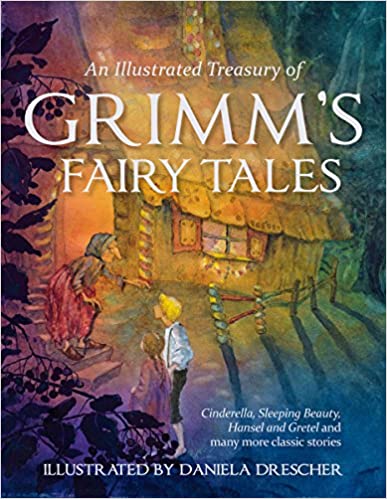
Grimm's Fairytale collection
Here’s an example.

Of course it has also gotten the Disney treatment in Tangled.

Here are the three (very VERY different!) Rapunzel retellings I will review this year. There’s something for everyone in this list, and I do mean everyone. Warning: Don’t just send a child to read these three, or not before you investigate, either on your own or through my blog posts. Only one of these is kid-friendly.

Megan Morrison’s Grounded

Measha Stone’s Tower

Kate Forsyth’s Bitter Greens

CINDERELLA:

The next three books I’ll discuss in this Fairytale Fantasy Week series of blog posts is the fairy tale most familiar of all to most readers (American readers, anyhow). Yet it, like Rapunzel, is more of a literary fairy tale than a folk tale. Unlike Rapunzel, though, Cinderella has many more folklore precedents.

Here’s a recap from last year’s series of blog posts. I discussed another Cinderella retelling, Gregory Maguire’s Confessions of an Ugly Stepsister, last year. It’s a wonderful novel, a great historical novel about the famous Netherlands “tulip bubble” that the author gave a Cinderella twist, so I’ll send it a quick shout-out, even though I’ll be discussing different Cinderella retellings this year.

Here’s what I said last year about Cinderella’s folklore, literary, and pop culture underpinnings:

Cinderella, as most American readers know it, has filtered through to them through (shhh. . . Walt Disney’s animated movie version from 1950) a number of English language versions. The real ancestor of the English-speaking world’s Cinderella, though, is Charles Perrault’s French version of the story from 1697, Cendrillon ou la petite pantoufle de verre (Cinderella, or The Little Glass Slipper). Through the Perrault version, the story acquired the pumpkin coach, the fairy godmother, and especially that glass slipper. (Why doesn’t the glass slipper break and cut Cinderella’s foot? It’s magic! It’s fiction! Don’t ask!) You can read a translation of the Perrault version HERE.

But the story is truly ancient. Scholars have traced it back to ancient Greece and the tale of Rhodopis (“Rosy-cheeks”). Think only scholars know that one? Nope. It makes an appearance in the MMORPG Everquest II as one of the sillier quests in the Rise of Kunark expansion pack. Among others, there’s an Italian version, a German version (the Brothers Grimm collected that one, Aschenputtel), and a number of Asian versions. A lot of versions, a lot of variations on the story and its details. Folklorists classify it as Aarne–Thompson–Uther type 510A, ” The Persecuted Heroine.”

Whatever its true origins, the tale really resonates for generations of young women, especially those who long to become a “Disney princess.” The implications of this longing were explored most famously by the feminist theorist Colette Dowling, in The Cinderella Complex: Women’s Hidden Fear of Independence (Summit Books, 1981). The book discusses the Cinderella fairy tale as the template for contemporary women’s longing to be swept off their feet by some powerful male and taken care of.

Here are the Cinderella retellings I’ll blog about this year:

The three (again, as in the Rapunzel books, very different) Cinderella retellings:

JJA Harwood’s The Shadow in the Glass

Laura Wood’s A Single Thread of Moonlight

L. Philips’s Sometime After Midnight

LET FAIRYTALE FANTASY WEEK BEGIN!

Look for my discussion of Megan Morrison’s Grounded next.