

Étienne Carjat‘s photo of Jules Verne around 1884. Image accessed through Wikimedia Commons, in the public domain.
Jules Verne, frequently named the Father of Science Fiction, was born on Feb. 8, 1828 in Nantes, France. He died in 1905. Along with Agatha Christie and Shakespeare, he is one of the most translated writers in the world.
Jules Verne was my father. . .
Ray Bradbury, introduction to S is for Space (1966)
During all my posting over Valentine Week, I realized I was missing an important milestone: Jules Verne’s birthday. So happy belated birthday, JV!
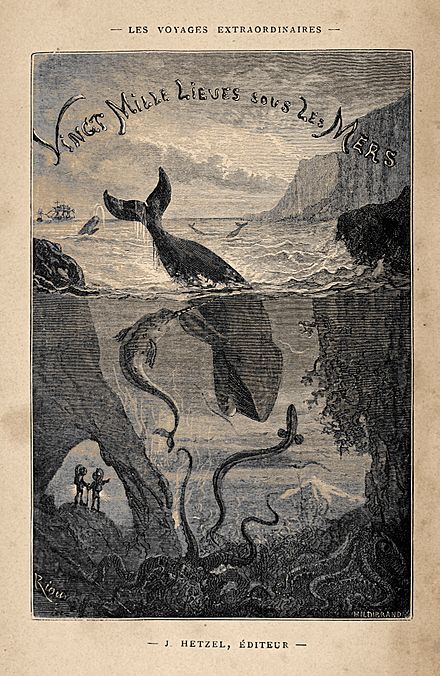
If Verne is not the inventor or “father” of science fiction (that may actually be the astronomer/scholar Johannes Kepler), he is certainly the granddaddy of contemporary SF (some would name H. G. Wells instead.) It’s just possible that Pierre-Jules Hetzel, Verne’s publisher, deserves that honor, though, because Hetzel commissioned Verne to write a series of scientifically-themed adventures in his quest to further scientific education. Whoever deserves to be called “Father of Science Fiction,” Verne is the one usually named. In honor of his birthday and his enormous significance to the world of speculative fiction, I just re-read the book for which he is best known: Twenty Thousand Leagues Under the Sea.
I say I just re-read the novel. Did I? I may have read it for the first time last week.
Twenty Thousand Leagues is one of those books we all think we’ve read but many of us actually haven’t. Examples include Gulliver’s Travels, Robinson Crusoe, Alice in Wonderland, The Wizard of Oz, Tom Sawyer. We all know those books—or think we do— but often we’ve merely encountered their plots, characters, most fascinating features through pop culture means— movies, for example, such as the great 1939 MGM film of Wizard of Oz starring Judy Garland. We may have read others repackaged as kiddie books, everything from the Disney version of Alice in Wonderland to kid versions of Gulliver’s Travels that include only the Lilliputians or maybe the Brobdingnagians, writ cute. But there are editions for adults that carefully excise anything that might seem too much for a contemporary reader. For example, this version of Robinson Crusoe retains all the adventure parts, simplifies the language, and eliminates the parts that make the book, essentially, a Protestant Puritan religious tract.
Is Twenty Thousand Leagues like this, and is that why I’ve always felt I read it while never actually doing that? I’m embarrassed to admit, thinking back to myself as a young reader, what I might remember is the Classics Illustrated comic book version of the book. If you’re old enough, you too may also remember this series of comic book retellings of “classic literature” that served, for many kids, as a pre-Cliff’s Notes/Spark Notes crib sheet when they were assigned a “hard” book in school.

In my recent experience of reading Verne’s seminal novel, I figured this was my first trip through the real thing.
Actually, I have my doubts I’ve done that, even now.
Full disclosure, I’m old, but at least I am much too young (as in, not even born yet) to have seen the 1916 silent movie released by Universal. It looks pretty unintentionally hilarious, and but the under-sea scenes were state of the art. I bring this up because the edition I read (1917), on Google Books, was the movie tie-in edition (must have been among the first of these marketing tricks) with stills from the movie. I was actually pretty enthralled–this is a photographic facsimile of the edition from the University of Virginia library, complete with a photo of the inside back cover record of when it was last checked out. Old-school! This version is also apparently based on a soundly derided early (1873) translation by Lewis Page Mercier that makes a ton of silly mistakes, not to mention, um, mercifully cutting out some of the endless descriptions of the sea, sea creatures, the sea bed, sea technology. . . If only I had gone to the Project Gutenberg edition, which is based on a much later, much more accurate translation by Frederick Paul Walter, including a restoration of the deleted parts. But if I had, I might still be reading.
As I turned page after page of meticulous names and descriptions of the molluscs and what-not viewed by our hero, Professor Aronnax (okay, so I skimmed a little. So sue me.), I had to wonder what the purpose of all this nerding out on sea-life was doing for Verne’s story. I suppose we might consider this book the hardest of hard SF, setting the hard SF standard. We learn all about this fantastical undersea world in detail so realistic-seeming that even though many of its details aren’t in fact realistic, most readers think they are. All about the technology of Verne’s imagined submarine, the Nautilus. All about exactly where, geographically, and at what exact depths, the submarine was at all times during its double circumnavigation of the globe. Twenty thousand leagues of circumnavigation. (So the actual title should have been Twenty Thousand Leagues Under the Seas, or Beneath the Seas, keeping sillyheads like me from thinking, “So, when do they go twenty thousand leagues down? That doesn’t seem possible, but then, Journey to the Center of the Earth, right?”)
However, in the novel’s defense, submarines–which were very primitive in Verne’s day–have indeed gotten as sophisticated as he suggests, the South Pole has indeed been discovered (just not where Verne puts it in Twenty Thousand Leagues), there are indeed giant squids in the deep (just not with the same number of arms as he thinks), and the sea is still mysterious, still exerts a powerful hold on us, still hasn’t yielded up all its mysteries.
It helped when I understood that the book was written in parts to be released bit by bit in the service of science education. I also had to remember that when this book was first published, the public was enthralled by the real-life adventures of real-life explorers such as Roald Amundsen, David Livingstone, Robert Falcon Scott, Robert Peary, Sir Ernest Shackleton, Richard Francis Burton, Alexander von Humboldt, George Mallory, Percy Fawcett (about Fawcett, read David Grann’s wonderful The Lost City of Z, which not only tells Fawcett’s story and Grann’s own but discusses what drove such men to feats that led to discovery and often, death. Just don’t watch the bad movie).
The deep seas were the Final Frontier to Verne’s readers. Obsessed Captain Nemo-like larger-than-life figures were fascinating to Verne’s readers, and remain fascinating today. The whole mystery surrounding Captain Nemo is fascinating, especially since Verne never explains it. Political objections by his publisher suppressed that part of his novel, although in a less-than-satisfying sequel (which, full disclosure, I have not read), The Mysterious Island, Verne reveals Nemo’s nationality and the reasons for his Ahab-like thirst for revenge. Apparently these are not the real nationality/reasons, though. Walter, Verne’s translator, explains how and why Nemo morphs from Polish nobleman oppressed by the Russians to Indian ruler oppressed by the British.
I really like Mike Perschon’s argument, in “Finding Nemo: Verne’s Antihero as Original Steampunk”, Verniana, 2/1/2010, that Twenty Thousand Leagues is the ur-Steampunk novel. I really like the widespread comparisons of Nemo with Melville’s Captain Ahab–not at all a fanciful connection, since Twenty Thousand Leagues mentions Moby Dick in chapter one. Nemo is a good reason to read Twenty Thousand Leagues. He’s a great character. Much like Milton’s Satan (at least according to the Blakean school), he’s the tormented bad boy who provides the real interest, much more than the pallid Aronnax.
In S is For Space (1966), Ray Bradbury wrote, “Jules Verne was my father,” adding, “H. G. Wells was my wise Uncle. Edgar Allen Poe was the batwinged cousin we kept high in the back attic room.” That’s why I’m making this tribute to Verne. Not because I liked reading Twenty Thousand Leagues, particularly, but because Verne’s novel, and all his others, charted a path and left a legacy. All of us are his beneficiaries.
A personal footnote to the “deep seas as Final Frontier” idea, and this doesn’t say very much about Verne, except as a man of his time, so you can skip it if you’ve had enough: Verne wasn’t just fascinated with scientific exploration for its own sake, but for the technology it advanced, developed, and supported. This is an era where Thomas Edison was practically a god. For Verne, at least if Twenty Thousand Leagues is any indicator, the big hero was Matthew Fontaine Maury, “The Pathfinder of the Seas.” At one time, Maury was. . .well, not as well-known and revered as Edison; no one was. . . but a venerated figure. Until well into the twentieth century, his works on geography and oceanography were used as university textbooks. A number of times in Twenty Thousand Leagues, Aronnax exclaims stuff like, “The learned Maury!” (p. 275, for example, in the edition I read) and in his many, many (many, many, many) descriptions of sea creatures and the features of the ocean’s floor, Aronnax cites Maury’s books. Maury was the man who, with the entrepreneur Cyrus Field, led the laying of the first transatlantic telegraphic cable, the communication technology that began the process of turning the globe into a village. (When I recently flew over the Maury Trench in the North Atlantic, I was thrilled. And a little unsettled. I think it may have been renamed on some maps.) In a scene in Twenty Thousand Leagues, Nemo is incensed to discover some rascal has tried to damage the cable. Nerd out more here about the gutta-percha covering that Aronnax is ecstatically happy to discover.
So Maury was quite a guy. He was also: 1. an ancestor of mine. 2. a commander in the Confederate Navy. 3. The architect of a Mexican colony that, after the defeat of the South in the Civil War, tried to establish a safe haven for Southern slaveholders to continue the practice of treating human beings like cattle. A mixed legacy, you might say. Decidedly mixed. Decidedly revolting.


 Fantastes
You must be logged in to post a comment.