Two More Short-Listed Arthur C. Clarke Awards Novels

In my quest to read all the short-listed for the 2024 Arthur C. Clarke Awards, I have devoured two more. Ugh–no, I devoured one of them, and the other I choked down. They are:

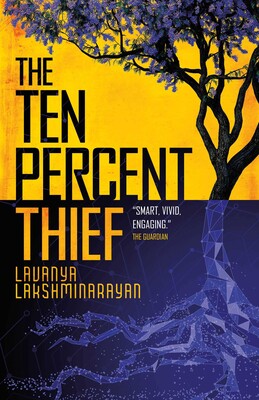
  • Lavanya Lakshminarayan, The Ten Percent Thief, Solaris, distributed by Simon & Schuster, 2023
  • Martin MacInnes, In Ascension, Grove Atlantic, 2023

Look HERE for my reviews of the first two I read.

And here are my reviews of the next two, in the order I read them:

Lavanya Lakshminarayan, The Ten Percent Thief
Find out about it HERE.

Brace yourselves. Some things, however hard, have to be said.

This novel, originally titled Analog/Virtual, is an extremely broad satire presenting a mosaic of characters and situations in a dystopian Bangalore. Here, society has undergone a draconian division between the haves–people whose every thought, twitch, and impulse is governed by a digital algorithm–and the have-nots, people living in squalor without benefit of a digitally-enhanced environment. The novel touches briefly on the devastation of climate change but is mostly about the drastically different quality of life people experience on either side of the analog/virtual divide. When the downtrodden Analogs revolt, a kind of very slow-motion, leadenly-described, predictable violence ensues.

I really don’t know what to say about this novel. It’s actually a series of sketches which, taken together, do not form much of a coherent narrative, and all of them relentlessly pound the author’s point home, like a hammer to the head. I couldn’t tell the characters apart. The writing is wooden. Why was this novel nominated for a prestigious award? Sorry, I don’t want to be overly harsh here. Using satire as its main method, the novel does speak to our society’s problem with rampant shallow thinking driven by social media and over-reliance on computer technology. I think the point could have been made in a much shorter form, though. In fact, this particular piece of short-form satiric fiction has already been written: E. M. Forster’s dated but still affecting “The Machine Stops.” A hard-hitting piece of journalism might have been a better way to get the point across, too. I was very disappointed in this book.

As I explored my mostly negative reaction to The Ten Percent Thief, I thought more deeply about satire in general and dystopian novels employing satire in particular. Satire is very hard to pull off in novel form, but it has been done brilliantly. Brave New World, for example, has a biting satiric edge, and while Huxley’s characters are nowhere near as well-developed as Orwell’s in the often-compared 1984, they do function as recognizable characters. Margaret Atwood’s The Handmaid’s Tale is another example–it, like Lakshminarayan’s novel, is a bunch of fragments, and some of its satiric touches are a bit heavy-handed. Unlike Lakshminarayan’s novel, The Handmaid’s Tale‘s fragments make sense as a plot device, and the moving tragedy of the main character’s situation far outweighs the satire. Her main character, a woman who doesn’t even have a name, is worlds more vivid than any of the characters in The Ten Percent Thief. The satiric novel has always had this problem, though, all the way back to the beginning. Is Gulliver’s Travels a novel? It was written at the dawn of the form and has many novelistic traits, but maybe isn’t a novel (also: not a children’s book!). I’ll leave that whole discussion for the 18th century lit experts, but this is a general problem and has been from the beginning. American Psycho, as it turns out, is satire, although the hapless reader doesn’t realize it for hundreds of pages of gut-churning nastiness. But, unfortunately, I found Lakshminarayan’s novel just pretty shallow and a slog to read.

To be fair: Here’s another thought about why The Ten Percent Thief was nominated for an Arthur C. Clarke Award, and it’s a matter of taste. I read widely–literary fiction, genre fiction of all types, everything I can get my hands on. I have four criteria for excellence in the novel, any novel of any type, and in this order: 1. quality of writing. 2. characterization and whether it fits the author’s vision. 3. world-building/setting/concept. 4. plot. Now–a lot of readers would put my no. 4, plot, in the no. 1 spot. I’m thinking of people who love “airport thrillers,” for example. And a lot of readers, especially SF readers, would put my no. 3, world-building/setting/concept in the no. 1 spot. This, right here, may explain my very negative reaction to this book, because–forget nos. 1, 2, and even 4–The Ten Percent Thief is all no. 3, all the way, all the time.

I’ve encountered this before, and I always come up with the same reaction: if that’s all you want to do, dear author, why not produce a nice quick PowerPoint instead?

But you, dear reader, may value your books very differently, and you may like this book. Its nomination for the Arthur C. Clarke Award suggests you have plenty of company even if at least one reader (me) can’t see why.

Martin MacInnes, In Ascension

Find out more HERE.

Like Chain-Gang All-Stars (previously reviewed by this blog), In Ascension has reaped accolades from readers of both literary and genre novels, with award nominations for both types of readers (often the same reader–me, for example). Chain-Gang All-Stars has been nominated not only for the Arthur C. Clarke Award but for the National Book Award, while MacInnes’s novel has been long-listed for the Booker Prize, one of the most prestigious awards for novels written in English. And, of course–short-listed for the Arthur C. Clarke Award, the fourth novel I’ve read in my quest to read every book on the list before the awards announcement on July 24th.

I didn’t believe any novel could top Chain-Gang All-Stars in my favorites category, but In Ascension is at the very least tied, if maybe my new favorite. The two novels are so different that it is really hard to choose between them, and probably unfair to try. I’m imagining that will be a big problem for the awards judges.

In Ascension is an astounding novel. It is beautifully-written, lyrical and meditative. The plot involves a young marine biologist whose discoveries and experiences on a previous and very mysterious oceanographic expedition have led to a coveted position on a team needing her expertise for a different kind of expedition entirely. Set against the backdrop of an environmentally-damaged and maybe dying earth, this novel explores deeply what it means to be human, one among countless life-forms inhabiting the planet and the universe. It’s a novel of discovery and loss, the small-scale mysteries of family relationships alongside the deepest mysteries of life. What a novel. It checks all of my boxes, 1 2 3 4, all at once, as all the best novels do. This novel cites Clarke’s Third Law: “Any sufficiently advanced technology is indistinguishable from magic.” Fitting that it is short-listed for the award honoring Clarke. If any novel serves as an avenue to understanding Clarke’s Third Law, this one does.

Two Powerful Contenders for the Arthur C. Clarke Award

Any of you following this blog know that from early May, my intention has been to read as many of the novels nominated for “best” category by the four biggest speculative fiction awards as I can. I started out with the first to hold its awards announcement, the 2024 Nebula Awards, and managed to read all the short-listed novels for “best novel.” You can read my reviews of each on this blog. The 2024 Locus Award short-list, coming so soon after the Nebulas (and, more to the point, so soon after I made my resolution), was a much, much bigger challenge. How does the saying go? Too many books, too little time? I couldn’t read all of them. But at least there was a bit of overlap with the Nebula list. I had to be content with that. Meanwhile, I am sprinting to read every one of the 2024 Arthur C. Clarke Award short-listed nominees before the July 24th announcement of the winner. I came to a belated realization that I needed to add this list to my other three (Nebula, Locus, Hugo) because I’m a reader in English, and even though the Arthur C. Clarke Award only goes to a writer published in the U.K, that still covers most of the English-speaking world. One of the first two writers I’m reviewing is a U.S. writer.

Awards, of course, aren’t the be-all and end-all. For whatever reason (maybe chiefly that indie writers aren’t usually included–a bit of a self-serving complaint, since I am indie-published myself), every novel that deserves a reward isn’t on these lists. That said, the short-lists for the major speculative fiction awards are an extremely helpful way to keep up with newly published novels (also other forms) in this cluster of genres.

Onward to my first two reviews of 2024 Arthur C. Clarke Award short-listed best novels. They are all SF, no fantasy, because SF is the only genre this award recognizes.

They are, in the order I’ve read them:

Emily Tesh, Some Desperate Glory (Macmillan–Tordotcom 2023)

Nana Kwame Adjei-Brenyah, Chain-Gang All-Stars (Penguin/Random House 2023)

Emily Tesh, Some Desperate Glory

Find it here.

I suppose this novel was short-listed for the Locus best new novel award–and not just for best novel– because Tesh’s World Fantasy Award-winning Silver in the Wood is actually a novella. Now, although Some Desperate Glory did not win in its Locus Awards category, it is short-listed for both the Arthur C. Clarke 2024 Awards and the Hugo 2024 Awards for best novel. Quite an achievement.

I was puzzled by this book at first. Not that I don’t enjoy a rousing space opera, but it seemed at first like an Ender’s Game sort of book, and given other nominated books this year, I didn’t think that would be enough for a major award. There are clues right away, though, that within the space opera wrapper and the space academy trope, this book offers a pretty deep experience. The first clue is the title. Do you recognize it? It’s from Wilfred Owen’s great poem about the horrors of World War I, “Dulce et Decorum Est.” Please read it if you haven’t, or if you haven’t in a while. It’s a terrific poem. But here’s the last stanza. If you could see the horrors I’ve seen, the narrator of the poem tells us,

My friend, you would not tell with such high zest
To children ardent for some desperate glory,
The old Lie: Dulce et decorum est
Pro patria mori.

Owen’s poem quotes another poem, a famous ode by the Roman poet Horace. “Dulce et decorum est/Pro patria mori” translates “how sweet and appropriate it is to die for one’s country.” This is a poem every schoolboy in England at the turn of the twentieth century would have known as the highest patriotic sentiment. And that schoolboy, statistically speaking, was soon to have an excellent chance of dying a horrible death in the trench warfare of World War I, a war which killed off an entire generation of young English, French, and German men, among others–including Wilfred Owen himself in the last weeks of the war.

So–a first clue about Emily Tesh’s intent. And the book goes on to ratify the clue–it’s a novel of child soldiers inculcated by their cynical elders with the patriotic ardor that will lead them to their needless deaths.

The novel is more complicated than that. The epigraph to the novel is our second clue, a quotation from the ancient Greek playwright Euripedes’s great Medea: “I would rather stand three times in the battle line than give birth to one child.” That line tells us how dangerous it was to be a woman in a society with scant medical help for women giving birth, and that’s the type of society Emily Tesh’s characters inhabit. The quotation (revisited several times in the novel) also makes us wonder, the moment we see a good number of the novel’s teenaged soldiers are female: what’s about to happen to these female soldiers? What will they be called upon to do as their patriotic duty to an all-consuming state?

More clues: chapter titles, character names, many taken from heroic Nordic or Graeco-Roman heroes and gods of old. These titles and names reinforce the idea of a militaristic society. For example, the novel’s villain is named for the Roman conqueror of the British Isles. The main (female) character’s name evokes the word valkyrie. The training exercises for the teenaged soldiers take place in a virtual reality facility called the agoge– a Spartan name for the rigorous training undergone in perhaps one of the most militaristic societies of the classical world. How many fantasy and SF novels have been set in a kind of Spartan- or Roman-inspired militaristic environment? Again, if we really think about this kind of clue, it leads us to deeper questions. Why are most of the character names drawn from Nordic or Graeco-Roman mythology? What does this tell us about diversity in the world of Tesh’s novel?

I found all of these hints pretty fascinating. However–around the two-thirds mark, I was ready to quit reading. The book takes a very sharp turn. No spoilers, but I hate a book that plays tricks on the reader. I hate a St. Elsewhere ending (old, old tv reference!), and it looked to me like that’s where we were headed. Luckily, I didn’t stop reading. I was so wrong. Some readers like that trick-the-reader stuff and might eagerly read on, but if you’re like me and hate it, just. . .trust the book and keep reading.

I think it’s safe to say that every time a lesser novel might have settled for easy answers, this novel rises above them. It’s not just about young eager military trainees at the space academy. It’s not just about the horrors of war, either. It’s a very interesting read, and I can see why it was nominated for so many awards.

Nana Kwame Adjei-Brenyah, Chain-Gang All-Stars

Find it HERE.

I finished this book around an hour ago, and I don’t even know how I’m writing. I should be falling on the floor moaning in despair. This is one powerful book. It’s near-future dystopia, but it is also SF, because (unlike a book like, say, Paul Lynch’s Prophet Song) it includes plausible technology and institutions extrapolated from existing ones–but they don’t exist quite yet. Hence the nomination for the Arthur C. Clarke SF award.

The novel takes as its premise the idea that some near-future America might broadcast deadly gladiatorial-type games between convicted murderers as highly monetized reality tv. The novel takes its inspiration from a loophole in the Thirteenth Amendment to the U.S. Constitution. This loophole actually allows chattel servitude–slavery–in certain instances. That’s not science fiction. That’s fact. The exception in the Thirteenth Amendment abolishing U.S. slavery is for prisoners incarcerated for committing certain crimes. The U.S. has far and above the highest proportion of incarcerated people in the developed world, and the highest percentages of those people are drawn from minority populations. Not science fiction. Not exaggeration. Fact. It’s a national shame and blot, and it’s one of the foundational reasons for the national shame and blot that is the U.S. incarceration industry. Other writers of speculative fiction have tackled similar issues. I’m thinking of Margaret Atwood’s not very satisfying novel, The Heart Goes Last, for example. But I can’t think of any that are as powerful as this one.

A few things to know about this novel:

  1. if you are an easily distracted reader, try to get it in hard copy. The novel is peppered with footnotes, and if you are reading it in e-book form, you may find yourself repeatedly shuttling back and forth from the text of a chapter to the end of a chapter. I’m not sure about this, but I’m imagining a hard copy will be less distracting, because the footnotes will be right there at the bottom of each page. Whatever you do, don’t skip the footnotes thinking they will give you some kind of optional bonus content. They’re an integral part of the narrative fabric. And don’t be put off by the idea. Some of the footnotes are fictional, many are real, all are heart-stopping.
  2. This is a very American book about a very American problem. If you’re from another part of the world, you may not feel the horrible social consequences as much as a U.S. reader will. I’m not sure about that, being a U.S. reader myself and maybe lacking perspective. But British readers–maybe you’ve encountered Claire North’s dystopian novel 84K. Not exactly the same, but a similar kind of problem. Other parts of the world have their own horrifying social problems and will be able to empathize, I think.
  3. The premise might make you think you are in for a grittier, more adult Hunger Games. Think again.

This is such a powerful novel that right now, I can’t imagine anyone NOT giving it an award. The Locus Awards for first novel overlooked it. I can forgive that, since that award went to The Saint of Bright Doors, by Vajra Chandrasekera, which is also a very powerful and important novel. Chain-Gang All-Stars, though-wow. Along with a slew of other nominations for genre awards, this novel has been nominated for the National Book Award. That’s one of the main U.S.-based awards for literary fiction. As a reader of literary fiction, I’d say I trust that award’s judges more than I trust the judges for the Pulitzer Prize, at least where fiction is concerned. Speculative fiction doesn’t usually win that kind of award. I say that, and then I’m thinking again (always thinking about it a lot–a very, very powerful novel) of Paul Lynch’s Prophet Song, the dystopian novel that won this year’s Booker Prize.

And the winners of the 2024 Locus Awards are. . .

. . .too many to discuss thoroughly in this space. Here are a few of the winners in categories I follow, and no knock to shorter forms, which I don’t read enough:

Best SF novel: Martha Wells, System Collapse

Best fantasy novel: Martha Wells, Witch King

Best first novel: Vajra Chandrasekera, The Saint of Bright Doors

I don’t have much standing to comment on these. My project for reading all of the finalists for best novel posted by all the major speculative fiction awards was a bit too ambitious for me this year–I only decided to read this huge list of novels at the beginning of May–and that is especially true of the Locus Awards, coming so fast after the Nebula Awards. Next year I’ll do better! My take on the Locus Awards is that the vote is for fan-favorites, which is fine. However, Martha Wells is such a brand name that I feel slightly skeptical of the results. I should read more of her books to decide on that.

In the SF category: I need to read Wells’s System Collapse and see what I think. Among the runners-up, Ann Leckie’s Translation State (see my review HERE) is a really good book, and Annalee Newitz’s The Terraformers is simply superb. See my review HERE. To vote against either of those two must have taken a lot, and I can only hope all voters made a good-faith effort to read the entire list. As I say, I have little standing to comment or complain–there are seven other novels on that short-list that I haven’t read yet! One of the runners-up, Starter Villain, by John Scalzi, is nominated for the Hugo Award this year, so I plan to read that one soon in my quest to read every novel short-listed for the Hugo.

In the fantasy category: Witch King, the novel by Wells that I did read, was good but not overpoweringly good (only my opinion). Of the runners-up, I’ve only read S. L. Huang’s The Water Outlaws, which I liked more. See my reviews HERE and HERE.

In the first novel category: Here’s a winner I can enthusiastically endorse. Chandrasekera’s The Saint of Bright Doors just won the Nebula Award for best novel, and it richly deserves the Locus win as well. See my review HERE. I did love one of the runners-up, Wole Talabi’s Shigidi and the Brass Head of Obalufon. If that book had won either of these two awards, the Nebula or the Locus, I would have called it a great decision. See my review HERE. My gut feel is that Chandrasekera’s novel has more gravitas, and Talabi’s novel is more fun. I haven’t read any of the other short-listed books on the first-novels list for the Locus, but I am just about to finish one of them, Some Desperate Glory, by Emily Tesh. That novel has been short-listed for both the Arthur C. Clarke Award and the Hugo Award, too. I’ll be reviewing it soon. I’m on the last few chapters, and I had to put the book down to write this post! (Just put. the. book. down, Jane.) Another novel short-listed for Locus best first novel is Nana Kwame Adjei-Brenyah’s Chain-Gang All-Stars. I’ll read this one next and review it soon, because it is also short-listed for the Arthur C. Clarke Award, coming up fast on July 24..

As I’ve mentioned in preceding posts: I don’t read horror. I have nothing against horror. Some of my most admired writer-friends and mentors are writers of horror (John Skipp!) and some of my favorite novels in other categories of speculative fiction (China Miéville!) have more than a touch of horror in them. My own writing has been known to have a touch of horror in it. But I don’t really know horror and don’t feel I have enough insight into the genre to blog about it. I imagine anyone really interested in reading horror will find some good choices in the Locus Awards horror category.

And I feel bad that I don’t pay enough attention to shorter forms, especially the short story. That’s something I as a reader should remedy. I’ve been participating in the great George Saunders Story Club substack, where I’ve started re-acquainting myself with some of the masters of (literary) short fiction, so I’m making an honest start on that project. The categories for shorter forms short-listed for the Locus Award will give any reader of speculative fiction plenty of chances to discover something great.

Not to mention other media. . .The Hugo Awards are awarded in categories other than fiction in print form, and I may have to take a look at some of their nominees in film, gaming, long-form video/television, and all the rest. Essentially, though, I am a reader first, mostly a reader of novels, and that’s what this blog is (mostly) about.

And now, on to some heavy-duty reading, all of the nominees, all SF, for the 2024 Arthur C. Clarke Award, to be announced on July 24th.