In this post, I review the last of the seven short-listed nominees for the 2026 Philip K. Dick Award. I have proceeded through the list alphabetically. See earlier posts in this series for all the rest. A reminder–the awards are made by the Philadelphia Science Fiction Society and will be presented at Norwescon‘s annual conference on April 3, 2026.
The Nominees:
- Sunward by William Alexander (Saga Press)
- Outlaw Planet by M. R. Carey (Orbit)
- Casual by Koji A. Dae (Tenebrous Press)
- The Immeasurable Heaven by Caspar Geon (Solaris)
- Uncertain Sons and Other Stories by Thomas Ha (Undertow Publications)
- Scales by Christopher Hinz (Angry Robot)
- City of All Seasons by Oliver K. Langmead and Aliya Whiteley (Titan Books)–REVIEWED IN THIS POST
City of All Seasons by Oliver K. Langmead and Aliya Whiteley (Titan Books)
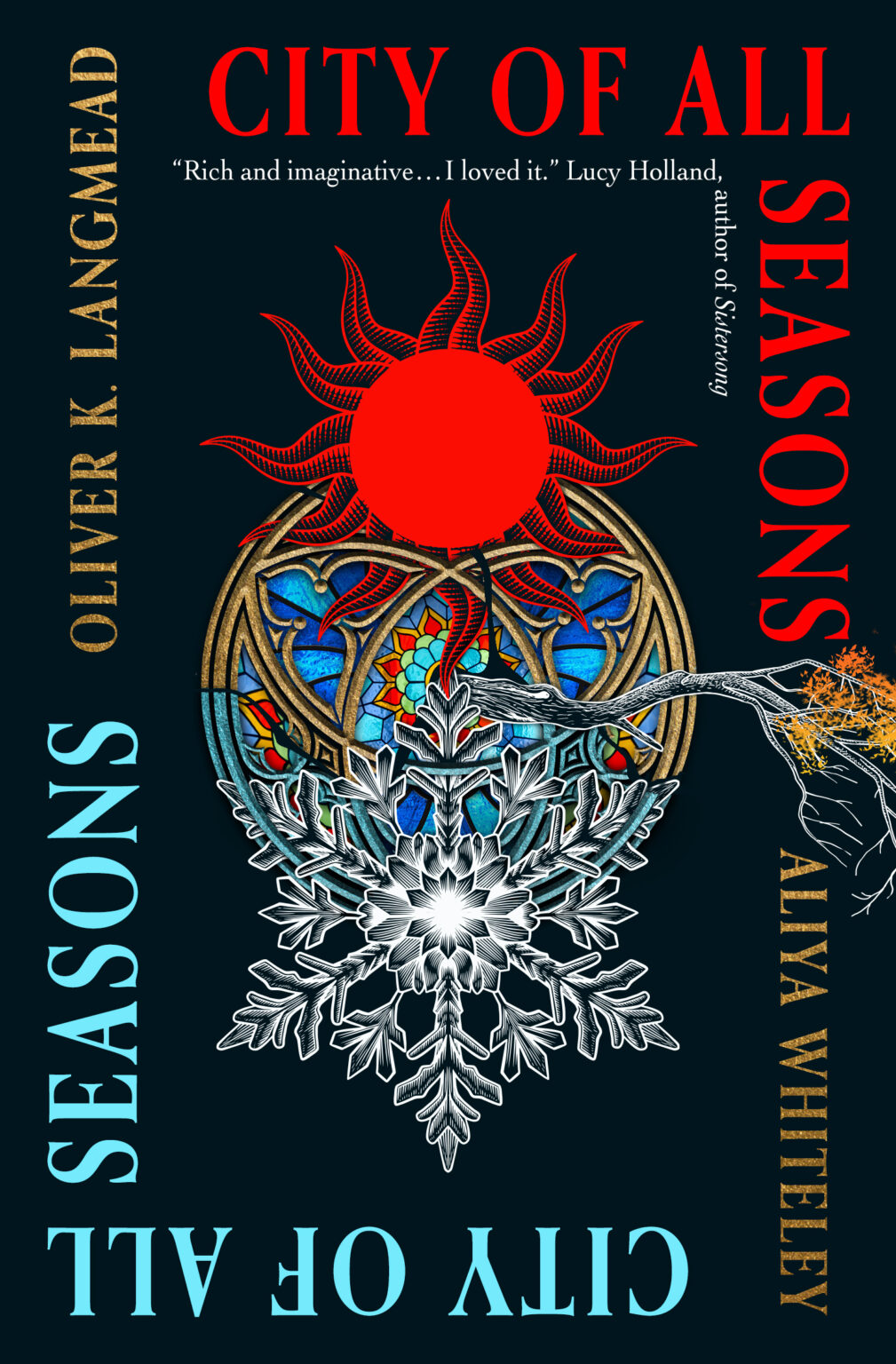
The gorgeous cover says it all about this experimental novel. It’s a novel about division and fracture–between civic visions, between family factions, and even within the individual. That makes it the story of our troubled, fractured times.
In the novel, a celebrated filmmaker named Pike, the leading citizen of Fairharbour, a city on an isolated island, is the controlling matriarch of a large and contentious clan. In the novel’s backstory, the matriarch has been murdered, and her city has been mysteriously and violently wrenched into two cities, one a city of hot, uncomfortable summer, the other a city of extreme frigid winter. The citizens of each have given up friends and family members for dead. Anyone trying to leave the island must pass through a barrier but can never come back, so there’s no way to find out what happened to their city through any information from the outside world. Each city’s inhabitants believe some mysterious “weather bomb” has descended on the city and they are the only survivors.
The disaster and resulting collapse of civil order allows an authoritarian to take control of each city. In the city of winter, one of the matriarch’s two sons employs the sinister Doormen to break down everyone’s doors and brick up every building, supposedly to protect against the freezing weather. In the city of summer, the other of the two sons employs a sinister Fenestration team to knock holes in all the walls, windows supposedly allowing more air circulation in the horrifying heat. All the citizens suffer, even the members of the Pike family, although the two authoritarians cut them more slack than others.
As the novel opens, a Pike family member in each city, mourning their close connection with their counterpart in the other, begins getting hints that a parallel but opposite city exists. Each begins wondering, then hoping, that their loved one is still alive, and each one begins devising intricate, enchanting objects to plant as clues for the counterpart to find. These two characters–Jamie in the city of winter, Esther in the city of summer–alternate telling the story.
As part of the matriarch’s huge, extended, rambunctious family, they have inherited the matriarch’s creativity and ingenuity, but they see mechanical and industrial skills as equal in importance and creativity to the matriarch’s own creative specialty, filmmaking. The grandmother asks one of the main characters, Esther, what kind of artist she hopes to be. “I thought,” Esther tells us, “deep down inside myself, that I didn’t want to be an artist at all but a maker. . .” Artist, maker. The novel asks whether there is actually a difference between the two. Esther really gets what it means to be an artist. When another character questions her motivations for creating a forbidden object, a glass harp–“You wasted all that glass. . knowing it would have to be broken?”–Esther’s response tells us a lot. “It’s the job of the artist to create, not to tell other people what to do with the creation.”
The novel is actually, I think, a huge extended poem or maybe extended metaphor. Both, I guess. As I began reading it, I was puzzled by the dystopian yet whimsical tone, by a setting where the technology suggests a world stuck in the ’50s, and by the erratic characters and plot developments. By the end of part one, told from Jaimie’s point of view, I had sort of figured it out. Then, as Esther’s point of view took over in part two, I got it–or thought I did. I was a bit disappointed by what I believed to be an ingenious but over-labored plot gimmick. As I read on, I discovered the novel is actually much stranger and more intriguing. By part three, I realized I was reading a call-and-response that was more about poetic concepts that believable plot.
This makes a kind of sense. One of the co-authors, Langmead, has written two verse novels. And the alternating points of view, the call-and-response structure, make sense of the dual authorship. I have to admit, when I see a co-authored book, my natural tendency is to steer away. I always think I’m about to encounter a manufactured object, not a real novel. A marketing arrangement, maybe. Especially in genre fiction, readers fairly frequently encounter books where one co-author has the “ideas” and the other has the words. Unfair, I know. What about all the brilliant collaborations in literary history? What about Gilbert and Sulllivan? What about Shakespeare’s collaboration with John Fletcher (and probably other uncredited or unknown collaborators)? City of All Seasons calls me out on my prejudice. Dual authorship, in this novel, only intensifies the doubling and dualities all the way through.
I ended up admiring this ingenious contraption of a novel, as ingenious and magical as the contraptions devised by Jaimie, Esther, and others in the authors’ novel–marvelous kaleidoscopes, puzzle boxes, glass harps. A contraption of a novel that provides us, the readers, with the clues we need to make sense of the fractured wider world beyond the fictional construct of the novel.
The whimsical tone, sometimes irritating, can be truly funny, too. In this maritime setting, Fairharbour celebrates The Turning of the Tides every year. The festivities involve the parading of an enormous tuna through the town, the eating of fish pies, the wearing of fish masks, and the like. (I’m reminded of Porto’s sardine festival with all the sardine hats.) Jaimie, the narrator of this part of the novel, faces a crowd and loses his courage. “I briefly flounder,” he tells us, before regaining his composure. Fish jokes!
The matriarch gives us a clue, too. Of her two wanna-be dictator sons: “You’ve always been boys with bricks. One makes a wall, the other knocks holes in it.”
I admired this novel but I had trouble reading it. Nothing made any overt sense in it, not in the ordinary way, so I as a reader was always looking for the surreal sense at the heart of it. But it’s a novel, and in novels, characters and plot do make sense. Usually. I do think fiction can establish a surreal world in which words suggest beyond themselves rather than try to nail things down. I think it’s very hard to bring off, though, especially at this length. And I don’t think this novel always works at the level of word, phrase, sentence as a great poem must. I’m thinking, for example, of China Miéville’s The Iron Council, where every word, phrase, and sentence does work. But then it’s just all too, too much. I ended up admiring City of All Seasons as a noble and very intriguing effort. Above all, I loved the call-and-response structure and its connection to the divided and the divisive. I admired its attempt to name and drop clues about and heal the breach.
 Fantastes