Here’s my next post reviewing the seven short-listed nominees for the 2026 Philip K. Dick Award. A reminder–the awards are made by the Philadelphia Science Fiction Society and will be presented at Norwescon‘s annual conference on April 3, 2026.
The Nominees:
- Sunward by William Alexander (Saga Press)
- Outlaw Planet by M. R. Carey (Orbit)
- Casual by Koji A. Dae (Tenebrous Press)
- The Immeasurable Heaven by Caspar Geon (Solaris)–REVIEWED IN THIS POST
- Uncertain Sons and Other Stories by Thomas Ha (Undertow Publications)
- Scales by Christopher Hinz (Angry Robot)
- City of All Seasons by Oliver K. Langmead and Aliya Whiteley (Titan Books)
The Immeasurable Heaven by Caspar Geon (Solaris)
Geon’s novel packs a myriad (pun, for those of you who have read the book) of worlds, characters, objects, and situations into 352 pages. I find that page count hard to believe. The publisher’s marketing copy assures me it is correct, but the novel seemed much longer than that as I read it in e-book form.
The novel comes across a bit like Gnumph, one of the novel’s few important characters standing out amid the welter of others. Gnumph is a fuzzy spore with the ability to expand hugely, to serve as a vehicle for travelers among all the many universes that populate the fictional world of the novel, and even to contain within himself a few extra dimensions encasing their own universes. Not like a Russian doll, though. They are speckled around him more haphazardly than that. Reading this novel is like boarding Gnumph and–like Gnumph’s passengers–discovering you can’t get off. Sort of a spherical Hotel California.
The premise behind the world-building is: there’s no single universe but instead the multiverse (by now an SF staple). But in Geon’s conception of the multiverse, the universes are all layered in strata like rock, and another is created every nanosecond. In this novel, I think we visit them all. That’s because characters in the know can escape any predicament in their own universe by Dropping–moving into a lower-strata universe than the one they currently occupy. Unfortunately, in this idea of the multiverse, yes, you can go down, but you can never move back up. Sort of a vertical Hotel California.
Or can you? This is murky. One of the main characters, a shadowy figure who begins the novel with the provocative statement, “They sent me to hell,” is determined to get his revenge on the people who did this to him (it?) by clawing his way back up through a flaw in the universes. But as he had fallen to his seemingly eternal fate, sort of like Satan in Paradise Lost, he had emitted a scream so horrifying that multiple beings in multiple universes pick it up via multiple senses. And it is so horrific that it even kills one of the listeners/smellers/viewers/touchers/tasters.
That’s the set-up. Then several other characters pursue him–one charged with her emperor to find and eliminate him, another a sort of bounty hunter looking to sell the knowledge to the highest bidder, and so on. But these are only a few of the multitudes and multitudes of characters in the multitudes of universes that are given names (as per usual in SF and fantasy, unpronounceable multisyllabic ones), and there are multitudes and multitudes more who are not named. But they are described. Multitudes and multitudes of them.
In most fiction, when the author gives a character a name, the name sends a signal to the reader: here’s a character you should pay attention to. This novel is not most fiction. With few exceptions, when this novel names a character, we never see that character again. Or that one. Or that one. Or that one, over there, or this one, over here, or. . . Do I sound annoyed? I am. But at the same time, I am in awe of the richness of the world the author has built.
The main characters really are interesting. Gnumph, the vehicle who is a spore. The personage of the horrifying yell. The two main characters pursuing that personage: Draebol, a person who has completed the monumental task of mapping the known universes and the pathways among them but then succumbs to despair. Whirra, a person sent out by her emperor to identify and thwart the guy who screams. (Why? Hard to say.) There are a few memorable others. In fact, when I could catch my breath and think about the screamer character, he seemed very Miltonic to me. I think of Satan in Paradise Lost contemplating “the immeasurable abyss.” I think of his vow to get out of hell and punish the creatures in the world above him. So is the title a reversal of this line from Milton? Maybe, maybe not. And why? Well, it’s indeed immeasurable, so there’s that. But we seem to stay in hell the entire way, unless you count a few idyllic episodes rapidly swept away into the sweep of all the other stuff. Above all, I wanted to stay with these major characters, and I wanted to understand their often inexplicable actions better. At the end, there’s a lot of back matter: lists of characters, place names, timelines, and the like. That helps.
Where this book does shine is in its endless descriptions. Each setting in the many, many, many universes is lovingly, intricately described right down to its (usually ) disgusting stench and defacatory and vomitory habits. Each body of each character is lovingly described–because for the most part, the characters never stay in one body. Every time they Drop, they acquire a new one. So not only do we have a bazillion characters to keep track of, but each one seems to have multiple bodies. Each one lovingly, intricately described. As I say, a world-builder’s delight. But I should also mention this book has one trait I prize very highly: the writing is great.
I think the problem and also the glory of the novel is that it’s an Hieronymus Bosch of a book. Think of an Hieronymus Bosch painting and all the wriggling, usually disgusting creatures who occupy every inch of canvas.
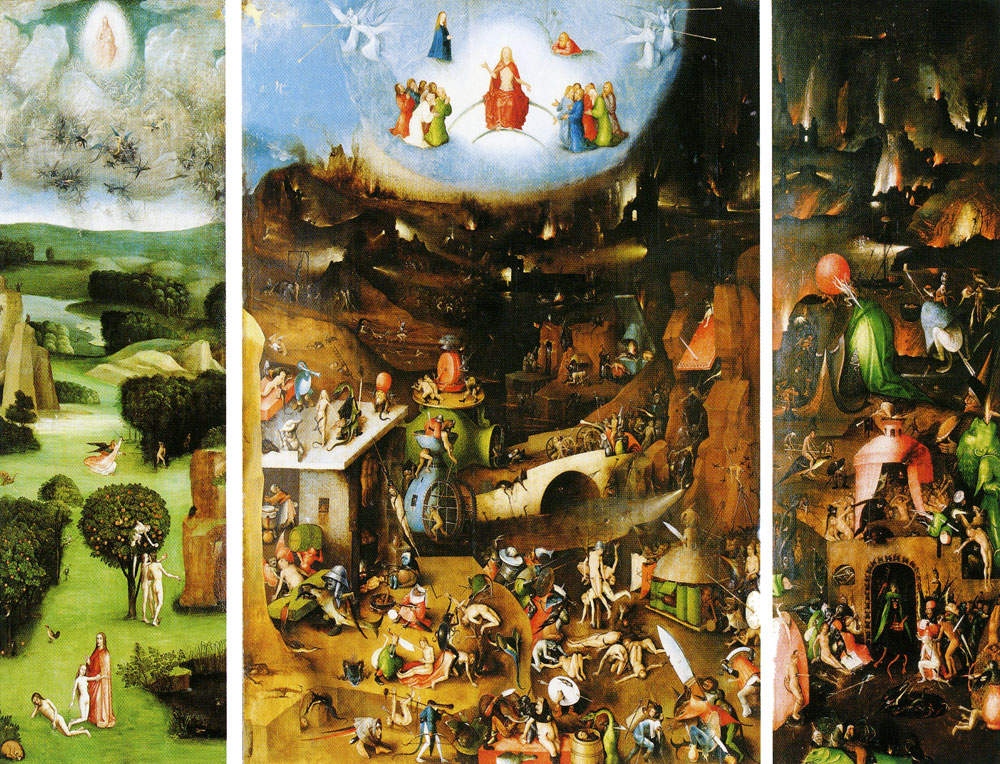
No, really. Enlarge it and take a good look. This novel is that, in book form. And I love looking at Hieronymus Bosch paintings. So why, I ask myself, don’t I love this book? I think it’s because we encounter a painting in a very different way than we encounter a novel. The painting hits our eye all at once. Our eye roams it, picking out details, always drawn back (in a good painting) to the whole–the pattern, the focal point, whatever the painting tries to accomplish. But a book is by its nature sequential. Page one–one detail. Page two–more. Page three–more. And so on. The task of the author is to unify all these sequential details into a whole by giving us clues all the way through about how they fit in. Page one of this book is a knockout. “They sent me to hell.” I love that first sentence. I want to know more. Who? Why? Who is “they”? What do they have against the speaker? etc. We finally do find out who this person is, but–at least for me–too little, too late. And while this book does give us clues to the overall picture (I think–I’m not sure I ever really got the overall picture, though), the clues are lost in a plethora of details that I found just distracting.
You are a different reader and you may feel very differently about this book. Many readers prize ingenious world-building above all other traits in a work of speculative fiction. You’re this reader? This is your feast. This is your book.
 Fantastes