Today, DAY TWO of FAIRYTALE FANTASY WEEK, I take a look at some of the many recent Robin Hood-themed recent novels and comment on two of them.
Every year during the week including Valentine’s Day, this blog explores a theme connected to fairytale fantasy.
What do I mean by fairytale? It may not involve fairies! This is a misleading word describing what anthropologists might call “traditional tales” or “tales from folklore,” especially one known to us from the oral tradition.
This series of posts will review Robin Hood retellings. In previous years, I have blogged about novels based on: fairytales from cultures world-wide, Cinderella and Rapunzel (two literary “fairytales”), dance-themed fairytales, and Little Red Riding Hood retellings. Click on the links to read those.
In the past, I’ve warned my readers that I will not deal with anything Disney. There’s the good Disney, the bad Disney, the downright ugly Disney, and occasionally there’s the brilliantly inspired Disney. All of it has its fans. I usually warn readers I’m not going there. This year I will. That’s because the Walt Disney animated Robin Hood movie from the ’70s is one of the best Robin Hoods ever. Oodalolly! AND there are very few other good Robin Hood retellings. Alas!
So that’s one problem with my Robin Hood posts this year.
The other is this: yes, Robin Hood is a piece of enduring folklore. His tales (see the preceding post) were mainly communicated via song. The folk ballad was a primary medium of storytelling among illiterate peasants and other people who couldn’t read or didn’t have easy access to books. And the Robin Hood folk ballads were widespread and widely known in the British Isles, beginning in the late medieval period or maybe earlier. So what’s the problem? If you consider fantasy to be a made-up tale with fanciful elements, such as tall tales and exciting, over-the-top feats of derring do involving swords (well, and in the Robin Hood story, longbows), Robin Hood is your man. But if you think of fantasy as having to do with bending the laws of nature in a magical way–there’s very little of that in the Robin Hood story. Swords, yes. Sorcery–not so much.
And that means the books I’ll be reviewing in these posts are more historical fiction than what we usually think of as fantasy fiction.
But here’s the hill I’ll die on: historical novels are just as much speculative fiction as fantasy novels or SF. The historical background of a novel is just as much a matter of the speculative imagination as a science fiction novel. The past is a mystery to us, in spite of what we think–perhaps not as much a mystery as the future, but amazingly close. The past is a country that is dead to us. To bring it alive takes a big imagination and a whole lot of speculation–like good SF, a whole lot of fact-based speculation.
As for Robin Hood retellings–yes, it is possible to cook in a little magic, and some authors have tried. These Robin Hood reboots generally seem to come in two flavors, though.
Flavor One: a retelling that preserves the folkloric atmosphere of the Childe ballads and the medieval texts. Older retellings, such as Howard Pyle’s (see my previous post) set out to do this–to transform the old texts and traditions into a single story a contemporary reader can enjoy.
Flavor Two: a retelling that asks the reader What if Robin Hood were a real person? What would he be like? What kind of world would he live in? What kinds of challenges would he face, and how would he handle them? From those questions, the writer builds a novel. Most recent Robin Hood retellings fall into this category.
I looked through many, many lists of Robin Hood retellings compiled by various organizations and readers. Here are a few:
- The Goodreads list is pretty comprehensive.
- The list on Bookriot is shorter, more curated, and accompanied by commentary and mini-reviews.
- The list posted on Bookshop.org, “Robin Hood Retellings So Good They Should be Outlawed.” I love Bookshop.org, and this is a worthy list.
Have at it. Dig through the dross to find the hidden gem for yourself!
I tried to. I really did. I discovered that a really satisfying reboot of the Robin Hood story is a hard treasure to come by. And please keep in mind: I ruled out the many, many retellings for children. Some of them are probably excellent, but my blog doesn’t usually deal with children’s literature. I also rarely deal with YA novels, popular though they are. I’ve had to review a few of them in this series of posts, though, because it’s just that hard to find a good Robin Hood read.
I say that, and I have to remind myself that readers look to speculative fiction for different joys. And of course any one reader might like some or all of these:
- Some readers want thrills, chills, action. They’re all about the plot, and they want ingenious twists and turns. They want cliffhangers, even (noooo!) cliffhanger endings. They want surprise endings, even the unearned kind that flimflam the reader. Especially those. I guess you can see I’m not this kind of reader, but many are.
- Some readers, especially speculative fiction readers, are in it for the world-building. Fantasy readers of this type often demand a magic system worked out to the nth degree. Some want the twists and turns and magic to be so ingenious and convoluted and spelled out that (in my opinion) you might just as well throw up a Powerpoint, turn all the plot points into bulleted items, and call it a day. These readers actually like the dreaded info dump. They’re the kind of gamers that there for the lore, while the rest of us are all just kill the monster already. I love a good well-built world myself, but I don’t think it should push to the foreground of the book and parade itself about.
- Some readers want to be able to identify with at least one of the characters and lose themselves in that character. I love that myself. But I love a good anti-hero too, the kind you love to hate. Has anyone ever written a better bad guy than Inspector Glokta? I ask you now. And Logen Ninefingers exists in a gray moral world himself. For some readers, though, the main character has to be sympathetic and likeable.
- Some readers want authenticity. The science in an SF novel they’re reading has to be accurate and at least plausible. My son-in-law the physicist sets a high bar for any SF novel he reads, I can tell you that. And a reader of an historical novel may want that book to be absolutely faithful to the facts as we know them. I’m kind of that reader when it comes to historical fiction, but I can be persuaded to love a book with a clever historical aroma as long as it does other things well. I also hate historical fiction that tries to be so faithful to its world that everything slows to a crawl while the author unloads a ton of historical trivia on us and/or tries awkwardly to mimic “ye Olde Englishe.” Ugh. Everyone addressing each other as thee and thou. This is rarely successful, because the author doesn’t often know, not really, what the English of the various periods and regions sounds or looks like. It seems to go along with the historical-novel-populated-by-cardboard-cutouts-in-fancy-dress type. Historical novel as visit to the wax museum. No, thank you.
Skip over this part if you want to. Old English aka Anglo-Saxon=a language a lot like German.None of us ordinary readers can read it without special training. HWAET!!! Middle English=comes in many dialects; the language of Chaucer is easy for us to read because modern English is more indebted to that dialect than others. “Whan that Aprille with his shoures soote the droghte of March hath perced to the roote. . .”–we can read that, right? yes, we can. If we need a little help, we can take a class or just cling to https://www.librarius.com; the language of Sir Gawain and the Green Knight, or Sir Orfeo, also Middle English, is really REALLY difficult for most of us to read. Modern English=yeah, okay, we speak it, am I right? So did Shakespeare. His language is not “Old English.” It’s not even Middle English. It’s modern English. So there are many modern Englishes, from many eras and parts of the English-speaking world, and some are easier than others for any one of us to read. AND NONE OF THIS JUSTIFIES AUTHORS WHO WRITE IN SOME AWFUL “Ye olde fantasye speake.” Historical novelists are guilty of this, too. Bad ones.
- Which brings me to what I really value in a novel, no matter what its ilk: good writing.
So to satisfy me, the poor Robin Hood retellings need to be historically accurate, or if not, they should be playful with history, and not heavy-handed about it. The world built out of these historical materials has to convince me. And the writing has to be good. I did find a few I might recommend. Here are three, one I thought more successful than the others. One is a romantasy, more or less, but historically themed. One is a straight-up historical novel. The other is a more traditional folk-tale retelling stitched together into an historical novel. No one of them is the iconic fantasy with the wizards in pointy hats and the poofs of magic. All three are “fairytale fantasy” in the sense that they recreate or riff off a traditional tale beloved through the centuries, taking place in a land and time far, far away–so far away from our ordinary experience here in the 21st century that it might as well be a galaxy far, far away.
What makes a good Robin Hood novel? These are the main tropes and characteristics, and any retelling may have some of them or all of them or play fast-and-loose with them:
- Robin Hood himself. He’s the lovable rogue who robs from the rich to give to the poor. He usually dresses in green, with a green–ahem–hood. Lincoln Green, to be specific. Robin’s weapon of choice is the longbow. He leads a band of his fellow outlaws.
- This band of Robin’s is “merry.” That means that they are all good stout-hearted fellows, but some authors want them to be giggling and slapping their thighs.
- His band, the Merry Men, should include some or all of these: Little John, Will Scarlet, Maid Marion (token woman), Much the Miller’s Son, Friar Tuck, and Alan a’Dale. (A Saracen often gets added into the mix in modern retellings. Token POC.)
- Robin and the Merry Men hide out in Sherwood Forest in England. Or not.
- His arch-enemy is the Sheriff of Nottingham, aided and abetted and sometimes directed by the despicable Sir Guy of Gisbourne. Behind these baddies stands the Big Bad, the usurper King John.
- His hero is King Richard the Lion-hearted.
- His tale is set during the time of the Third Crusade, when Richard I (Richard the Lion-Hearted) is King of England but his weasly brother John wants to usurp the throne. Or not.
- There’s an underlying conflict between the Saxon natives (not actually, but anyway) of England and the late-comer Normans originally from France who conquered them and took England over. Or not.
- Robin’s origins: He is a proud English yeoman. Or maybe he is a proud English nobleman robbed of his lands and/or in disgrace.
Here are three fairly recent novels that attempt to turn the merry tale of Robin Hood, the Robin Hood of the ballads, into historical fiction of a sort. In these books (unlike many other contemporary retellings, which I’ll get to in the very next post), Robin is the main character.
The Scarlet Forest, A. E. Chandler (2nd ed. 2020)
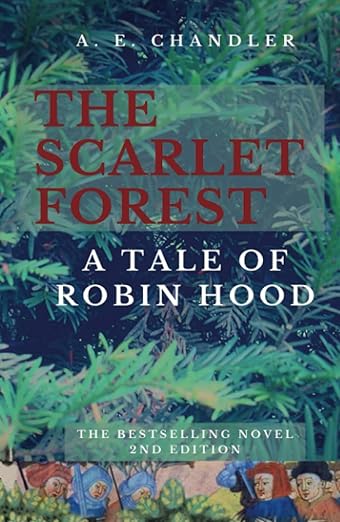
Chandler’s book comes more from the first category I mentioned, Flavor #1. Chandler takes the material of the medieval texts and the ballads, adds some of her own material, stirs in several charming tales-within-a-tale and ballad-like snatches of song, and puts it all together into a coherent story about Robin Hood, from boyhood (you have to wait a bit for that part) through to the very bitter end. It is historically accurate, and a bit stiffly told, like a Robin Hood pageant you might see performed at a folk festival. It gives off a definite storyteller’s vibe. First published in 2017, this new edition has more historical information in its back matter and “bonus features” which I found very interesting. The story itself is charming, and it updates the Robin Hood story to include a bigger role for Maid Marion.
At first the language annoyed me. It seemed to be an example of that “ye olde fantasye speake” I deplore, but I don’t think it is. Actually, I trust this writer. I think the language is pretty accurate–not at all a lazy simulacrum of what some fairly uninformed writer just thinks medieval people should sound like. Chandler’s writing reminds me, though, of a sort of corollary. It’s also not too helpful for a writer to go overboard with language that’s determinedly too accurate. Does that sound like I’m contradicting myself? I probably am. But look, an historical novel is actually not history. It must lure the reader into an imagined history. I found the very accuracy of the language in Chandler’s book a bit distracting. In other words, it pulled me out of the story.
The writer who manages to hit the exact right balance between a language that sounds of its time AND a language that makes the reader feel part of things is a rare talent. I can think of a few writers who bring off this amazing hybrid: Hilary Mantel, Nicola Griffith, Patrick O’Brian, and Paulette Jiles come to mind, and for both playfulness and skill, I think of Susanna Clarke and Charles Portis. How about we add Cecelia Holland and Francis Spufford? (As you can see, I really admire good historical fiction.)
Nevertheless, I enjoyed Chandler’s book. It recounts just about every Robin Hood story known to folklore, creates a contemporary take on these old favorites, and introduces a few new ones of Chandler’s own invention. If you are a die-hard Robin Hood junkie, here’s the Howard Pyle replacement you’ve been looking for. Chandler’s storyteller voice is engaging, and I find it intriguing that she divides her book into sections named after types of forest trees. Her book IS the Scarlet Forest–I love that. Her authority is unquestioned. She wrote her doctoral dissertation on Robin Hood, and she has written other novels that attempt to bring old traditional tales to the attention of contemporary readers.
Hood: A Robin Hood Origin Story, by M. C. Frank (2019)
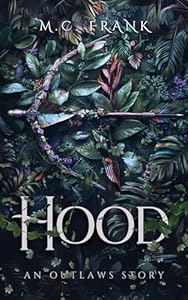
This book is romantasy, at least of a sort. It’s a prequel that tells you things like how Robin Hood got his name, and other bits of backstory for the author’s Outlaws series. There’s a lot of merriment from the merry men, a lot of angst from Robin. . .
I mean, just look at this moody, swoony guy. . .
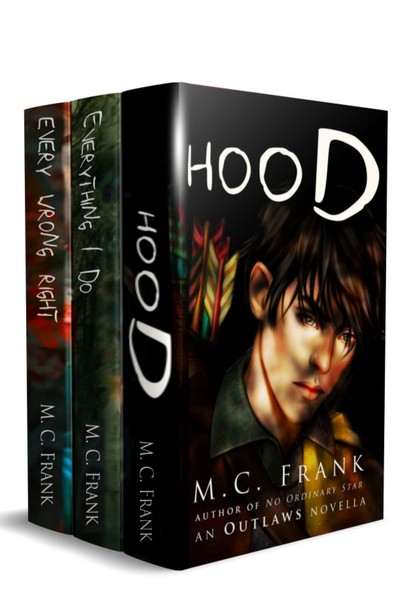
. . . and a surprising amount of piety. If you like this novella-length prequel, you have four more volumes to go. We have the opposite of “ye olde fantasye speake” here. The snarky back and forth among the merry men. . .and women. . .sounds right off TikTok.
Frank seems to love retellings. If you enjoy her sort of fiction, visit her web site (click on the link above) to discover the rest of her Outlaws books and her other novels of this type. I’m probably not her ideal reader. Just saying.
Arrow of Sherwood, Lauren Johnson (2013)
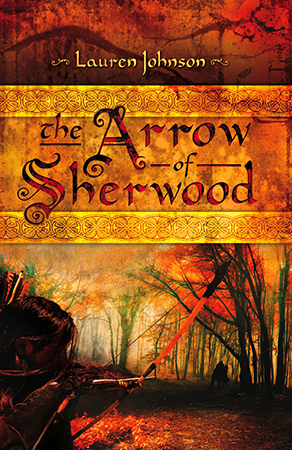
Johnson, like Chandler, is a working historian. Click the link above and check out her web site. She has written several books, and most of them are nonfiction history. I plan to read one or two or three of those. They look fascinating.
This Robin Hood book of hers is a very accurate, well-written, absorbing historical novel. The underlying assumption seems to be, no, there was no real Robin Hood, but if there had been, here’s what his life might have looked like–why he became an outlaw, and what the politics of the time, both local and national/international, had to do with his social status as a lord and then his outlawry. As for the plot, it’s a kind of Robin Hood Meets the Scarlet Pimpernel. Maid Marion plays an interesting role in this one, and there’s a pretty grisly scene of apparently historically accurate torture. This isn’t a fantasy novel, except in the sense that Robin Hood is a fantasy figure, but it really works well. There is no ye olde fantasye speake here. Thank you, Ms. Johnson.
Here’s sort of a quirky thing about me, the reader: I am a structure junky. I loved the division of Chandler’s novel by types of tree, and how that reflected the concept of her novel. Johnson, too, uses the structure of her novel to communicate her theme. The epigraph of this novel is from the monk and chronicler Richard of Devizes, who writes: “As the earth grows dark when the sun departs, so the face of the kingdom was changed by the absence of the king.” Johnson’s novel continues this idea that the wheel of the year reflects the fate of the kingdom. Her novel is set in 1193, so it’s the traditional wheel of the church year, from Candlemas in the bleak midwinter all the way through to Easter and and then on into the following year. The man who will become known as Robin Hood returns to his home in Nottinghamshire, dejected and about to face a terrible personal dilemma, straight from the ill-fated misery that was the Third Crusade. He has gone on crusade as a penance for his sins. Good lord, I thought I was about to see the face of Max von Sydow. But the novel turns a lot more light-hearted than The Seventh Seal, because come on, this is about Robin Hood, people. It still has its grim moments, but they work, and there’s a twisty plot (not a fan of twisty plots) which also works.
I liked this novel a lot.
Coming up in the next post!
Favorite Robin Hood characters get their own books
 Fantastes

Pingback: Fairytale Fantasy Week 2026: Happy Valentine’s Day! – Fantastes