In this series of posts, I will discuss six novels of alien communication I find convincing and satisfying:
- China Miéville, Embassytown
- Ann Leckie, Translation State–reviewed in this post
- Ray Nayler, The Mountain in the Sea
- Adrian Tchaikovsky, The Children of Time
- Cinxin Liu, The Three-Body Problem
- Ursula LeGuin, The Dispossessed
Translation State, Ann Leckie (2023)–note: fixed a typo if you are reading the revised post
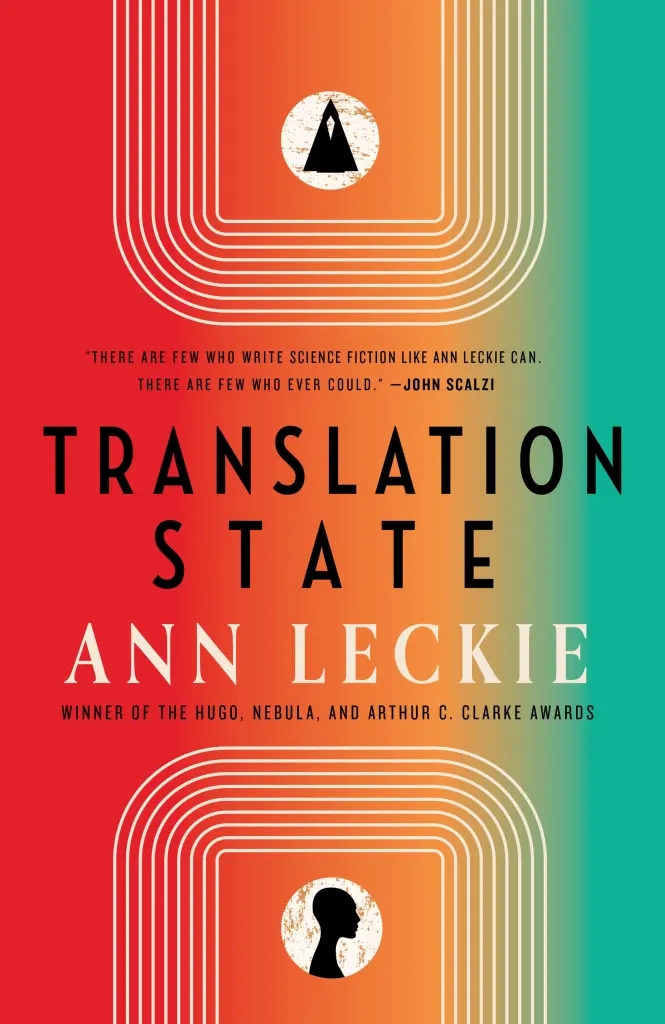
Leckie’s answer to the problem of human/alien communication is pretty brilliant, I think, and close to Miéville’s (see my last post). The characters in Translation State are embroiled in a politically very precarious situation, one so fraught it could easily lead to an extinction event for all the sentient species of the universe. The sentient species, I should say, which consist of individual species members.
These species on their various planets and in their differing cultures and biologies (or other constituent parts!) have enough trouble just dealing with each other, but at a time before the novel begins, they have encountered a radically different species, the Presger, who are so alien that communication with them seems impossible. Worse, the Presger are so much more advanced than the other species that they have the power to wipe out all the other species and think no more about it than a person stomping on a bug. Worse than even that, the Presger don’t recognize individuals or individual striving, pain, thought processes, inherent value–only the collective. How does a universe full of jostling, quarreling individuals communicate with THAT?
A very fragile truce has been struck before Translation State begins, and as with Mieville’s Ariekei/human communication dilemma, holding onto the truce depends on a jury-rigged and barely adequate bridging of the communication divide. As the novel begins, interspecies infighting imperils the truce.
Reader: It helps to understand the political (and legal!) quagmire in the back story of this novel if you have read Leckie’s wonderful Imperial Radch series (see my post HERE), and also her other Imperial Radch-adjacent novel Provenance, but it’s not necessary. Translation State, a lovely novel of found family, short-listed for the 2024 Hugo Award, can stand on its own.
In Leckie’s imagined world (universe), there is no way the Presger mind and a more human-like mind will ever fathom each other. But it’s crucially important to do so, because, on a mere whim, the Presger could end the other species at any time. In their inscrutability, the Presger themselves have understood the need for a treaty with the other species, and they have the vast intelligence to go about it. They have deliberately crafted an intermediate type of creature explicitly designed and educated to translate between themselves and the others.
Leckie’s imagined solution intersects in a very satisfying way with the individual personalities of her characters and their emotional needs. So her novel avoids that all-too-common SF trap of creating essentially an enormous PowerPoint of “what-if.” Her book is actually a novel, not a disguised diagram or tract. Her characters are actually characters, not bullet points. The characters of the novel occupy a translation state, and so does Leckie the author, between us readers trying to imagine the unimaginable, and that object of unimaginability.
What if you were one of those members of the interspecies “translation state,” her novel asks the reader. How would you understand yourself and live your life? What if the biological imperatives built into your physical and psychological fabric mean that your own agency is limited; that even though you are a thinking, sensing, feeling individual, you will die if you don’t fulfill a biological mandate? What if the fate of the treaty depends on your putting aside your own needs and fulfilling the fate you were specifically designed for? And so–what if the fate of all other sentient species in the universe depends on it?
This is a thrilling twist on the “Chosen One” trope. It is also a sensitive exploration of what it means to be different, what it means to suffer abuse, what it means to lack and then find a family and community. We readers shuttle between the thoughts and feelings of two young people caught up in an impossible situation. A third character becomes the catalyst bringing them together. But, the novel asks, along with the third character irself (no, not a typo): is this a good thing? Or a dangerous thing imperiling everyone?
A lot of questions here, but the novel is full of them and feels its way to its conclusion, just as we readers do. This is an SF book that engages the reader and takes the reader along for the ride.
I was struck with the differences between novels like Leckie’s and Miéville’s on the one hand, and some of the space opera solutions to alien communication on the other (see my previous post). Leckie and Miéville both deal with imperfect solutions to near-impossible communication problems–a very real possibility if a human-like species ever did come into contact with an alien one. But both Leckie and Miéville, interestingly, don’t deal with first contact. Their novels both look back to an imperfect solution and then ahead to a crisis point in that communication–also a very real possibility in such a communications attempt. Miéville wants to examine how language works in the context of a real impasse between species. Leckie is more interested in the conflicts among the characters when the impasse happens, and more interested in the way biology shapes communication. For example, Miéville does delve a bit into how the twin pairs are engineered to communicate with the Ariekei and what in the Ariekei biology might account for their need for the double messaging of their language, but he appears to be more interested in how language itself works, and then how it might work under extreme circumstances. Leckie takes us straight into the nitty-gritty and sometimes gut-churning details of how the translation state is physically achieved.
An inspired space opera like (pick any one of) Iain Banks’s Culture novels posits a universe where all these thorny communication problems have already been worked out. We don’t need to think about them or talk about them much. They just ARE. Don’t ask why Cinderella’s glass slipper doesn’t cut her foot. By the rules of the fairy tale game, it just doesn’t. Willingly suspend your disbelief, space opera tells us. With delight (if the novels are good enough, like Culture), we do. Such novels are content to let that problem alone. They are after other conflicts. (The heart of any good novel being: conflict. If all you are after is ideas, just go write an essay. Go format your PowerPoint.)
Novels like these by Leckie and Miéville want to poke the bear. How is communication between a human-like species and an alien being/consciousness even possible? How could it possibly come to be? And then–what happens when it all unravels?
 Fantastes