The novels short-listed for this major speculative fiction award include:
- Annie Bot, Sierra Greer WINNER, reviewed in this post
- Private Rites, Julia Armfield
- The Ministry of Time, Kaliane Bradley
- Extremophile, Ian Green
- Service Model, Adrian Tchaikovsky–reviewed in this post
- Thirteen Ways to Kill Lulabelle Rock, Maud Woolf
In my last post, I reviewed the novels by by Green and Woolf. The first post in this series reviewed the novels by Armfield and Bradley.
Service Model, Adrian Tchaikovsky(2024, Tor)
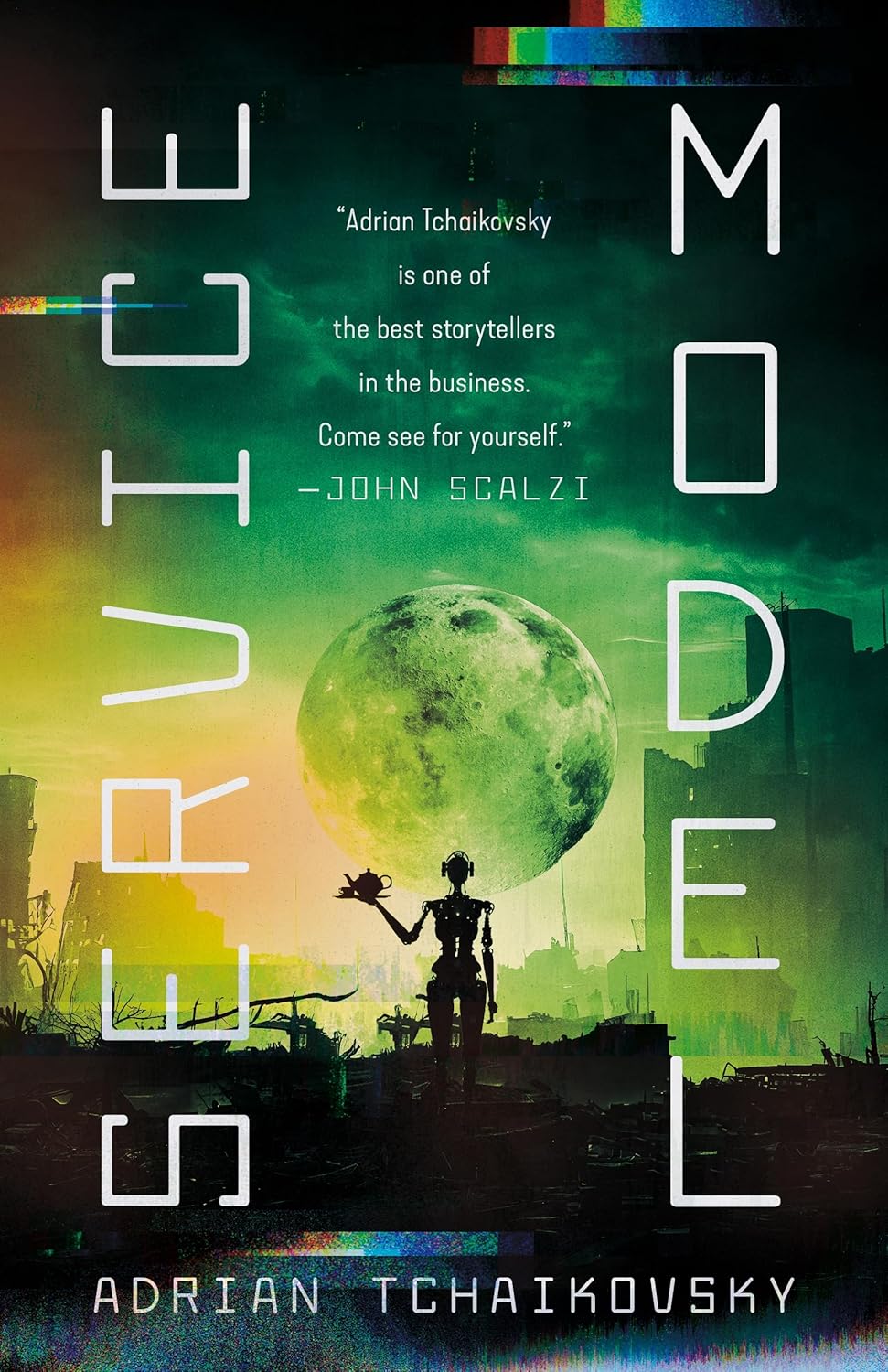
Pay no attention to the masterful, wizardly author behind the curtain. Charles the robot, aka Uncharles, is the star of this show. Here’s the story of total societal collapse told through the point of view of a robot completely hung up on procedure. Technically, you might call the point of view “close-in third person.” We don’t see straight through Charles’s eyes, but we do see all the novel’s events through his robot take on the world. It’s a tour-de-force.
In the opening scene, Charles, a valet robot, has just murdered his master. He has no idea that’s what he has done, just that after he has shaved his master with the usual straight razor, a mysterious red stain on his master’s clothing must be dealt with. You can think here of C-3PO or Murderbot, but really, Tchaikovsky’s portrayal–while every bit as sly and satirical–goes much deeper, into the ways robots operate and how they really might approach the end of humanity and the human-built world.
In his attempt to get his obvious if puzzling robot dysfunction addressed, Charles goes on a lengthy odyssey that takes him to all the important sites of human societal dysfunction: the clogged-up bureaucratic systems, the lust for power run amuck, the misappropriation of information technology, the misunderstanding of what robots are and what they are capable of accomplishing. It’s a kind of reverse Wizard of Oz. In this world of encroaching uncontrolled AI, the problems Charles encounters are also important issues for Tchaikovsky’s human readers.
Charles’s perspective and his trajectory change when he happens upon another seeming dysfunctional robot calling herself The Wonk. Together, the two first work together simply to survive, but then they begin working on the main problem, how to salvage society. They make the perfect team: Charles’s dogged procedural robot nature and The Wonk’s creative unpredictability. She must be a very dysfunctional robot, then, mustn’t she?
This book is incredibly fun to read, and underneath the fun lurks a sly message. It was short-listed not only for this year’s Arthur C. Clarke award, which it didn’t win, but also for the upcoming Hugos.
Annie Bot, Sierra Greer (2024, HarperCollins)
This year’s Arthur C. Clarke Award WINNER for best novel

It’s easy to see why this novel won this year’s Arthur C. Clarke Award. It’s the very engaging first-person account of an AI girlfriend and her struggles with her controlling boyfriend/owner, so it checks a lot of SF boxes as well as a lot of relationship boxes. I don’t pretend to know how awards committees come up with their decisions. All I know about it I learned from Percival Everett’s Erasure. But I can see why this novel would be a popular choice.
I paired my review of this book with Tchaikovsky’s because, well, robots, right? There the comparison ends. Although. . . they are both books from the robot perspective. Greer’s novel goes whole hog; it is written in first person, so everything we see, we see through Annie Bot’s eyes. This also, I imagine, makes the book fun and accessible for readers who come to their task of fictional empathizing through this increasingly common technical writing device.
In a near future, this novel postulates that lonely men can buy themselves a robot companion for sex. That is not SF. It is absolutely believable, since personal robots are already on the market and sex robots are definitely a thing (Be warned before you click on that link to a site called The Guy Shack, if you don’t want your eyeballs or your internet history to reflect such a topic, and I hope my kids understand after I’m gone that I’m just a writer doing her research!). The science fiction part comes in when the main character of this novel, Annie Bot, a robot, begins to explore her own agency. Or is that SF? Here’s the intriguing premise behind the novel. Which of your friends’ girlfriends is actually human, and which might just be pretending? The Turing Test comes to mind. But Annie’s struggle also reflects real issues of abuse and control in intimate relationships. The writing sounds sort of robotic, but I guess that fits the character. It’s an engaging novel and a fast read.
AT THIS POINT in my series of reviews for short-listed novels, I usually pick my favorite. And I never try to second-guess the judges, because as I mentioned above in this post, I have no idea what drives them. It feels funny to do that now that a decision has been made, but I can tell you that FOR ME and me alone, there was no contest. My favorite of the novels in this list was Ian Green’s Extremophile. I found almost all the others to be interesting, worthwhile, and often entertaining novels, and I’m glad I read all of them.
 Fantastes
Pingback: 2025 Hugo Awards: the last two finalists – Fantastes
Pingback: A Word About Awards – Fantastes