
This year’s theme: RED RIDING HOOD
A reminder–The novels I’ll review during this year’s Fairytale Fantasy series:
Red Rider, by Kate Avery Ellison (2019, indie-published)—reviewed HERE
Wolves and Daggers: A Red Riding Hood Retelling, by Melanie Karsak (2018, indie published–Clockpunk Press, which seems to be owned by the author)–reviewed HERE
Beauty and the Werewolf, by Mercedes Lackey (2011, Harlequin Nocturne)–TODAY’S REVIEWED NOVEL
Crimson Bound, by Rosamund Hodge (2015, HarperCollins)
Scarlet, by Marissa Meyer (2013, Macmillan)
For the Wolf, by Hannah Whitten (2021, Orbit)
And finally: a medley of interesting outlier pieces, all based on Little Red
TODAY’S REVIEWED NOVEL:
Beauty and the Werewolf, by Mercedes Lackey (2011, Harlequin Nocturne)
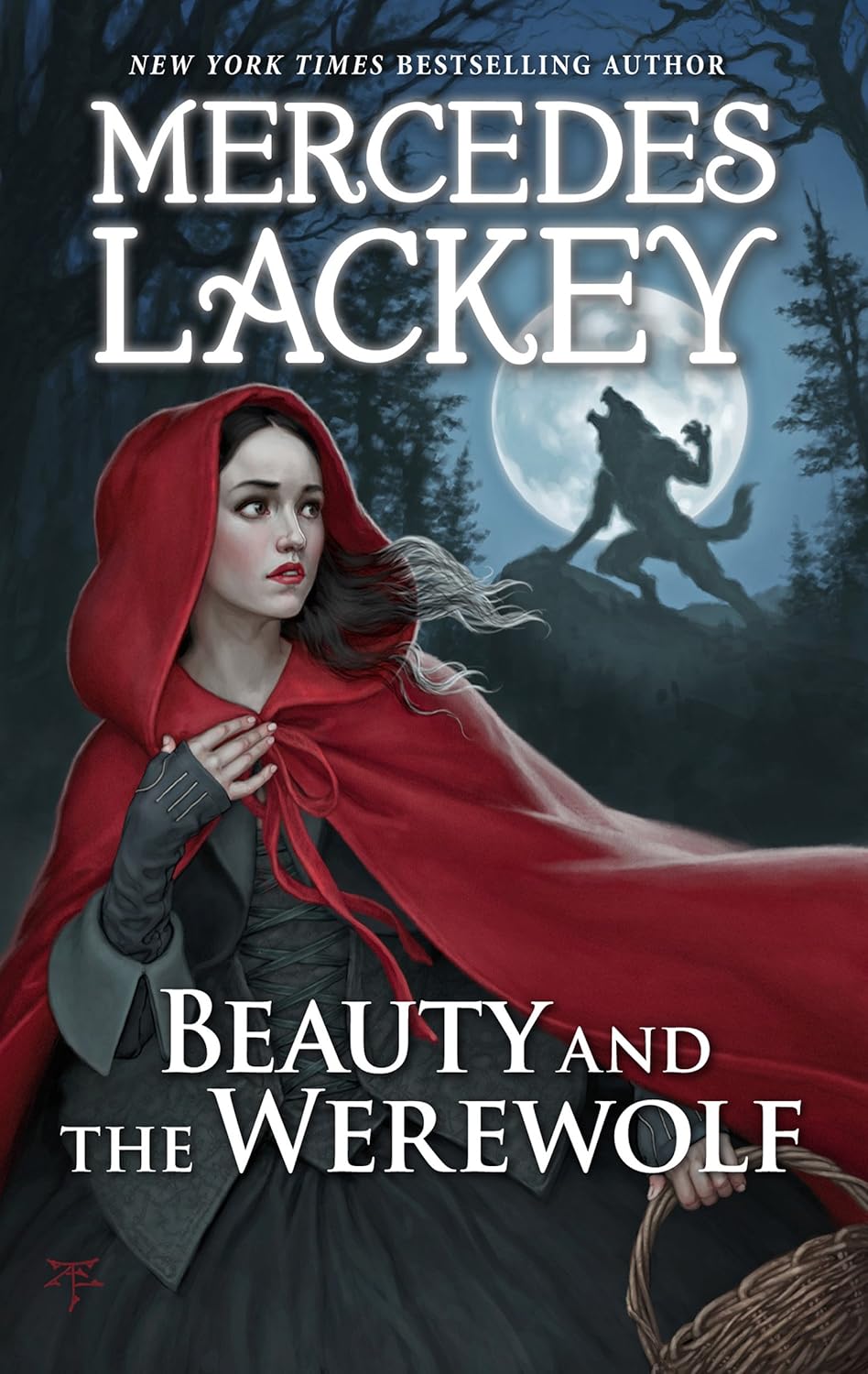
You can find this novel, book six in a series titled A Tale of the Five Hundred Kingdoms, on Amazon (individual title and series in hard cover, paperback, ebook, and audiobook formats). At Barnes & Noble, you can find the novel in paperback and ebook, as well as all five of the others in the series. The Apple Store is confusing on the topic–looks like they do carry this novel in ebook and audio formats. Apple also offers all or mostly all of the other titles in the series in both formats, but it’s a little hard to tell. Kobo sells the novel in ebook format, as well as a three-volume box set including all six novels in the series. And if you are a U.S. reader, don’t forget your public library and the Libby app! Also a caution: another author has published a novel with the same title, so if you want to read Lackey’s novel, be careful you don’t order the wrong book.
Mercedes Lackey is a beloved fantasy writer, so I was glad to find she had written a Red Riding Hood-themed novel. . . or so it seemed. But the title suggests it’s a Beauty and the Beast retelling instead. Or is it? I’m confused. . .
As in a number of these novels retelling the story of Red Riding Hood, there is a lot of overlap between the two tales. You have a beast. You have a young woman in peril. It’s not a book for children. . .so I suppose the overlap makes a kind of sense, especially when you add in the werewolf connection to the Red Riding Hood tale.
As I began Lackey’s novel, I confess I felt a bit underwhelmed. There were a number of familiar Red Riding Hood tropes, of course: the woman in the red cloak, the grandmother, taking a basket of comestibles to grandmother’s house through a scary forest, the warning not to stray from the path, and then the straying from the path anyway, in spite of all the dire warnings. And finally, the wolf in all its ferocity and magnificence. I couldn’t help thinking of Greta Garbo’s exclamation at the end of Jean Cocteau’s iconic 1946 Beauty and the Beast film, when beast transforms to prince: “Give me back my Beast!”
The setting was interesting, too— a kind of Regency-romance setting, even though it was clear we readers weren’t, in imagination, entering actual Regency England. With the guns and all, was this another gaslamp retelling?
There were some gaslamp trappings. Mostly, though, there was none of that gaslamp gadgety feel to the thing but rather, a gothic atmosphere—the mysterious castle exuding danger, the lonely moors, a glowering gamekeeper. So okay, I thought— another Red Riding Hood-Beauty and the Beast hybrid, with the twist that the “beauty” is no conventional pretty damsel in distress but an unconventional heroine too independent-minded for the times or the story.
And that, readers, turns out to be the point of the novel. A character too independent-minded for the story. To my shame, I have never read anything by Mercedes Lackey before, and probably shouldn’t have started with this one. Also, this novel is the last novel in of a series of interconnected stories, A Tale of the Five Hundred Kingdoms, all fairytale retellings. Admitting that, I can also tell you I found Beauty and the Werewolf very intriguing. The magic system is elaborate and pretty fascinating. Maybe if I had read some of the earlier novels in the series, I would have caught on right away. Even without that advantage, I did get the drift pretty fast, and the story itself is stand-alone.
The fun in this retelling is the magic of this fantasy world. Here magic is overseen by powerful Fairy Godmothers who are on constant alert to keep a mysterious force called the Tradition from pushing and manipulating the residents of the world into predetermined story stereotypes. So Isabella, the Red Riding Hood character, is constantly being enticed onto one or more pathways of action determined by age-old story tropes— the damsel in distress, for example. The problem then becomes how Isabella can help the young duke cursed into wolf form ( the werewolf theme again!) and remain in her own form without falling into any fairytale stereotype. Not to mention how she will be able to decide her true feelings as they whipsaw between two different hot men. There’s a continuing narrative about stepmother and stepsister relationships, too—another Beauty and the Beast incursion, with a lot of Cinderella thrown in. What a very meta, very clever way of retelling a story positively awash in storytelling tropes! I enjoyed this novel very much.
A note about fairytale tropes: Anthropologists and folklorists study these matters! When the Brothers Grimm collected Little Red Cap and all the other folktales they preserved, they were acting out of scientific curiosity and the 18th-19th century passion for observing and classifying everything in the world: Linnaeus for plants and animals, John James Audubon for birds, Dmitri Mendeleev for elements, Wilhelm and Jacob Grimm of Germany for their country’s folkways, tucked away and preserved in stories told in villages and out on remote farms.
Later on, the American folklorist Stith Thompson classified the elements of folk tales into a system of motifs, basing his work on that of Finnish folklorist Antti Arne. You can read more about this important work HERE, but the article is behind a firewall, unfortunately. If you want to find out more and you are just beginning a study of this field, don’t discount Wikipedia as a valuable starting point, especially the article’s footnotes and bibliography. Thompson’s and Arne’s work on indexing folklore motifs or tropes has been further refined by the German scholar Hans-Jörg Uther. In the Thompson-Arne-Uther Index, Little Red Riding Hood is classified as ATU 333, a classification called “Tales of Magic–Supernatural Adversaries” (and it also overlaps with ATU 123, a classification of animal tales). Find out more HERE and HERE.
I find it fascinating that Lackey, in her fairytale retellings, doesn’t stop at dressing up the story in new fictional clothes but actually explores (in a playful and highly entertaining way!) what it means to the world and human beings to possess such a treasure trove of stories, and to explore how we readers think about them and relate to them.
NEXT UP: A review of Crimson Bound, by Rosamund Hodge (2015, HarperCollins)
 Fantastes
Pingback: Valentine Week 2025: Fairytale Fantasy, Day FIVE – Fantastes
Pingback: Valentine Week 2025: Fairytale Fantasy, Day SIX – Fantastes
Pingback: THE END of Valentine Week 2025: Fairytale Fantasy, Day SEVEN – Fantastes