the day itself!
HAPPY VALENTINE’S DAY!

This year’s theme: RED RIDING HOOD
A reminder–The novels I’ll review during this year’s Fairytale Fantasy series:
Red Rider, by Kate Avery Ellison (2019, indie-published)—reviewed HERE
Wolves and Daggers: A Red Riding Hood Retelling, by Melanie Karsak (2018, indie published–Clockpunk Press, which seems to be owned by the author)–reviewed HERE
Beauty and the Werewolf, by Mercedes Lackey (2011, Harlequin Nocturne)–reviewed HERE
Crimson Bound, by Rosamund Hodge (2015, HarperCollins)–TODAY’S REVIEWED NOVEL
Scarlet, by Marissa Meyer (2013, Macmillan)
For the Wolf, by Hannah Whitten (2021, Orbit)
And finally: a medley of interesting outlier pieces, all based on Little Red
TODAY’S REVIEWED NOVEL:
Crimson Bound, by Rosamund Hodge (2015, HarperCollins)
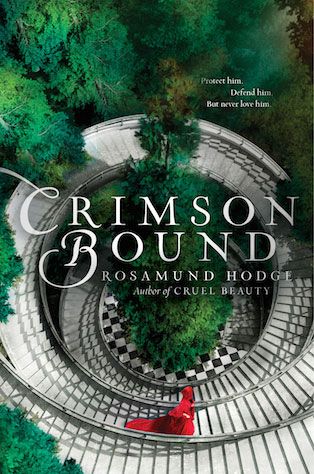
You can find this novel on Amazon in hard cover, paperback, ebook, and audiobook formats. At Barnes & Noble, get it in paperback and ebook formats, and free as an audiobook with a Barnes & Noble audiobooks subscription–otherwise the audio CD version is pretty pricey. Both Kobo and Apple offer ebook and audiobook versions. Google Play sells the ebook version. Best of all, check out the author’s web site HERE to see how you can order the ebook through Bookshop.org, benefiting an indie bookstore of your choosing while also giving a bit of a commission to the writer. Visitors to Hodge’s web site will find other goodies there, including an alternate ending and a playlist for Hodge’s curated soundtrack. You can download that on Spotify right from her web site.
Hodge is a YA writer, and Crimson Bound is a YA book “inspired by” the Red Riding Hood story and also the opulent court of 17th century Versailles. It is packed full of lore–any fantasy reader who loves a book for its lore may love this one.
But while the story may have been inspired by Red Riding Hood, this is not really a fairytale retelling, in that not much of the fairytale remains. As Hodge comments in the book’s acknowlegements, she was also inspired by a different folktale, “The Girl With No Hands.” Another source of material, she says, are the Old Norse sagas Völuspá and Vǫlundarkviða, both part of the Poetic Edda. (The quickest way to find out about that cycle of poetic narratives is to start HERE and use the bibliography to go further.)
Crimson Bound offers up some of the familiar Red Riding Hood tropes. There’s a grandmother-like figure, the main character’s aunt. The main character faces a wolf-like creature in a scary woods and must choose between two paths. There’s also a red cloak. But as the story begins, Hodge teases the reader with snatches of what looks like a different folk tale entirely–maybe a little whiff of Hansel and Gretel. This tale turns out to be part of Hodge’s own intricate lore. How completely that lore is beholden to her sources of inspiration, I can’t really say, but they seem at odds with the courtly Versailles backdrop. On the other hand, we know that a lot of fairytale material was reshaped from folk tale into literary form by Charles Perrault, Charlotte-Rose de Caumont de la Force, and others at the court of the Sun King. Whatever its exact origins, any reader of Hodge’s novel can agree it is saturated with a fairytale atmosphere.
I found Crimson Bound to be a bit overwhelming. Every time I thought I had the characters sorted out and their motives figured out, the scenario got murkier. The novel is interesting in that the main character is no damsel in distress but a hardened killer, and a person who regards herself as damned. There is a lot of lore about demonic forces here, and a lot of questing for a magic sword that will somehow save the world from those forces. This is a world where the darkness is literally encroaching on the light, and the heroine must fight to save the world against the final darkness–in spite of knowing that she can just relax and be a demon. There seems to be allegory going on, although I was never quite sure.
As in most YA fantasy novels, the heroine is also torn between a dark dangerous sexy man and a more benign man.
I should mention, too, that the language is at times very beautiful–poetic in the best sense, not the cheap trashy Hallmark card sense. I admired that.
By the end of the novel, my head was spinning trying to keep track of so many bits of lore, so many mixed motives, so many outright obscure motives, so many ornate rooms in the palace. It was an interesting book, though.
AND ANOTHER THING: HAPPY VALENTINE’S DAY!

Did Valentine’s Day really originate with Geoffrey Chaucer’s Parlement of Foules (Parliament of Fowls, Assembly of the Birds), when Chaucer envisions a day when a great congregation of birds assemble to choose their mates? “The lyf so short, the crafte so long to lerne. . .” Not only that, it’s really HARD to pick the perfect mate, especially when someone else, or some unstoppable force, or maybe peer or social pressure, is working on you to pick X when you actually love Y. Dame Nature in the end lets the beautiful female eagle make her own decision, in spite of the various pushy guy eagles who keep chirping (squawking?) “Pick me! Pick me!”
Or was the Roman fertility festival of the Lupercalia the real origin of Valentine’s Day? Or was it one of the many, many Saint Valentines of the Roman Catholic calendar?
As a lover of Chaucer, I vote for him. But I don’t think anyone really knows for sure. So eat lots of chocolates, grab yourself some fairytale fantasy, and read, read, read.
NEXT UP: A review of Scarlet, by Marissa Meyer (2013, Macmillan)
 Fantastes
Pingback: Valentine Week 2025: Fairytale Fantasy, Day SIX – Fantastes
Pingback: THE END of Valentine Week 2025: Fairytale Fantasy, Day SEVEN – Fantastes