In my quest to read all the short-listed for the 2024 Arthur C. Clarke Awards, I have devoured two more. Ugh–no, I devoured one of them, and the other I choked down. They are:
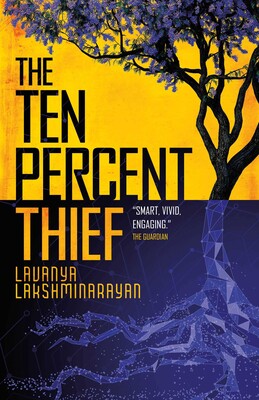
- Lavanya Lakshminarayan, The Ten Percent Thief, Solaris, distributed by Simon & Schuster, 2023
- Martin MacInnes, In Ascension, Grove Atlantic, 2023
Look HERE for my reviews of the first two I read.
And here are my reviews of the next two, in the order I read them:
Lavanya Lakshminarayan, The Ten Percent Thief
Brace yourselves. Some things, however hard, have to be said.
This novel, originally titled Analog/Virtual, is an extremely broad satire presenting a mosaic of characters and situations in a dystopian Bangalore. Here, society has undergone a draconian division between the haves–people whose every thought, twitch, and impulse is governed by a digital algorithm–and the have-nots, people living in squalor without benefit of a digitally-enhanced environment. The novel touches briefly on the devastation of climate change but is mostly about the drastically different quality of life people experience on either side of the analog/virtual divide. When the downtrodden Analogs revolt, a kind of very slow-motion, leadenly-described, predictable violence ensues.
I really don’t know what to say about this novel. It’s actually a series of sketches which, taken together, do not form much of a coherent narrative, and all of them relentlessly pound the author’s point home, like a hammer to the head. I couldn’t tell the characters apart. The writing is wooden. Why was this novel nominated for a prestigious award? Sorry, I don’t want to be overly harsh here. Using satire as its main method, the novel does speak to our society’s problem with rampant shallow thinking driven by social media and over-reliance on computer technology. I think the point could have been made in a much shorter form, though. In fact, this particular piece of short-form satiric fiction has already been written: E. M. Forster’s dated but still affecting “The Machine Stops.” A hard-hitting piece of journalism might have been a better way to get the point across, too. I was very disappointed in this book.
As I explored my mostly negative reaction to The Ten Percent Thief, I thought more deeply about satire in general and dystopian novels employing satire in particular. Satire is very hard to pull off in novel form, but it has been done brilliantly. Brave New World, for example, has a biting satiric edge, and while Huxley’s characters are nowhere near as well-developed as Orwell’s in the often-compared 1984, they do function as recognizable characters. Margaret Atwood’s The Handmaid’s Tale is another example–it, like Lakshminarayan’s novel, is a bunch of fragments, and some of its satiric touches are a bit heavy-handed. Unlike Lakshminarayan’s novel, The Handmaid’s Tale‘s fragments make sense as a plot device, and the moving tragedy of the main character’s situation far outweighs the satire. Her main character, a woman who doesn’t even have a name, is worlds more vivid than any of the characters in The Ten Percent Thief. The satiric novel has always had this problem, though, all the way back to the beginning. Is Gulliver’s Travels a novel? It was written at the dawn of the form and has many novelistic traits, but maybe isn’t a novel (also: not a children’s book!). I’ll leave that whole discussion for the 18th century lit experts, but this is a general problem and has been from the beginning. American Psycho, as it turns out, is satire, although the hapless reader doesn’t realize it for hundreds of pages of gut-churning nastiness. But, unfortunately, I found Lakshminarayan’s novel just pretty shallow and a slog to read.
To be fair: Here’s another thought about why The Ten Percent Thief was nominated for an Arthur C. Clarke Award, and it’s a matter of taste. I read widely–literary fiction, genre fiction of all types, everything I can get my hands on. I have four criteria for excellence in the novel, any novel of any type, and in this order: 1. quality of writing. 2. characterization and whether it fits the author’s vision. 3. world-building/setting/concept. 4. plot. Now–a lot of readers would put my no. 4, plot, in the no. 1 spot. I’m thinking of people who love “airport thrillers,” for example. And a lot of readers, especially SF readers, would put my no. 3, world-building/setting/concept in the no. 1 spot. This, right here, may explain my very negative reaction to this book, because–forget nos. 1, 2, and even 4–The Ten Percent Thief is all no. 3, all the way, all the time.
I’ve encountered this before, and I always come up with the same reaction: if that’s all you want to do, dear author, why not produce a nice quick PowerPoint instead?
But you, dear reader, may value your books very differently, and you may like this book. Its nomination for the Arthur C. Clarke Award suggests you have plenty of company even if at least one reader (me) can’t see why.
Martin MacInnes, In Ascension

Like Chain-Gang All-Stars (previously reviewed by this blog), In Ascension has reaped accolades from readers of both literary and genre novels, with award nominations for both types of readers (often the same reader–me, for example). Chain-Gang All-Stars has been nominated not only for the Arthur C. Clarke Award but for the National Book Award, while MacInnes’s novel has been long-listed for the Booker Prize, one of the most prestigious awards for novels written in English. And, of course–short-listed for the Arthur C. Clarke Award, the fourth novel I’ve read in my quest to read every book on the list before the awards announcement on July 24th.
I didn’t believe any novel could top Chain-Gang All-Stars in my favorites category, but In Ascension is at the very least tied, if maybe my new favorite. The two novels are so different that it is really hard to choose between them, and probably unfair to try. I’m imagining that will be a big problem for the awards judges.
In Ascension is an astounding novel. It is beautifully-written, lyrical and meditative. The plot involves a young marine biologist whose discoveries and experiences on a previous and very mysterious oceanographic expedition have led to a coveted position on a team needing her expertise for a different kind of expedition entirely. Set against the backdrop of an environmentally-damaged and maybe dying earth, this novel explores deeply what it means to be human, one among countless life-forms inhabiting the planet and the universe. It’s a novel of discovery and loss, the small-scale mysteries of family relationships alongside the deepest mysteries of life. What a novel. It checks all of my boxes, 1 2 3 4, all at once, as all the best novels do. This novel cites Clarke’s Third Law: “Any sufficiently advanced technology is indistinguishable from magic.” Fitting that it is short-listed for the award honoring Clarke. If any novel serves as an avenue to understanding Clarke’s Third Law, this one does.
 Fantastes
Pingback: A final two novels short-listed for the 2004 Arthur C. Clarke Award – Fantastes
Pingback: Soon to be announced: The Arthur C. Clarke Award for 2024 – Fantastes
Pingback: Arthur C. Clarke Award Winner! – Fantastes
Pingback: Color My Speculative Fiction GREEN – Fantastes