If you missed the introduction to this year’s Fairytale Fantasy series of posts, find it HERE.
Laura Wood’s A Single Thread of Moonlight
Find the book on Wood’s web site (and check out all the other goodies there).
Laura Wood’s Cinderella-themed YA novel (Scholastic, 2021) is a lovely read, my favorite of the Cinderella re-tellings I’ve discussed in this Valentine Week blog series. Marketing copy claims this is a book for “the Bridgerton generation” and “perfect for Jane Austen fans,” all implying this novel is Regency romance set in the early 19th century. It’s not–it is set in the England of 1899, just at the end of the Victorian era. But it IS romance, not fantasy. There’s no magic in it at all. The Cinderella theme, though, is not simply tacked on but interwoven into the plot–a mystery plot!–and very skillfully, too.
The book’s epigraph is from The Count of Monte Cristo, and Wood’s novel is indeed a tale of revenge and a disguised, wronged main character. Her love interest has an equally intriguing sub-plot involving the same rich stew, and the intersection of these two characters and their schemes to right terrible wrongs is very satisfying.
The main character, Iris, is spunky and sparkling, the love interest Nick is sardonic and aloof but a swoony guy underneath the rough exterior–catnip for many a reader of historical romance. Even better, the two of them partner up to solve an intriguing mystery involving an imposing, opulent old Downton-Abbey-esque manor house. The novel exhibits its YA creds by having Iris tell the whole thing in the first person.
I suppose a lot of the plot elements are improbable, but I didn’t care. I can’t speak for most readers, but I was swept away and willingly suspended my disbelief. The premise is this: Iris, an heiress, is mistreated by an evil step-mother after her father’s suspicious death. Fearing she’ll be next, Iris flees to London and hides out there, pretending to be a seamstress as she makes use of the needlework skills imparted by her mother. She’s her own fairy godmother, sewing her own ball gown for the big scene where she attracts the attention of an actual prince.
Here’s just one example of how much fun this book is to read:
Iris, on the topic of her disguise and her ruse to regain her inheritance and solve the mystery:
You see, people always assume that I’m the pretty little piece of embroidery. But I’m not. I am the needle.
–from chapter one
What fun! Historical romance, cozy mystery, old house setting–this book has everything (except fantasy, so some readers of this blog may not want to go there). I really enjoyed this novel.
NEXT (and last) UP: Valentine Week Fairytale Fantasy recap
If you missed the introduction to this year’s Fairytale Fantasy series of posts, find it HERE.
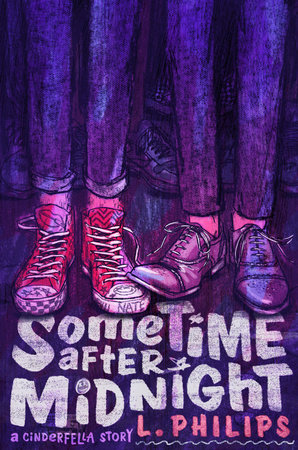
Sometime After Midnight (Viking, 2018) is billed as a “CinderFella” story–a reimagining of the Cinderella story through an LGBTQ+ lens. It’s a fun, sweet read, but it’s not fantasy. This is very diverting and lovely YA romance.
This YA romance alternates chapters between the two main characters, Nate and Cameron. Nate is a poor boy, while Cameron is rich. They meet at a club where an indie band is playing, and it looks like sparks are going to fly. But then Nate realizes Cameron is the son of the man who maybe caused his own father’s death, and Nate flees before Cameron can get his name. All Cameron has to go on, as he yearns for Nate, is a blurry picture his phone snapped of Nate’s DIY-decorated Chuck Taylor high-top sneakers. The romance goes on from there, following a familiar romance arc. But you can see the Cinderella elements even in this brief description: the poor person reduced to scut-work (in this case, Nate has to work at his grouchy step-mother’s Dairy Barn drive-up), the rich person who is pretty much a modern-day prince whose dad is the king of a far-flung and powerful recording empire. And the shoes! Instead of going door-to-door with the photo of the Chucks, Cameron’s twin sister posts the pic on social media, and the hunt is on.
The way the author twines the Cinderella story into the romance tropes is tons of fun. The music industry backdrop is completely fascinating. I don’t know much about that stuff, but I was enthralled, and it’s clear the author knows what she’s talking about.
A couple of the novel’s features did not completely satisfy me as a reader, but since I’m an older reader and not the intended YA audience, I’m not sure how seriously you blog readers should take my misgivings. First, the middle of the novel seemed to me to sag under the weight of young adult angst. As the novel nears its end, though, the angsty feelings made more sense to me, and the romance was truly satisfying.
Another part that hit me wrong: Cameron is a singer/songwriter, Nate is a guitar player who would have made his doomed guitar-playing father proud. That’s all fine. But the author gives us a bunch of Cameron’s lyrics, and they turned me off. Nothing is really wrong with them–they just seem like the kind of bad self-absorbed poetry any random teen would write. Now, this may have more to do with my own taste as a poet and reader of poetry than anything else, and besides, lyrics are not the same as poetry intended to be read, either silently or (best) aloud. They’re intended to be set to music. But we don’t have the music. We have to imagine that.
This kind of problem, it seems to me, can really hurt a work of fiction. I’m thinking, for example (speaking of fantasy!) of the third book in Scott Lynch’s wonderful Gentleman Bastards series, The Republic of Thieves. For all its great features, it has one (avoidable) flaw. The plot involves our rascally heroes, Locke and Jean, on the run with a troupe of actors performing a play very much like one of Shakespeare’s. Unfortunately, we get too much of the play in the novel–lines and lines of it, and it’s not Shakespeare, folks. Well. . .maybe one of Shakespeare’s really bad early plays? This part of the book does the novel no favors.
I think something like this can be done very well, though. I just finished reading Emily St. John Mandel’s fine dystopian novel, Station Eleven, involving a mysterious art zine. Mandel’s novel gives us bits of the dialogue, and they work well. This may be because we’re talking about essentially comic book dialogue, not Shakespeare (or, in the case of Sometime After Midnight, song lyrics supposedly the next big genius indie thing). Mandel sets us up to understand the context by ingeniously doing stuff like quoting Star Trek.
Here are two other places I’ve seen similar devices work very, very well. One is in the film Hustle & Flow (2005, directed by Craig Brewer, produced by John Singleton), with a very similar plot device: indie musicians trying to make it in a tough recording environment. The advantage the film has over a novel, of course, is actually letting us hear the music. The film’s theme song, “It’s Hard Out Here for a Pimp” (Three 6 Mafia/Cedric Coleman) won the Academy Award for Best Original Song, and was performed in the movie by its star, Terrence Howard with co-star Taraji P. Henson. The other example I’m thinking of is the superb over-the-top amazing Jim Jarmusch film, Ghost Dog: The Way of the Samurai(1999), although in that film, the compelling music by Wu-Tang Clan’s RZA is used more as a Greek chorus device, so maybe it’s not comparable. I see I’ve used two examples from hip-hop. Full disclosure: I know next to zero about hip-hop. All I do know is that in these two films, the music is used to brilliant effect.
My quibbles aside, Sometime After Midnight is a fine YA novel, and I really enjoyed it. It’s not fantasy, but the Cinderella material is not just tacked on, the way the Rapunzel references seem to be in Tower (discussed earlier this week). Sometime After Midnight is a delightful update of the Cinderella story. . .er. . .CinderFella story, and I recommend it.
ADDENDUM: I can’t resist adding one more example of novels in which embedded works of other types of art play a major part. That’s Margaret Atwood’s 1988 novel Cat’s Eye–Atwood in realism mode, not dystopian. The main character in Cat’s Eye is a visual artist. Atwood’s descriptions of this character’s paintings that don’t exist except in our imaginations are so compelling that they might as well exist. (Or I could be wrong about that–Atwood could have actually painted them. I believe she did do her own cover art that her publisher replaced with its own.)
If you missed the introduction to this year’s Fairytale Fantasy series of posts, find it HERE.
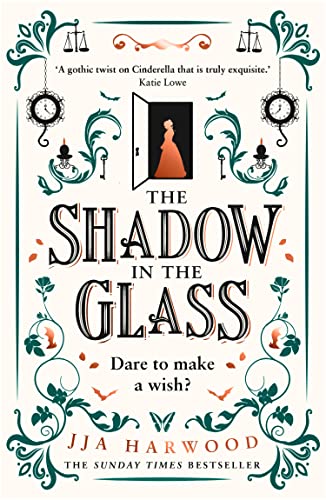
Harwood’s The Shadow in the Glass (HarperCollins, 2021) is billed as a “gothic” retelling of the Cinderella literary fairy tale by Charles Perrault (1697). The first European literary version of the story was, as in the case of Rapunzel, by Giambattista Basile (1634), and it was “collected” by the Brothers Grimm and titled Aschenputtel in 1812. Unlike the Rapunzel story, though, Cinderella’s origins are more grounded in folklore, so its inclusion by the Grimm Brothers makes more sense.
Harwood’s version, set in Victorian England, is grim indeed. Amazon.com actually subtitles it “the Extraordinary Fairytale Debut of 2021,” a tactic only traditional publishers can get away with (in its defense, the book’s title page carries no such marketing language), and its ad copy on Amazon quotes a reviewer calling the novel “deliciously dark.”
Hmm. Sorry, “delicious” is not a word I’d use. It’s a very gloomy setting, and all the characters are morally gray. Do I mind that? In this case, I do, and I’m trying to figure out why. Who’s a more morally gray figure than Walter White, for example, and Breaking Bad is one of my favorite fictional experiences of all time. Who writes grimmer–and better–than Joe Abercrombie, where even the characters we love most are grim and morally gray? No one. Abercrombie is one of my favorite fantasy writers ever.
Hardly anyone in Harwood’s novel is a sympathetic character, especially the heroine, Ella (Eleanore), the orphaned Cinderella figure who is menaced and mistreated by her guardian. She is fiercely loyal to her friends and goes to great lengths to protect them–admirable. But at the same time, she engages in more and more dubious activities and makes more and more dubious decisions for herself. I suppose you could say the same of Tony Soprano. Or Walter White. Or almost anyone in any of Abercrombie’s novels. And it’s okay for a novelist to write about an unsympathetic main character. Actually, the writer I was most reminded of during my gloomy slog through Harwood’s novel is Theodore Dreiser, although Dreiser is very American and The Shadow in the Glass is a very British book. Dreiser’s Sister Carrie is a pretty unsympathetic character. This novel is kind of Bleak House Dickinsian without the humor and generosity. It’s Vanity Fair without the sharp satiric edge.
In the end, Harwood’s Ella strikes me as unsettlingly inconsistent in her principles. One minute she’s one way, another minute she’s something else. I’m just never sure how to take her. A good girl gone wrong? A person who was all about power from the get-go? And the “prince” character is a simpering idiot, so it’s hard to know why anyone would risk all for such a silly guy. I suppose she really doesn’t. I’m thinking in the end it’s all about the power.
Here’s the thing I really loved about Harwood’s novel: the Victorian setting. The novel is gloomy because those times and that London were gloomy. Everything in the novel is in a state of decay, mildew, and rot. I found that to be very realistic and interesting, and it’s clear Harwood knows what she’s talking about. I’ll mention just one detail out of many: dye colors in women’s dresses tended to run in wet weather–and so, given the weather in London, especially a London where industrialization had created rampant, toxic air pollution–women were in constant danger of having their elegant dresses go damp and runny on them. I found that a fascinating little fact, and I think Harwood does a great job of cooking it into the overall ambiance of the novel. I never had the feeling she was pushing her research into my face. All of it seemed organic to the novel. I really admired that.
Unfortunately, I think the very realism of the setting jarred, for me, with the improbable magic parts. By the end of the novel, those parts had come to seem more psychology than magic, and I wish Harwood had taken the novel more in that direction. I guess she couldn’t because she was too bound to the Cinderella story. I ended up wishing this book had been more like Sarah Perry’s The Essex Serpent or Melmoth. Harwood is really talented. I wish she’d write some kind of book relying on atmosphere with perhaps more of a magical realism twist than fantasy. In the end, I don’t think the Cinderella underpinnings of her novel do her any favors. Any favors for the reader, I should say, because apparently this was a savvy marketing decision. But maybe I’m just a cynical, grouchy reader. There’s always that.


 Fantastes
You must be logged in to post a comment.