Sidney Sime was born into poverty in 1867 and died in 1941, but he became one of the most beloved fantasy illustrators of the early 20th century. His illustrations were mostly for fantasy pioneer Lord Dunsany’s books, including Time and the Gods, A Dreamer’s Tale, and The Book of Wonder. You can read many of Lord Dunsany’s books free on Project Gutenberg, but if you read them that way, you’ll miss some of their most charming features: the illustrations. Almost none of the print re-issues of Dunsany’s books have the Sime illustrations, either. One of the few reprints that does is the “Lovecraftian Librarium” edition (for the Kindle e-reader) of The Gods of Pergana. Dunsany is widely credited as the precursor to and inspiration for master of fantasy and horror H. P. Lovecraft, and this edition also includes some tales by Lovecraft that were specifically inspired by Dunsany.
Here are two of Sime’s most evocative fantasy illustrations:
Romance Comes Down Out Of Hilly Woodlands Sime illustration in the public domain in the EU, non-EU countries, and the U.S. (because copyright expired in 1923)
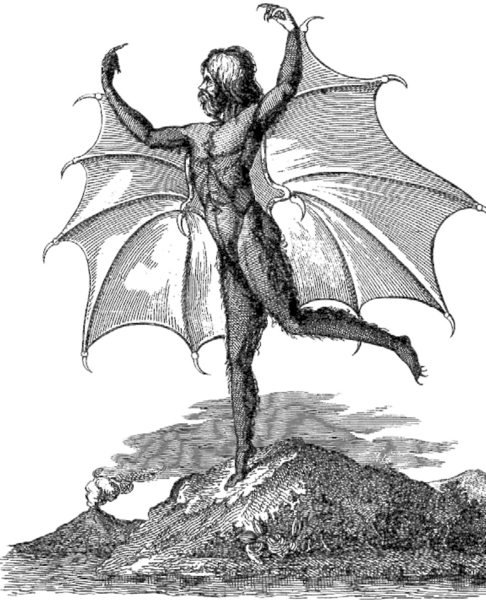
Bat-monkey-men on the moon, as envisioned in the New York Sun of 1835. Image in the public domain. Source: Wikimedia Commons.
For a six-day period beginning Aug. 25, 1835, the New York Sun (probably via one of its reporters, Richard A. Locke) made most of America believe such a thing. The Sun claimed the series of articles about moon people was based on a discovery by famous astronomer Robert Herschel. For months, if not years, the Sun and other media milked the supposed discovery for every ounce of sensationalism they could get out of it. The Sun falsely claimed its circulation was boosted by the series. As a result of the hoax, further publications (including translations into other languages), dramatic productions, supposedly scientific dioramas, and many other spin-offs extended its imposition on the public.
Herschel was reportedly amused by the brouhaha until he realized how many people were confusing his process of scientific discovery with the trumped up story pulled off by the Sun.
The Great Moon Hoax of 1835 has gone down in media history as one of the first episodes of widespread mass-media hysteria. You can find a full account at The Museum of Hoaxes web site, including the original news stories about bat-monkey-men, beaver people, blue unicorns, and sacred temples on the moon: http://www.museumofhoaxes.com/hoax/archive/permalink/the_great_moon_hoax.
Source: NASA
What explains the hoax’s success? For one, people are fascinated with the idea of sentient beings on other worlds and love to read and think about them. The Great Moon Hoax has also been labeled “America’s First Science-Fiction Story,” but I remember that my elementary school library still had books on the shelves (long after science had discredited such a notion) revealing the amazing “fact” that there were canals on Mars–canals built by Martians! What will Curiosity discover as it creeps across the Martian landscape? Are Martian bat-monkey-men giggling at us just over the next ridge? No, but I’m sure Curiosity discover something else amazing, maybe something beyond our wildest imaginings. Its discoveries will no doubt derive from the realms of chemistry and physics, not bat-monkey-men or canals.
I guess strange creatures could live out there somewhere. Look at brave little Voyagers I and II as they head into deep space past the edges of the Heliosphere. On board each of the Voyagers, golden discs proclaim, to any aliens they may encounter (I’m quoting the words of the Whos in Dr. Seuss’s Horton Hears a Who), “We are Here! We are Here! We are Here! We are Here!” http://voyager.jpl.nasa.gov/
As for bat-monkey-men, we may laugh at our great-grandfathers and -mothers for their credulity as they marveled over their copies of the New York Sun, or gawked at P.T. Barnum’s shows, but aren’t we equally gullible, at least at times? A visit to snopes.com and factcheck.org will quickly show us that we are as vulnerable to swiftboatery, chicanery, malarky, and falderol as our ancesters were. If 20th century history teaches us nothing else, it teaches us that sometimes (too often?) such gullibility is extremely dangerous. The U. S. Office of Strategic Services reported that Adolf Hitler followed this propaganda principle: “people will believe a big lie sooner than a little one; and if you repeat it frequently enough people will sooner or later believe it.” (O.S.S. psychological profile of Adolf Hitler, Hitler As His Associates Know Him, http://www.nizkor.org/hweb/people/h/hitler-adolf/oss-papers/text/oss-profile-03-02.html).
A new book about all things Zelda is coming in January: The Legend of Zelda: Hyrule Historia, by Shigeru Miyomoto, published jointly by Dark Horse Books and Nintendo. Based on pre-orders alone, it has already reached #8 on Amazon.com’s top ten list.
Wikimedia Commons
Princess Zelda, if you don’t know about her, is one of the main characters in Nintendo’s popular Legend of Zelda video game series, first produced in 1986 in Japan, first sold in the U.S. in 1987, and presented on Nintendo consoles and otherNintendo products, now including the Wii, ever since.The series, which is frequently cited as the most popular video game series of all time, stars protagonist Link, a hero in a Peter Pan getup whose main task is usually to save Princess Zelda. In almost every game in the series, she is either kidnapped by the game’s villain or under threat of kidnapping. Nevertheless, although in some of the series titles Zelda is one of those passive Snow White-type princesses, in other titles she takes on an active role to fight the forces of evil arrayed against her–more of a Princess Bride kind of girl.
The official U.S. web site for the series is www.zelda.com. From time to time, the site and other Nintendo sources have published complex time-lines linking all of the games in the series together into a master plot. This new book is just what Zelda fans want: an authorized version of how the entire legend of Zelda ties together.
Two interesting Zelda factoids: 1. Shigeru Miyomoto named Zelda after F. Scott Fitzgerald’s wife. 2. Robin Williams named one of his daughters after the Princess herself.





 Fantastes
You must be logged in to post a comment.